GestaltReview.com · Educational Essay
Consciousness and Perception
in Gestalt Psychology
How the Gestalt movement transformed the scientific understanding of perception, organized experience, and the structure of conscious awareness — and why its questions remain central to psychology, neuroscience, and clinical practice today.
Introduction: Why Perception Matters
What we perceive is not a faithful transcript of the physical world. It is a construction — structured, selective, and shaped by principles that operate largely below the level of deliberate awareness. The ease with which we segregate a voice from background noise, recognize a half-obscured face, or grasp the emotional arc of a piece of music after only a few bars reflects not the passive reception of sensory data but the active imposition of form upon experience. Understanding how that form arises — why perception delivers organized wholes rather than a chaos of disconnected stimuli — has been one of the central questions of scientific psychology since the early twentieth century.
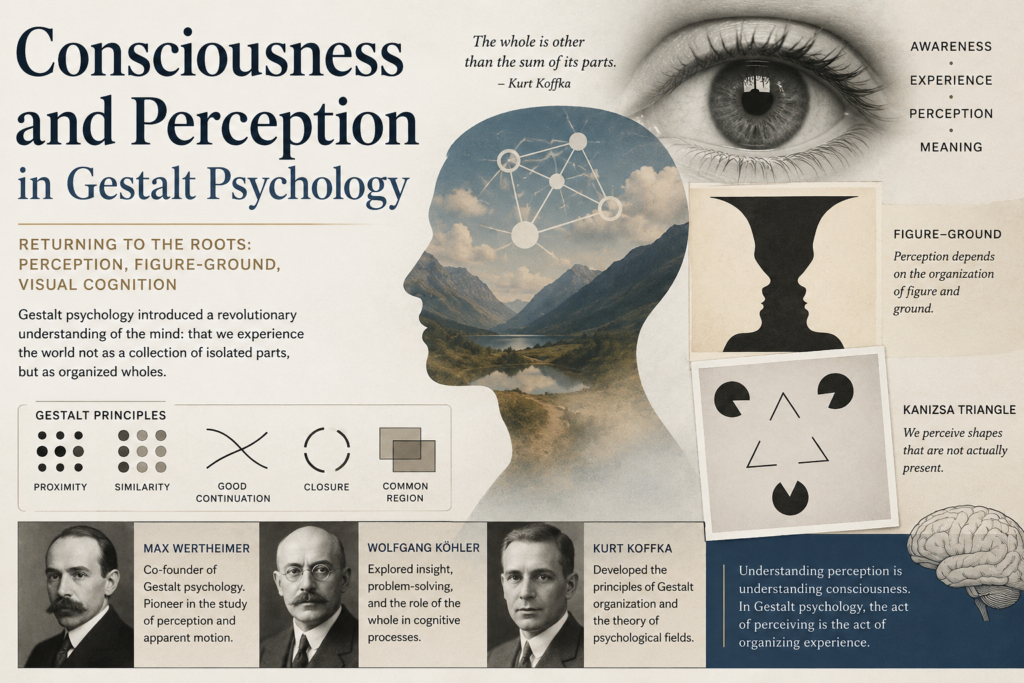
Gestalt psychology emerged as a direct answer to that question. Originating in Germany in the second decade of the twentieth century, it argued that conscious experience is inherently structured: that perception, thought, and awareness are organized into coherent Gestalten — integrated forms that stand out against a background and that cannot be explained by cataloguing their constituent parts. Phenomena appear in awareness not as aggregates of sensation but as unified, meaningful wholes shaped by organizational principles that operate across the entire perceptual field.
The implications of this argument extend far beyond the psychology of vision. They bear on the nature of consciousness itself, on the relationship between brain processes and subjective experience, on how psychotherapy understands the structure of a person’s inner world, and on the degree to which any science of the mind can reduce its subject matter to sub-personal mechanisms without loss of explanatory adequacy. This article traces the historical roots of the Gestalt program, examines its principal theoretical contributions, and assesses their continued relevance for contemporary psychology, neuroscience, and clinical practice.
Origins of Gestalt Psychology
The founding moment of Gestalt psychology is conventionally placed in 1912, when Max Wertheimer published his account of the phi phenomenon — the perception of apparent motion. Wertheimer demonstrated that when two stationary lights are flashed in rapid succession at the correct temporal interval, observers do not perceive two discrete events but a single light moving continuously through space. The experience of movement was immediate and compelling; nothing in the physical stimulus corresponded to it. What the perceptual system was delivering was not a record of the input but an organized interpretation that went beyond it — a whole that the stimulus alone did not contain.
The experiment was conducted in Frankfurt, where Wertheimer worked alongside Wolfgang Köhler and Kurt Koffka, both of whom served as subjects. The three men formed an intellectual partnership that would define the Gestalt movement for the next three decades. Their shared theoretical orientation was shaped by a remarkable convergence of German philosophical traditions. Carl Stumpf, who trained both Wertheimer and Köhler in Berlin and was himself a student of Franz Brentano, brought the tradition of phenomenological description directly into experimental psychology. Ernst Mach had earlier shown that sensory forms — spatial shapes and temporal patterns — are experienced as wholes independent of their particular material elements. Christian von Ehrenfels had formalized this observation in 1890, arguing that melodies and geometric shapes possess Gestaltqualitäten — form-qualities that persist when all the individual elements are transposed, provided their relational structure is preserved. A melody remains recognizable in any key because what is heard is the configuration of intervals, not the absolute pitches. The concept of Gestalt — German for form, shape, or configuration — gave the new movement its name and its central theoretical commitment: that psychological inquiry must address structured wholes, not isolated elements.
What distinguished the Gestalt psychologists from von Ehrenfels and Mach was their systematic opposition to the prevailing structuralism of Wilhelm Wundt and Edward Titchener. Structuralist psychology held that conscious experience could be exhaustively analyzed into elementary sensations, combined by associative laws into complex percepts. The Gestalt theorists rejected both halves of this claim. Against atomism, they argued that the basic units of experience are not sensory atoms but organized configurations — Gestalten. Against associationism, they denied that the relations between elements are imposed secondarily by learned associations; on the contrary, relations and wholes are primary, and the properties of individual elements are determined by the structural context in which they appear.
Max Wertheimer (1880–1943) was born in Prague and completed his doctoral work under Oswald Külpe in Würzburg before moving to Berlin to study with Stumpf. His 1912 paper on apparent motion established the Gestalt program theoretically; his 1923 paper on the laws of perceptual grouping gave it its empirical foundation. Beyond perception, Wertheimer devoted much of his later career to the psychology of productive thinking, arguing that genuine problem-solving involves a structural reorganization of the problem field — the sudden perception of new relationships that transforms an impasse into a solution. When the Nazi government came to power in 1933, Wertheimer emigrated to the United States, joining the faculty of the New School for Social Research in New York. His posthumously published Productive Thinking (1945) extended the Gestalt framework to education, reasoning, and the psychology of insight.
Wolfgang Köhler (1887–1967) was born in Reval (now Tallinn) and, like Wertheimer, trained under Stumpf in Berlin, completing his dissertation in psychoacoustics in 1909. Between 1913 and 1920, stationed at the Prussian Academy of Sciences research station on Tenerife while World War I made return to Germany impossible, Köhler conducted his celebrated studies of problem-solving in chimpanzees. His ape Sultan, presented with a banana hung out of reach, would survey the scene and then abruptly construct a solution: stacking boxes, or joining two sticks by fitting one into the hollow end of the other. Köhler called this insight learning (Einsicht): not the incremental strengthening of responses through reinforcement, but the sudden reorganization of the entire problem situation into a new perceptual structure in which the solution becomes visible. His The Mentality of Apes (1917) and Gestalt Psychology (1929) brought these findings and their theoretical implications to wide audiences. Under increasing pressure from the Nazi regime — having published one of the few academic protests against Nazi interference in German universities — Köhler emigrated to the United States in 1935, joining Swarthmore College.
Kurt Koffka (1886–1941) was born in Berlin and also trained under Stumpf, taking his doctorate in 1908. His The Growth of the Mind (1924) applied Gestalt principles to child psychology, arguing that perceptual organization is present from early in development rather than built up through experience. His 1922 article “Perception: An Introduction to the Gestalt-Theorie,” published in the Psychological Bulletin, was the movement’s first systematic introduction to English-speaking audiences. His Principles of Gestalt Psychology (1935), published while he held a professorship at Smith College in Northampton, Massachusetts — where he remained until his death in 1941 — is the most comprehensive theoretical treatment the movement produced. Koffka’s careful distinction between the geographical environment (the physical world described by physics) and the behavioral environment (the world as experienced by the organism) gave the program a conceptual precision that shaped its reception in both academic psychology and philosophy.
Kurt Lewin (1890–1947), a colleague at Berlin and a student of Stumpf, extended field-theoretic thinking from perception into social psychology, developing his influential concept of the psychological life-space — the total constellation of dynamic forces and regions that constitute an individual’s experienced world at any moment. His influence runs through social, organizational, and clinical psychology, providing one of the most consequential channels through which Gestalt ideas entered applied psychology beyond the study of perception.
Consciousness as Organized Experience
The foundational claim of Gestalt psychology — that conscious experience is organized — sounds modest until its full implications are drawn out. It is not merely the claim that experience has structure in some loose sense. It is the claim that the form of experience is primary: that wholes are perceived directly, not assembled from parts, and that the properties of any element within a perceptual field are determined by its relationships to all other elements rather than by its intrinsic character.
This requires a distinction that the Gestalt theorists were careful to maintain: the difference between sensation and perception. Sensation, in their account, refers to the local activation of sensory receptors — the retinal response to a point of light, the cochlear response to a particular frequency. Perception is something more and different: the organized, meaningful experience that the perceptual system constructs from these activations. A row of colored dots on a page produces discrete retinal stimulations; what is perceived is a line, a pattern, perhaps a face. The gap between sensation and perception is precisely what Gestalt theory sought to explain — not by adding associative machinery to a fundamentally atomistic model, but by arguing that the perceptual system operates at the level of organized wholes from the outset.
The structuralist program had attempted to bridge this gap by positing associative laws: elementary sensations become bound together through spatial and temporal contiguity, producing the complex percepts of ordinary experience. The Gestalt critique was directed at both the atomism and the associationism this involved. Against the atomistic premise, the Gestalt theorists pointed to the immediate phenomenological character of organized experience: when you see a triangle, you do not first see three lines and then synthesize a triangle; the triangularity is there from the beginning, as a structural property of the whole field. Against associationism, they argued that what binds elements together is not learned contiguity but intrinsic relational properties — proximity, similarity, continuity, good form — that operate on any perceiver encountering the stimulus for the first time.
“The whole is something other than the sum of its parts — not larger in quantity, but different in kind.”
The movement’s best-known theoretical formulation, most precisely stated by Koffka, is that the whole is something other than the sum of its parts. The conventional paraphrase — “greater than” — misses the point: the whole is not larger but different in kind. The properties that make a face a face are not properties of any individual line; they are properties of configurations, and they exist only at the level of the organized whole. Phenomenal experience, in this sense, is populated by Gestalten — integrated, coherent forms that are irreducible to their components considered independently.
Closely connected to this is Köhler’s hypothesis of isomorphism: the claim that the structural relationships in perceptual experience are isomorphic with structural relationships in the underlying brain processes. Köhler did not argue for a point-by-point spatial correspondence between percept and neural activity. He argued for a structural correspondence: the topological and relational properties that characterize a percept — its figure-ground organization, its grouping structure, its dynamic tensions — are reflected in large-scale patterns of neural field activity. This was a bold theoretical claim that placed the Gestalt program in direct dialogue with neurophysiology, anticipating by decades the interest in distributed and relational neural coding that characterizes contemporary neuroscience.
Figure-Ground Dynamics
If there is a single perceptual phenomenon that most directly illustrates the Gestalt claim that experience is organized rather than given, it is figure-ground organization. The concept was developed with particular rigor by the Danish psychologist Edgar Rubin, whose 1915 doctoral thesis provided the first systematic empirical analysis of how the visual field segregates into figures and grounds, and was subsequently integrated into the broader Gestalt theoretical framework.
In any visual scene, the perceptual system organizes the field into a figure — a bounded, shaped region that appears to be in front and to possess a definite contour — and a ground — a relatively formless, unbounded region that appears to continue behind the figure and to lack a definite shape of its own. This is not a trivial distinction. The figure has shape; the ground does not. The figure appears closer; the ground recedes. The boundary between them is experienced as belonging to the figure, not to the ground, even though physically the contour is shared. And crucially, this organization is not a property of the physical stimulus — it is a product of the perceptual system’s active work.
Rubin identified specific image properties that systematically favor figural dominance. Regions that are smaller in area tend to become figure against a larger ground. Regions that are symmetric tend to be seen as figures. Regions that are vertically or horizontally oriented tend to be more readily organized as figures than obliquely oriented regions. Regions that are enclosed by others tend to appear as figures. These are not inviolable rules but probabilistic tendencies — bias conditions that the perceptual system uses to arrive at a stable, interpretable organization of the field.
Rubin’s vase is the paradigm case of figure-ground ambiguity. The image consists of a white central region flanked by two symmetric dark profiles. Either the white region or the dark regions can become figure, but not both simultaneously. When the white region is figure, one perceives a vase or goblet; when the dark regions are figure, one perceives two faces in profile. The identity of the central contour changes depending on which region is assigned figure status — as the figure’s outer edge in one interpretation, as the ground’s inner edge in the other. This reversal demonstrates that the assignment of border ownership is a perceptual act, not a physical fact, and that the same physical stimulus can support mutually exclusive perceptual organizations.
Figure-ground organization is not solely a bottom-up process driven by image properties. Wagemans and colleagues, in their landmark centennial review of Gestalt psychology (2012), confirmed that figure-ground assignment is influenced by past experience, attentional set, and familiarity with particular shapes. When a region has previously been seen as a figure, it tends to be assigned figure status more readily in subsequent presentations. This suggests that figure-ground organization occurs at a level where perception and memory interact — a finding that complicates any purely stimulus-driven account.
The asymmetry between figure and ground extends into what might be called the phenomenal weight of experience. The figure is the object of attention; it is what stands out, what carries significance, what is named. The ground is what surrounds and sustains the figure but is itself largely unnoticed. This has direct clinical implications: at any moment, the most pressing need, feeling, or concern of an organism tends to emerge as a figure against the background of all else that is present. Understanding what comes forward, what recedes, what remains rigidly fixed, and what refuses to emerge is fundamental to understanding both normal awareness and its disturbances. Recent research has extended this analysis to non-visual modalities: Millar (2017) has argued that figure-ground segregation operates in olfactory perception as well, suggesting that the organizational principles identified by Rubin reflect a general architecture of perceptual consciousness, not merely a property of vision.
Laws of Perceptual Organization
Underlying all figure-ground organization, and governing the finer-grained clustering of elements within the visual field, is what Wertheimer called the law of Prägnanz (from the German for precision or conciseness). Prägnanz is the master principle of Gestalt perceptual theory: the perceptual system tends toward the simplest, most stable, most regular organization that the available stimulation permits. Perception does not produce an arbitrary interpretation of a scene; it produces the interpretation that minimizes complexity and maximizes coherence given the constraints imposed by the stimulus. Contemporary theoretical work by Wagemans and colleagues has developed this principle in terms of Bayesian optimality and structural information theory — a Gestaltist visual system that minimizes internal coding complexity tends, as a consequence, to generate veridical percepts of the external world. Prägnanz is not merely a descriptive generalization; it expresses something about the computational economy the perceptual brain pursues.
The specific grouping principles Wertheimer catalogued in his 1923 paper can be understood as particular expressions of this master tendency:
It is worth noting that the principle of dissimilarity has received renewed theoretical attention. Pinna and colleagues (2022) have shown that dissimilarity can function as a basis for grouping and figure-ground segregation in ways the similarity principle alone cannot explain: highly dissimilar elements within a uniform field pop out as new perceptual groups, and manipulating dissimilarity can both generate and annul visual illusions. The classical principle of similarity, in other words, describes only half of a reciprocal organizational dynamic.
These grouping principles are primarily described in visual terms, but they generalize. Auditory streaming — the perceptual separation of simultaneous sound sources into distinct auditory objects — obeys analogous principles of proximity in pitch and temporal continuity. Todorović (2008) noted that Gestalt organization principles apply to auditory and somatosensory perception as well as vision, and the emergence of a clear auditory figure against a background of noise follows organizational rules structurally parallel to those governing visual scene segregation.
Three famous perceptual illusions illustrate the grouping principles and reveal the active, constructive character of perceptual organization:
Müller-Lyer Illusion
Two lines of identical length appear different because one is flanked by inward-pointing arrowheads and the other by outward-pointing arrowheads. The surrounding configuration cannot be perceptually ignored — context overrides local measurement.
Ponzo Illusion
Two identical horizontal bars appear different in size when placed across converging lines that suggest perspective depth. The perceptual system applies a depth-organization assumption even when no actual depth is present, computing size relationally.
Hermann Grid
Illusory dark spots appear at the intersections of white corridors on a black grid, yet vanish when fixated directly. The spots are emergent properties of the grid as a whole — not present at any single intersection in isolation, but arising from relational context.
Visual Cognition and Pattern Recognition
The Gestalt analysis of perceptual organization connects to the broader study of visual cognition through three concepts that have proven especially generative: emergence, reification, and multistability. Each captures a different aspect of the gap between stimulus and percept, and each carries implications for the study of consciousness that extend well beyond the laboratory.
Emergence is the appearance of perceptual properties that are not contained in any of the constituent elements and cannot be predicted from a knowledge of those elements considered individually. The perception of a square from four line segments is emergent: no single segment is square, and no arithmetic combination of line properties yields squareness. More dramatically, the impression of depth in a flat perspective drawing, the sense of motion in a static cartoon, and the immediate recognition of a face from a few schematic lines involve radical emergences of perceptual quality from simple visual elements. Westheimer (1999) observed that the concept of emergence was being rediscovered in visual neuroscience as investigators sought organizing principles for the complex data emerging from cortical physiology — suggesting that what appeared to structuralist psychology as a mystical claim about holism has proven to be a precise empirical observation about the multi-level organization of the visual system.
Reification refers to the perceptual construction of spatial structure in excess of what the stimulus physically contains. The most celebrated example is the Kanizsa triangle: when three Pac-Man figures are arranged with their mouths pointing inward, observers perceive a bright white equilateral triangle whose sides appear whiter than the surrounding white background — despite the fact that no such triangle is drawn. The illusory contours are not merely inferred; they are seen. Research has shown that neurons in cortical areas V1 and V2 respond to illusory contours as if they were real ones, with response properties that mirror those for physically present edges (Grossberg, 2016). Reification is therefore not a cognitive inference layered onto vision but a product of early visual cortex — a genuinely perceptual construction with identifiable neural correlates.
Multistability occurs when a single stimulus supports more than one stable perceptual interpretation and conscious experience alternates between them. Three phenomenologically distinct varieties deserve to be distinguished. Figure-ground reversal, exemplified by the Rubin vase, involves the alternation of border ownership between two possible surfaces. Perspective reversal, exemplified by the Necker cube, involves the alternation of spatial depth assignment — which face of a wireframe cube is in front — without any change in border ownership. Object interpretation ambiguity, exemplified by Jastrow’s duck-rabbit figure, involves the alternation between two different semantic categorizations of the same contour. These are not merely different instances of the same phenomenon; they engage different perceptual processes and have different temporal dynamics.
A more extreme form of perceptual competition is binocular rivalry, in which completely different images are presented simultaneously to each eye. Observers do not perceive a superimposition; they experience one image for a period, then the other, in an alternation that shares the all-or-none switching character of classical multistability. Binocular rivalry has become a major paradigm in consciousness research precisely because the physical stimulus does not change while conscious experience does, making it possible to isolate the neural correlates of conscious perception from those of sensory processing. The Gestalt concept of the holistic switch — the all-or-none reorganization of a perceptual field — anticipated this research tradition by several decades.
This holistic switch is not confined to vision. Vitello and Salvi (2023), reviewing behavioral and neuroscientific evidence on Gestalt insight, have argued that the “Aha!” experience in problem-solving — the sudden leap of understanding that follows a period of impasse — is structurally analogous to the sudden reorganization of a bistable figure. In both cases, a new perceptual or cognitive structure emerges discontinuously, all at once, with the phenomenological character of inevitability — as if the solution had always been there, waiting to be seen. Wertheimer’s account of productive thinking as a restructuring of the problem field thus finds direct support in contemporary cognitive neuroscience of insight.
Phenomenology and Awareness
Gestalt psychology was not merely an empirical program; it was grounded in a philosophical commitment to taking the structure of conscious experience seriously as a datum. This commitment aligned the movement with the phenomenological tradition in philosophy, particularly the work of Edmund Husserl, though the relationship was one of productive engagement rather than doctrinal allegiance.
Husserl’s phenomenology is organized around the concept of intentionality: consciousness is always consciousness of something. Every act of awareness has a directional structure — it is aimed at an object, a state of affairs, a value. This is not a trivial observation. It means that consciousness cannot be adequately described by cataloguing its internal contents, because those contents are always already organized in terms of their reference to objects in a world. To study perception phenomenologically is therefore not to catalogue sensory atoms but to describe the structure of the act through which an object is intended — the way it is presented, the aspect under which it appears, the horizon of further possible presentations that surrounds any actual one. The Gestalt insistence that percepts are organized wholes directed at objects in a world is phenomenologically continuous with Husserl’s intentional analysis: both reject the idea that experience is built up from non-intentional, object-free sensory atoms.
Koffka’s distinction between the geographical and the behavioral environment carries this commitment directly into psychological theory. The geographical environment is the physical world as described by the natural sciences — a distribution of matter and energy in space. The behavioral environment is the world as it is lived and acted in — a field of objects, affordances, and meanings. Psychology, for Koffka, has the behavioral environment as its proper object: not the stimulus as a physical event, but the percept as an experience organized in terms of its significance for the organism. What matters for human behavior is not whether the retinal image subtends a particular angle, but whether a face looks threatening, whether an opening looks passable, whether a sequence of sounds sounds like one’s name being called.
Maurice Merleau-Ponty, in his Phenomenology of Perception (1945), developed the phenomenological implications of Gestalt psychology more systematically than any of the founders themselves. Merleau-Ponty argued that perception is not a cognitive operation performed by a disembodied mind on neutral sensory data; it is a bodily engagement with the world. The perceiving subject is always already a body oriented in space, moving through a meaningful environment, with a perspectival grip on things that is irreducibly first-personal. Gestalt perceptual principles, on this account, are not laws that the brain applies to sensory input; they are expressions of the body’s pre-reflective attunement to the world. Critically, Doyon (2021) has shown that Merleau-Ponty explicitly extended Gestalt structure to the perception of other people: the other person appears in consciousness not as an inferred mind behind a body but as a Gestalt — a whole, expressive, meaningful figure organized against a social ground. Gestalt theory, for Merleau-Ponty, is not merely a theory of visual pattern recognition but a framework for understanding all of conscious experience, including social and interpersonal awareness.
Köhler himself identified a related phenomenological property he called requiredness (Gefordertheit): the experienced sense that certain perceptual or cognitive configurations call for particular completions. An unresolved musical cadence does not merely fail to end; it demands resolution. An incomplete circle does not merely have a gap; it pulls toward closure. A visual asymmetry does not merely look unbalanced; it creates a tension that calls for equalization. Requiredness is a phenomenological datum — a quality of experience as it is lived — and it cannot be reduced to learned expectation or associative habit, since it appears on first encounter with a stimulus. It points to an intrinsic dynamic character of perceptual fields: they are not static aggregates of elements but systems under tension, organized around tendencies toward equilibrium and completion.
Albertazzi (2024), working in the tradition of experimental phenomenology that builds on Gestalt psychology’s legacy, has argued that contemporary consciousness research has been limited by its commitment to bottom-up emergence as its explanatory model. On that model, consciousness arises when lower-level neural processes achieve sufficient complexity or integration. But this model struggles with what Albertazzi calls the non-detachability of parts in subjective experience: the fact that experienced qualities — the redness of red, the threateningness of a face, the tension of a dissonant chord — are not detachable from the experiential whole in which they appear. They cannot be extracted and analyzed independently without losing precisely the properties that make them what they are. This is the hard problem of consciousness stated in Gestalt terms, and it suggests that the Gestalt framework has philosophical resources for consciousness theory that have not yet been fully exploited.
Context and Meaning in Perception
Gestalt psychology’s account of contextual determination connects figure-ground organization and grouping principles to a broader claim about the nature of meaning in perceptual experience. The properties of any element within a perceptual field are not fixed; they depend on the structural context in which the element is embedded. This is not a metaphor or an analogy; it is an empirically demonstrable and theoretically fundamental feature of how perception works.
The simultaneous brightness contrast phenomenon makes the point precisely: a gray patch surrounded by a darker region appears lighter than an identical gray patch surrounded by a lighter region. The physical stimulus at the gray patch is unchanged; only its surround varies. What the perceptual system delivers is a brightness value computed relationally — as a ratio or difference between the target region and its context — not as an absolute registration of local light intensity. The perceived property is a property of the relationship, not of the element in isolation.
The Ebbinghaus illusion extends this principle to size perception. A circle surrounded by smaller circles appears larger than an identical circle surrounded by larger ones. Here again, perceived size is a relational quantity determined not by the absolute size of the circle but by its size relative to its context. This is not a failure of the perceptual system; it is a feature of a system tuned to perceive objects in relation to their environments — precisely the information most relevant for action and navigation in a structured world.
Köhler formalized this contextual principle through the concept of transposition: the relational structure of a percept is preserved when all its elements are uniformly transformed, but disrupted when the relational structure itself changes. A melody transposed to a new key retains its identity because the intervals — the relations among notes — are preserved; the absolute pitches are irrelevant. What perception detects is structure and relation, not absolute magnitude. This principle generates both the phenomena of perceptual constancy (perceived size, color, and brightness remain relatively stable despite wide variations in proximal stimulation) and the phenomena of contextual illusion (perceived properties are distorted by changes in relational context).
Kurt Lewin, working in close proximity to the Berlin Gestalt school, extended field-theoretic thinking from perception to social psychology. His concept of the psychological life-space — the totality of possible events for a person at any given moment, structured by psychological forces analogous to physical field forces — applied the Gestalt idea of the perceptual field to the domain of motivation, conflict, and social behavior. A goal, on Lewin’s account, is not an abstract representation; it is a region of positive valence in the life-space that draws the person toward it. Conflict arises when a person is caught between attracting and repelling field forces in a way that is structurally analogous to the tension in an ambiguous perceptual figure. Lewin’s influence on social psychology, group dynamics, and organizational psychology represents one of the most consequential applications of Gestalt thinking beyond the perceptual domain.
More recently, the extension of Gestalt concepts to social perception has been developed explicitly. Gamboa and Egües (2023) have reviewed how Gestalt principles inform impression formation — the way a person is perceived as a coherent whole rather than a set of independent traits — and group dynamics, where a social collective takes on properties not present in any individual member. Lynch and Eisenmann (2022) have traced how Garfinkel’s ethnomethodology transposed Gestalt figure-ground and contexture concepts to the analysis of embodied social interaction, treating collective action as a phenomenal field organized by the coordinated bodily work of participants. These extensions suggest that the Gestalt framework addresses not merely the psychology of visual pattern recognition but the fundamental organization of any field of experience in which part-whole relationships and contextual determination are at work.
Gestalt Psychology Versus Reductionism
The philosophical debate between Gestalt psychology and reductionist approaches to the mind is not merely a historical dispute; it identifies a genuine and unresolved tension in the scientific study of consciousness. Reductionism holds that complex psychological phenomena can be fully explained by decomposing them into simpler components and specifying the laws governing how those components combine. The Gestalt theorists did not oppose scientific explanation; they opposed a specific form of explanation that they argued was systematically inappropriate to the subject matter of psychology.
Their critique had two distinct targets. Against atomism, they argued that the basic units of psychological analysis should not be elementary sensations or stimulus-response connections but organized configurations — Gestalten. The choice of a wrong unit of analysis is not merely an inefficiency; it makes the most important properties of the subject matter invisible. A musicologist who insisted on explaining music in terms of the physical properties of individual air pressure events, without reference to tonality, rhythm, or harmonic structure, would systematically miss what makes music music. Against associationism, the Gestalt theorists argued that the relations among elements are not imposed secondarily by learning but are constitutive of the elements themselves: the same note sounds different in different harmonic contexts, the same word means different things in different syntactic frames, the same face looks different in different emotional situations. The units are not given independently of the field; they acquire their properties from it.
The behaviorist program, which dominated American psychology through the mid-twentieth century, presented a third form of reductionism: the reduction of all psychological explanation to stimulus-response associations, without reference to internal states, representations, or perceptual organization. Köhler’s chimpanzee research was directed precisely against this framework. Sultan’s sudden invention of a solution — joining two short sticks to retrieve a distant banana, or stacking boxes in a configuration that had never been reinforced — could not be explained as the product of accumulated stimulus-response connections. It required the postulation of a cognitive structure: a representation of the problem situation as an organized whole, capable of being reorganized when a new configuration became salient. The all-or-none character of insight — its sudden, discontinuous quality — pointed to the same holistic, field-like properties of perceptual and cognitive organization that the Gestalt theorists had identified in simpler visual phenomena.
The contemporary challenge to Gestalt holism comes not from behaviorism but from connectionism and deep learning. Artificial neural networks trained on large datasets have demonstrated remarkable capacities for object recognition, scene segmentation, and pattern completion — capabilities that superficially resemble Gestalt perceptual organization. Critics have argued that these achievements demonstrate that holistic perceptual outputs can be produced by purely bottom-up, element-level processing mechanisms: that Gestalt organization emerges from the interaction of many simple units, without any need for a distinct level of holistic analysis. Defenders of the Gestalt perspective respond that the apparent success of these models in mimicking perceptual outputs conceals their failure to capture the structure of perceptual experience: deep networks are brittle in ways that human perception is not, are susceptible to adversarial perturbations that no human perceiver would be deceived by, and do not reproduce the contextual sensitivity and configurational coherence that characterize normal visual experience. The debate is ongoing, but it illustrates that the Gestalt question — whether organized wholes can be fully explained by their parts, or whether the whole must be taken as a genuine level of analysis — remains a live scientific and philosophical problem.
Influence on Modern Cognitive Science
When cognitive psychology emerged as a discipline in the 1950s and 1960s, it rehabilitated many of the questions that behaviorism had foreclosed — questions about mental representation, perceptual organization, attention, and memory. The Gestalt legacy was foundational to this revival, though it was not always explicitly credited. The fundamental premise of cognitive science — that the mind processes structured representations, not bare stimuli — is, at its core, a Gestalt premise.
In the formal study of visual perception, Gestalt principles were taken up and extended by researchers including Stephen Palmer, whose comprehensive synthesis of perceptual grouping research added the principles of common region, element connectedness, and synchrony to the classical catalogue while preserving the Gestaltian framework. Irving Biederman’s Recognition by Components (RBC) theory proposed that objects are recognized by decomposing them into elementary volumetric primitives (geons) and their spatial relations — a model that reflects the Gestalt insight that scene parsing proceeds by identifying bounded, closed regions and their organizational relationships. David Marr’s influential computational theory of vision engaged directly with the problem of how organized object representations arise from the visual input; its intermediate representations (the primal sketch, based on edge detection and grouping) implicitly drew on Gestalt principles of boundary completion and contour integration.
The neuroscience of figure-ground and grouping has advanced considerably in recent decades, and specific brain mechanisms have been identified that correspond to Gestalt organizational processes with a precision the founders could not have anticipated. Grossberg’s computational work (2016) has modeled how cortical area V2 combines border ownership signals, stereoscopic depth cues, and Gestalt grouping information through reciprocal feedback loops between boundary and surface processing streams, generating the consciously experienced 3D structure of visual scenes from 2D retinal input. Shishikura and colleagues (2024) have shown that local contour features in natural stimuli contribute to figure-ground segregation in V4 neural populations, indicating that the cortical hierarchy progressively constructs border ownership signals from local evidence in early visual areas through mid-level areas to higher integration regions.
Zaretskaya and colleagues (2013) identified the anterior intraparietal sulcus (aIPS) as directly involved in the conscious perception of global Gestalt percepts: in a bistable motion display, fMRI showed aIPS activity specifically correlated with perception of grouped illusory figures rather than ungrouped local elements, and transcranial magnetic stimulation of aIPS selectively shortened the duration of grouped Gestalt percepts without affecting the perception of ungrouped elements. The parietal cortex thus appears to play a role in the spatial binding that produces consciously experienced Gestalten — providing direct neural evidence for what Köhler had theorized in field-dynamic terms.
At the level of large-scale neural dynamics, Lieberman (2025), writing in Trends in Cognitive Sciences, has proposed that a “Gestalt cortex” — involving inferior parietal and temporal regions — tracks perceptual interpretations through differential synchrony, integrating non-sensory representations (memories, semantic knowledge, emotional valence) with sensory inputs to generate the coherent, meaning-laden experiences that characterize conscious perception. This proposal resonates directly with Köhler’s isomorphism hypothesis: what corresponds to the Gestalt in the brain is not the activity of individual neurons but a large-scale synchronized pattern — a dynamic whole that mirrors the structure of the perceived whole. EEG research by Liu and colleagues (2021) adds a further dimension: frontal lobe activity is systematically greater for disordered stimuli than for ordered Gestalt images, suggesting that Gestalt organization reduces neural processing demands — a neurophysiological expression of Prägnanz as a principle of neural economy.
Westheimer (1999) observed, with apt economy, that as neurophysiological research into cortical visual processing advanced, “the need for organizing principles is increasingly making itself felt” — and that concepts like contour salience and figure segregation, once the province of Gestalt psychology, were taking on renewed significance as investigators combined neural modeling, psychophysics, and electrophysiology. More than two decades later, that process of rediscovery has accelerated substantially.
Relevance for Contemporary Psychotherapy
The connection between Gestalt psychology and clinical practice was established by Fritz Perls, who, in collaboration with his wife Laura Perls and the social theorist Paul Goodman, developed Gestalt therapy in the late 1940s and published its foundational theoretical statement, Gestalt Therapy: Excitement and Growth in the Human Personality, in 1951. Fritz Perls’ intellectual formation was eclectic: he trained as a psychiatrist in Berlin, underwent psychoanalysis with Wilhelm Reich (whose emphasis on bodily character structure directly influenced Gestalt therapy’s attention to posture, gesture, and physical sensation), and was analyzed in Vienna by Helene Deutsch and in Frankfurt by Karen Horney. The Gestalt psychological framework provided the organizing conceptual vocabulary for an approach also shaped by phenomenological philosophy, psychoanalytic clinical observation, and humanistic psychology.
The central clinical application of Gestalt perceptual theory is the figure-ground metaphor applied to the stream of awareness. In the framework of Gestalt therapy, a person’s psychological life is understood as a continuous process in which needs, feelings, memories, and sensations emerge as figures against the background of all that is currently present but not foregrounded. Healthy functioning — what Perls called the contact cycle — involves a fluid, responsive process: a need emerges as figure, the organism orients toward its satisfaction, contact is made with the relevant aspect of the environment, the need is met, and the figure dissolves back into the ground, allowing a new figure to emerge. Disturbance is understood as disruption of this cycle: a figure that cannot be completed and cannot recede (intrusive anxiety, unresolved grief), a ground too undifferentiated to support clear figural emergence (depressive flattening), or a perceptual rigidity that always organizes the field in terms of a fixed, habitual figure regardless of what is actually most salient.
A direct application of Gestalt perceptual research to clinical theory comes through the work of Bluma Zeigarnik, a student of Kurt Lewin who conducted her doctoral research in Berlin in 1927. Zeigarnik demonstrated that interrupted tasks are remembered significantly better than completed ones — a finding now known as the Zeigarnik effect. Within the Lewin-Gestalt framework, an unfinished task maintains a dynamic tension in the psychological field, a persisting quasi-need that keeps the task in awareness, whereas a completed task releases this tension and allows the representation to fade. The clinical parallel is immediate: incomplete emotional experiences — unmourned losses, unresolved conflicts, unexpressed anger — maintain a similar persisting tension in the psychological life-space, repeatedly drawing attention and generating distress. The Gestalt therapeutic emphasis on “unfinished business” (unvollendete Gestalten) is a direct clinical elaboration of Zeigarnik’s experimental finding, and represents one of the clearest bridges between the academic perceptual research tradition and clinical practice.
The phenomenological orientation of Gestalt therapy also reflects the Gestalt psychological commitment to treating first-person experience as primary scientific data. The therapist attends not only to the verbal content of what the client reports but to the whole expressive field — posture, gesture, vocal quality, gaze, and the quality of contact or withdrawal in the therapeutic relationship. These are understood as expressions of the person’s organized experiential field rather than as behavioral symptoms to be decoded through a theoretical system. Perls’ famous emphasis on the “here and now” — on what is actually happening in the present moment of the therapeutic encounter — is an application of the phenomenological method to the clinical situation: a bracketing of theoretical interpretation in favor of careful attention to how things present themselves.
The concept of the contact boundary — the zone of interaction between organism and environment where experience is formed, not a wall but a site of dynamic exchange — has been developed extensively in relational and dialogical approaches to Gestalt therapy, finding resonance with attachment theory’s account of the regulatory co-construction of psychological states in early relationships, and with neuroscientific research on interpersonal synchrony and embodied co-regulation. Merleau-Ponty’s argument, confirmed and developed by Doyon (2021), that all perception — including social perception — manifests in the form of a Gestalt, provides a philosophical foundation for understanding why the therapeutic relationship is not merely a vehicle for techniques but is itself the medium in which the client’s characteristically organized field of experience becomes visible and potentially reorganized.
It is important to maintain the distinction between Gestalt therapy and Gestalt psychology as an academic discipline. The founders of Gestalt therapy adapted rather than directly applied the theoretical concepts of the academic movement, and some of their interpretations — particularly Perls’ later, more confrontational style — are difficult to derive from the theoretical principles of the Berlin school. The relationship is one of creative appropriation, not systematic derivation. Nevertheless, the therapeutic tradition preserves and extends genuine core insights of the academic movement: that experience is organized rather than atomistic, that the whole person in context rather than isolated symptoms is the proper object of clinical attention, and that present-moment awareness, rather than retrospective reconstruction, is the fundamental medium of therapeutic change.
Conclusion
Gestalt psychology established something more lasting than a set of empirical findings about visual perception. It established a framework — a way of approaching the study of mind that insists on organized wholes as the proper units of analysis, that takes the structure of conscious experience seriously as scientific data, and that refuses the explanatory strategy of reduction to parts when the properties of the whole are precisely what needs to be explained.
The specific contributions of Wertheimer, Köhler, and Koffka — the phi phenomenon, the laws of grouping, the figure-ground distinction, the concept of insight, the isomorphism hypothesis, the behavioral environment — remain reference points in perceptual psychology, cognitive science, neuroscience, and philosophy of mind. But their deeper significance lies in the theoretical orientation they represent: that consciousness is not a sum but a structure; that the brain does not assemble experience from pre-given atoms but actively organizes it in accordance with principles that reflect both the architecture of the nervous system and the regularities of the physical world; and that first-person experience, far from being an epiphenomenal byproduct of neural processing, is the phenomenon that psychology must ultimately explain.
Contemporary neuroscience is identifying the specific cortical mechanisms — V2 border-ownership signals, parietal spatial binding, temporal-parietal synchrony — through which Gestalt-like organization arises in the brain. Contemporary consciousness research is using multistability and binocular rivalry as windows into the neural dynamics of perceptual awareness. Contemporary clinical practice continues to draw on figure-ground dynamics, the Zeigarnik effect, and the phenomenology of contact and withdrawal. Across all of these domains, the questions Gestalt psychology raised in the early twentieth century remain the right questions — and the insight that what appears in awareness is always an organized figure against a ground, shaped by the structure of the whole field, remains as fundamental as it was when Wertheimer first watched two lights become one.