GestaltReview.com · Educational Essay · Systems & Field Theory
Gestalt Therapy and Systems ThinkingFrom Field Theory to Complexity Science
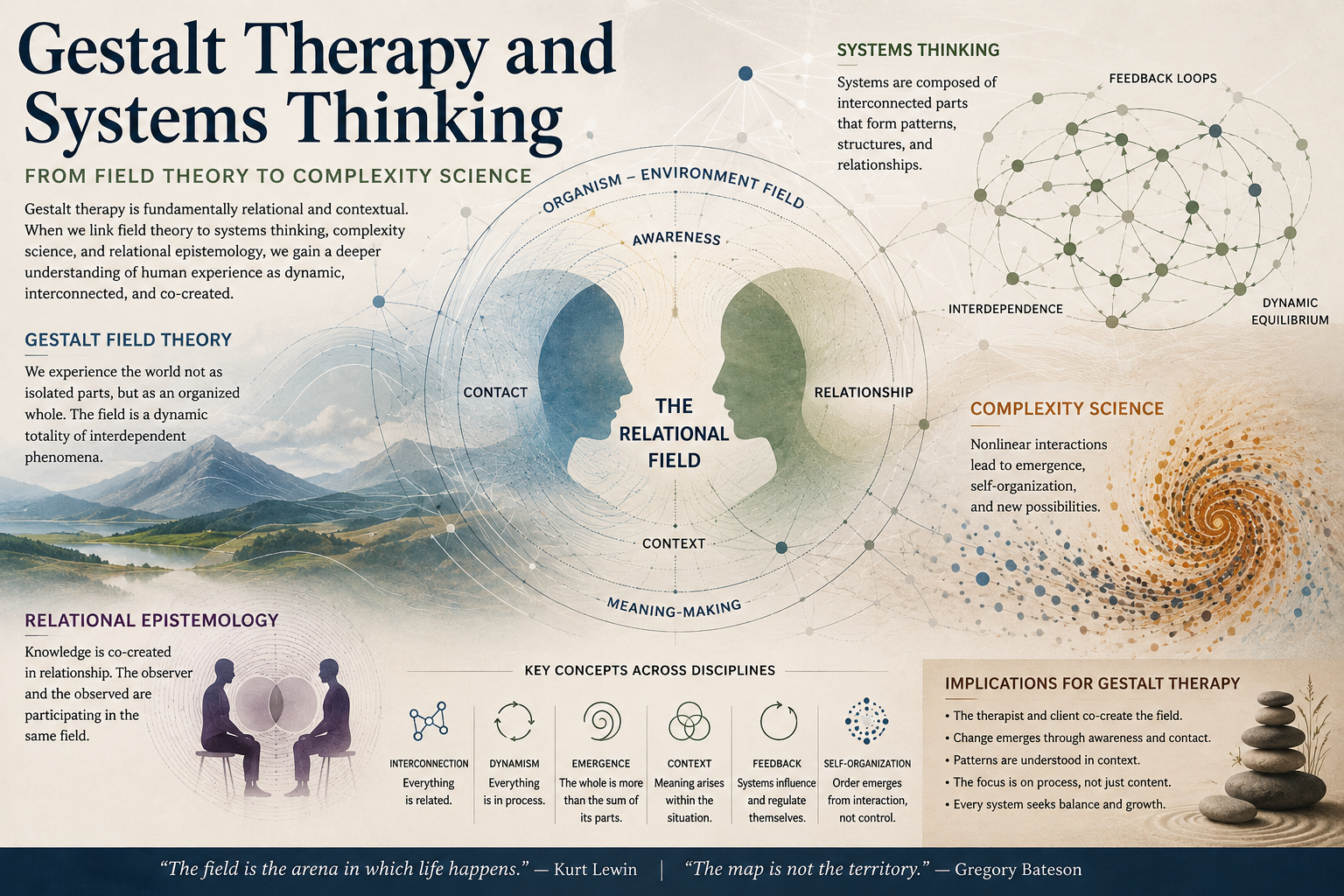
Long before systems theory and complexity science acquired their contemporary vocabularies, Gestalt psychology and Gestalt therapy were already thinking in wholes — attending to fields, feedback, emergence, and the irreducible interdependence of organism and environment. This article traces those intellectual connections across a century of thought and draws out their implications for clinical practice, organizational work, and the study of consciousness itself.
Kurt Lewin
1890–1947Gestalt orbit; founder of psychological field theory, action research, and group dynamics.
Fritz Perls
1893–1970Co-founder of Gestalt therapy; applied field theory to clinical practice and existential encounter.
Laura Perls
1905–1990Co-founder of Gestalt therapy; foregrounded embodiment, relational support, and field sensitivity.
Paul Goodman
1911–1972Social theorist and anarchist intellectual; provided the systems-theoretic foundations of Gestalt therapy's 1951 text.
Ludwig von Bertalanffy
1901–1972Biologist; founder of General Systems Theory and the open systems concept.
Gregory Bateson
1904–1980Anthropologist and cybernetician; developed relational epistemology and the ecology of mind.
Humberto Maturana
1928–2021Biologist; co-developed autopoiesis, structural coupling, and the biology of cognition.
Francisco Varela
1946–2001Neuroscientist; extended autopoiesis into enactivism and the phenomenology of consciousness.
Edgar Morin
b. 1921Sociologist and philosopher; developed the theory of complex thinking and transdisciplinary method.
Introduction: Why Systems Thinking Matters for Gestalt Practice
Scientific psychology has long been pulled between two explanatory strategies. The first is reductive: understand the person by decomposing them into simpler parts — neurons, drives, cognitive schemas, behavioral repertoires — and specify the mechanisms governing each part in isolation. The second is relational: understand the person as a node in a web of relationships, contexts, and feedback processes that cannot be decomposed without losing precisely the properties one sought to explain. For much of the twentieth century, academic and clinical psychology pursued the first strategy with increasing technical sophistication. Gestalt psychology, and the therapy that grew from it, insisted on the second.
That insistence turns out to have been prescient in ways that were not fully legible at the time of its articulation. The second half of the twentieth century witnessed the emergence of a cluster of disciplines — General Systems Theory, cybernetics, complexity science, autopoiesis theory, and relational epistemology — that converged, through independent theoretical routes, on a set of ideas strikingly continuous with what the Gestalt tradition had been articulating since the 1920s. Wholes possess properties absent in their parts. Systems self-organize through the interaction of their components. Behavior is regulated by feedback loops operating across multiple levels simultaneously. Change is frequently nonlinear, discontinuous, and sensitive to initial conditions. Context is constitutive, not incidental to meaning.
What is remarkable about this convergence is not merely that the conclusions were similar but that the Gestalt tradition reached them earlier — through phenomenological observation and clinical experience — than the systems and complexity traditions reached them through formal theoretical and mathematical work. Gestalt therapy's account of the contact cycle anticipated cybernetic homeostasis by a decade. Its concept of the organism-environment field anticipated open systems theory. Its understanding of figure-ground dynamics as context-dependent anticipated the ecological psychology of the 1970s. And its emphasis on the co-created quality of therapeutic experience anticipated the relational epistemology of Maturana and Varela by nearly thirty years.
This article traces those anticipations and connections systematically. Its aim is not to claim retrospective credit for the Gestalt tradition but to demonstrate that Gestalt therapy has a coherent theoretical relationship with contemporary systems and complexity science — one that deepens and enriches clinical practice when made explicit, and that positions the Gestalt framework as one of the most intellectually robust approaches available for working with complex human systems.
The Origins of Field Theory in Gestalt Thought
The concept of the psychological field did not originate with Kurt Lewin, though his formalization of it is the most consequential. Its roots lie in the encounter between the German Gestalt psychologists — Wertheimer, Köhler, and Koffka — and the physical field theories of nineteenth-century science. Michael Faraday's concept of the electromagnetic field, and James Clerk Maxwell's mathematical formalization of it, offered a model in which the behavior of charged particles could not be understood by examining the particles themselves in isolation; their behavior was determined by their position and velocity within a field of forces that was itself modified by every particle in it. The field was causally prior to the particles, not the other way round.
The Gestalt psychologists recognized in this model a structural analogy for what their perceptual experiments were demonstrating. The brightness of a gray patch cannot be determined by measuring the patch alone; it is determined by the patch's relationship to its surround — the field in which it is embedded. The perceived direction of a line cannot be read off from the line itself; it depends on the configuration of lines surrounding it. What one perceives at any location in the visual field is a function of the entire field, not merely of the local stimulus at that location. The field concept made it possible to describe these relational properties rigorously, without invoking either mystical vital forces or the associative machinery of structuralist psychology.
Wolfgang Köhler, who had trained in physics before turning to psychology, was particularly explicit about the theoretical implications. His isomorphism hypothesis — the claim that the relational structure of perceptual experience corresponds to dynamic structural configurations in the brain's neural field, not to the firing of individual neurons — was a direct application of physical field theory to neuropsychology. For Köhler, both the perceiving mind and the underlying brain processes were field phenomena, and both needed to be studied at the level of organized wholes rather than isolated components. This was a genuinely revolutionary claim in the 1920s, and it anticipates by decades the interest in distributed, relational, and synchronous neural coding that characterizes contemporary neuroscience.
For a deeper examination of how field theory operates in clinical dialogue and the therapeutic relationship, see our article on Field Theory and Dialogue in Gestalt Therapy.
Lewin's Field Theory: Topology, Life-Space, and Group Dynamics
Kurt Lewin's contribution to the systemization of field theory in psychology was both more formal and more far-reaching than is sometimes appreciated. Working first at the Berlin Psychological Institute and later, after his emigration from Nazi Germany in 1933, at Cornell, Iowa, and MIT, Lewin developed a comprehensive theoretical framework — psychological field theory — that extended the Gestalt perceptual field into the domains of motivation, development, personality, social behavior, and organizational change.
Lewin's central formulation — B = f(P, E), behavior is a function of person and environment — is deceptively compact. Its significance lies in what it refuses: it refuses to treat the person as a self-contained system whose behavior is determined by internal states alone, and it refuses to treat the environment as a mechanical cause that determines behavior from the outside. Both person and environment are poles of a single dynamic field — the life-space — and behavior is a function of the total configuration of that field at any given moment. This is not interactionism (the view that internal and external factors combine additively to produce behavior); it is a genuinely holistic and field-theoretic position in which neither pole can be specified independently of the other.
Lewin borrowed the mathematical vocabulary of topology to describe the structure of the life-space. Topological concepts — regions, boundaries, pathways, barriers — allowed him to represent the psychological field with a precision that verbal description alone could not achieve, without committing to the quantitative assumptions of Newtonian mechanics that he regarded as inappropriate for psychology. A goal, in topological terms, is a positive region of the life-space toward which the person is drawn by a vector of positive valence. An obstacle is a region of high barrier strength that must be traversed to reach the goal. Conflict arises when the person is positioned between regions of comparable but incompatible valence — a topological representation that captures the phenomenological experience of being trapped, pulled in incompatible directions, without reduction to physiological or behavioral categories.
Lewin's concept of quasi-stationary equilibria — the tendency of social systems to settle into stable but dynamic patterns that resist change — is among his most practically important contributions and one of his strongest anticipations of later systems thinking. He observed that social groups, organizations, and communities tend to maintain their characteristic patterns not because the forces sustaining them are necessarily strong in absolute terms, but because the forces driving toward change and the forces resisting it are approximately balanced. Effective change, on this account, does not require increasing the driving forces (which typically increases the resisting forces by equal measure, increasing tension without producing movement); it requires reducing the restraining forces, allowing the system's own dynamics to carry it toward a new equilibrium. This is a systems insight — specifically, a homeostatic and feedback-theoretic insight — articulated in Lewinian field-theoretic terms decades before those vocabularies were formalized.
Lewin's action research methodology, his T-group (sensitivity training) programs developed at the National Training Laboratories in Bethel, Maine from 1947 onward, and his group dynamics research all applied this field-theoretic logic to social and organizational contexts. The T-group was, in effect, an experimental social field in which participants could observe the field conditions they were co-creating in real time and learn to work with group dynamics rather than being unconsciously governed by them. This approach was the direct ancestor of the organizational development movement, and it established the template for Gestalt-informed organizational consulting that continues to the present day.
A Gestalt-informed facilitator working with a management team notices that decisions in the group are consistently made by two or three members while others remain silent, and that the silences are met with no acknowledgment. Rather than addressing the communication pattern directly (increasing the driving force toward more participation), the facilitator works to reduce the restraining forces: she names what she observes in the field without attribution to any individual ("I notice some voices are very present here and others seem to be waiting"), creates a pause that opens space for other voices, and attends to the shift in the group's energy as the field reconfigures. The change is not engineered; it is enabled by reducing the conditions that were maintaining the existing equilibrium.
Lewin's work on group dynamics also produced one of the earliest and most rigorous demonstrations of emergence in social science: the observation that groups possess properties — norms, climates, decision-making patterns, levels of productivity — that cannot be predicted from the properties of the individual members and that change when the composition of the group changes in ways that no individual member's behavior directly explains. The group field is a genuinely emergent level of organization, and its dynamics follow laws that operate at the group level, not reducible to individual psychology.
The Organism–Environment Field in Gestalt Therapy
In Gestalt Therapy: Excitement and Growth in the Human Personality (1951), co-authored by Fritz Perls, Ralph Hefferline, and Paul Goodman, the field concept is radicalized in a way that has no direct precedent in either Lewinian field theory or the perceptual psychology of the Berlin school. The book does not treat the organism and the environment as two entities that interact; it treats them as poles of a single field that has no meaningful existence at either pole considered alone. Experience is not something that happens inside the person; it is constituted at the contact boundary between organism and environment, in the dynamic process of their mutual engagement.
Paul Goodman's theoretical formulations — he wrote much of the theoretical Volume Two of the 1951 text — are the clearest statement of this position. Goodman, a social theorist and anarchist intellectual with a deep familiarity with the systems-theoretic and cybernetic ideas circulating in the immediate post-war intellectual milieu, understood the organism-environment field not merely as a psychological concept but as a general biological and social principle. The organism and the environment co-constitute each other: what the organism is, at any moment, is partly a function of what the environment offers, demands, and withholds; what the environment is, from the organism's perspective, is a function of the organism's needs, capacities, sensitivities, and history. Neither can be fully specified independently of the other. This is not interactionism but a genuinely field-theoretic ontology in which the field is prior to and generative of both poles.
"The contact boundary is not a wall between organism and environment — it is the site where both are defined through their dynamic encounter."
The contact boundary — the most clinically central concept in Gestalt therapy's theoretical framework — follows directly from this field ontology. It is not a spatial membrane that separates the person from the world; it is the ongoing event in which the person-world system is constituted. What a Gestalt therapist attends to is not what is happening inside the client, as if the client were a vessel containing a private psychological reality to be excavated, but what is happening at the contact boundary: how the client is engaging with, withdrawing from, deflecting, or distorting their encounter with the present field. For a detailed exploration of how contact and withdrawal operate as the fundamental rhythm of this process, see our article on Contact and Withdrawal: The Rhythm of Relationship in Gestalt Therapy.
Laura Perls, whose theoretical contributions have been systematically underestimated in the historical literature, consistently foregrounded the embodied and relational dimensions of the organism-environment field. For Laura Perls, the contact boundary is experienced in the body — in breathing, posture, gesture, proprioception, and movement — before it is known conceptually. The body is not a vehicle for the mind that does the real psychological work; it is the site where the field is lived. Therapeutic attention to bodily expression is therefore not an auxiliary technique but a direct attunement to the primary locus of field experience. This emphasis on embodied contact anticipates, in important respects, both Merleau-Ponty's phenomenology of the lived body and the enactivist theories of Maturana and Varela, which we discuss in Section 10.
Gestalt Therapy as a Systemic Approach
The systemic character of Gestalt therapy is not an interpretation imposed retrospectively by theorists seeking alignment with fashionable frameworks. It is inscribed in the theory's foundational premises, and it can be identified at four distinct levels of analysis, each of which corresponds to a central commitment of systems thinking:
Paul Goodman's concept of the social field extends this systemic logic beyond the individual to encompass the institutions, cultural norms, power relations, and historical conditions within which psychological life is embedded. For Goodman, a neurosis is not merely a disturbance in an individual's contact cycle; it is a symptom of a field in which authentic contact has been made structurally difficult or impossible — by poverty, by oppressive social norms, by institutional arrangements that frustrate genuine need-satisfaction. A therapy that addresses the individual without attending to the field conditions that sustain their distress risks, at best, restoring the person to a more effective functioning within a pathogenic field, rather than supporting genuine change.
This social field perspective makes Gestalt therapy not merely a systemic approach to individual psychology but an approach with inherent implications for social and political analysis — a dimension that connects it to the critical systems thinking of later theorists, including Bateson's ecology of mind and Morin's complex thinking.
Systems Theory and Open Systems: Bertalanffy and Beyond
Ludwig von Bertalanffy, the Austrian biologist who developed General Systems Theory in the 1940s and 1950s, arrived at conclusions strikingly parallel to those of the Gestalt tradition through an entirely independent theoretical route. Working from the biology of living organisms rather than perceptual psychology or clinical practice, Bertalanffy argued that living systems could not be understood through the reductive methods of mechanistic physics — methods that decompose a system into its parts and model each part as a machine governed by linear causation. Biological systems are irreducibly organized; their properties at the systems level cannot be derived from the properties of their components considered in isolation. The whole is, as the Gestalt psychologists had argued from phenomenological observation, other than the sum of its parts.
Bertalanffy's most consequential contribution was the concept of the open system. A closed system — the idealization of classical thermodynamics — tends toward equilibrium through the progressive dissipation of its internal organization, moving inexorably toward maximum entropy. An open system maintains or increases its organization by continuously exchanging matter, energy, and information with its environment. Life, on this account, is the maintenance of organized complexity through continuous environmental exchange. The organism survives not by protecting itself from environmental influence but by remaining selectively open to it: importing low-entropy energy, transforming it in service of internal organization, and exporting entropy back into the environment.
The convergence with Gestalt therapy's contact cycle is immediate and precise. The organism-environment field described by Perls and Goodman is an open system in exactly Bertalanffy's sense: the organism maintains its vitality through selective, rhythmic contact with the environment, taking in what it needs, transforming it through its own processes, and releasing what has been metabolized. The contact boundary is the selectively permeable membrane of the open system — not a wall but a zone of selective exchange. The contact disturbances catalogued in Gestalt therapy — confluence, introjection, retroflection, projection, deflection — are, in systems-theoretic terms, dysfunctional alterations of the system's boundary permeability: either too open (confluence dissolving the boundary entirely) or too closed (retroflection turning outward-directed energy back on the self, cutting off the exchange that sustains self-regulation).
Bertalanffy also introduced the concept of equifinality: in open systems, the same final state can be reached from different initial conditions and by different pathways. This is in direct contrast to closed mechanical systems, where the final state is uniquely determined by the initial conditions. Equifinality is a systems-level expression of what Gestalt therapy's paradoxical theory of change implies clinically: there is no single correct pathway to psychological health, and attempts to prescribe a specific trajectory of change are likely to underestimate the system's own self-organizing capacities. The organism-environment field will find its own pathway to new equilibrium if the conditions are right, and the therapist's task is to create those conditions rather than to engineer the specific outcome.
A client presenting with chronic emotional numbness can be understood in open-systems terms as a person whose regulatory boundary has become dysfunctionally rigid in one direction: certain categories of experience — vulnerability, need, tenderness, anger at close others — cannot cross the boundary from the outside in (they are deflected before they can be registered) or from the inside out (they are retroflected before they can be expressed). The system is partly closed where it needs to be open. The therapeutic task is not to breach the boundary by force — which increases the system's defensive closure — but to cultivate the conditions in which the boundary's selective permeability can be gradually restored: creating sufficient safety that the client can risk allowing more of the field's information to enter their awareness, and more of their internal experience to reach the contact boundary with another person.
Cybernetics, Feedback, and Self-Regulation
Cybernetics — the science of self-regulating systems, developed by Norbert Wiener, Warren McCulloch, and colleagues through the Macy Conferences of the 1940s — introduced the feedback loop as the fundamental mechanism of goal-directed behavior. A feedback loop is a circular causal process in which information about a system's output is returned as input, enabling the system to compare its current state with a reference state and adjust its behavior to reduce the discrepancy. This apparently simple mechanism is capable of generating extraordinarily complex and flexible behavior without requiring a central controller or a pre-programmed response: the system regulates itself through the continuous circulation of information about its own performance.
Negative feedback — error-correcting, homeostatic feedback — drives the system toward a target state by detecting and reducing deviations from it. A thermostat is the canonical simple example; the human body's thermal regulation, blood glucose homeostasis, and immune response are more complex biological examples. Positive feedback amplifies deviations from a reference state, producing runaway change, growth, or — when it destabilizes an existing equilibrium — transition to a new organizational state. Both types of feedback are present in all complex living systems, and their interaction determines the system's dynamics: negative feedback maintains stability, positive feedback drives change, and the balance between them governs how the system responds to perturbation.
Gestalt therapy's concept of organismic self-regulation is a cybernetic concept, though it was formulated without the cybernetic vocabulary. The contact cycle — the rhythmic alternation of need and satisfaction, engagement and withdrawal — is a homeostatic feedback process maintaining the organism's dynamic equilibrium with its environment. A need arises (deviation from homeostasis is detected), the organism orients toward the relevant part of the environment (error-correcting behavior is initiated), contact is made and the need is satisfied (the discrepancy is reduced), and the cycle completes (the system returns to a new equilibrium). Disruptions of the cycle are disruptions of the feedback process: information about need does not reach the organism's awareness (the error is not detected), or awareness does not produce effective action (the error-correcting response is blocked), or contact does not produce genuine satisfaction (the feedback signal is distorted).
Consider a couple in which one partner pursues emotional connection when anxious and the other withdraws when overwhelmed. The pursuer's approach increases the withdrawer's sense of overwhelm, triggering further withdrawal; the withdrawer's increasing distance amplifies the pursuer's anxiety, triggering more intense pursuit. Neither partner's behavior is irrational in isolation — each is responding, with some logic, to the information available to them — but the mutual feedback loop generates a self-amplifying dynamic that neither can interrupt from within. This is a positive feedback loop: deviation from the relational equilibrium each partner seeks is amplified rather than corrected by the other's response, escalating the system's instability. The pattern cannot be understood or effectively addressed at the level of either individual's psychology; it is a property of the relational field, and it can only change when both partners can observe the loop itself — the circular causation — rather than each attributing the problem to the other's behavior.
A client who habitually retroflects — turning outward-directed anger back against themselves as self-criticism — can be understood as operating a dysfunctional feedback loop. The anger arising in response to a perceived injustice generates a motor impulse (toward expression, assertion, or confrontation) that is intercepted before it reaches the contact boundary and redirected inward. The "error signal" (the unmet need for recognition or justice) is never delivered to the environment, and no corrective environmental response is possible. The retroflection maintains a particular type of self-regulation — it prevents the social risks associated with direct expression — but at the cost of ongoing self-attack and progressive accumulation of unexpressed energy. The therapeutic task is to help the client become aware of the interception point, explore the field conditions (historical and present) that made the retroflection adaptive, and experiment with allowing the energy to complete its natural arc toward the environment. See our article on Contact Interruptions in Gestalt Therapy for an extended treatment of how these disturbances operate relationally.
Bateson's Systemic Epistemology
Gregory Bateson occupies a singular position in the intellectual history of systems thinking. An anthropologist by training who worked across biology, psychiatry, linguistics, cybernetics, and ecology, Bateson was uniquely positioned to see the systemic patterns that cut across disciplinary boundaries — and to articulate a philosophical framework adequate to their description. His contribution to systems thinking goes considerably deeper than cybernetics: it amounts to a fundamental rethinking of what mind, knowledge, and mental process are.
Bateson's central epistemological claim — developed across Steps to an Ecology of Mind (1972) and Mind and Nature (1979) — is that mind is not a property of individual organisms but a property of systems. Mental process, in Bateson's account, requires: a pathway along which differences can travel; feedback loops that enable self-correction; and the hierarchical organization of logical types. None of these requirements can be met by a brain considered in isolation from its body and its environment. The minimal unit of mental process is therefore not the individual but the individual-plus-environment — a claim that is structurally identical to Lewin's field equation and to Gestalt therapy's organism-environment field, arrived at through an entirely independent theoretical pathway.
Bateson's concept of logical types — borrowed from Bertrand Russell's theory of types in logic and applied to communication — is particularly important for clinical work. Different levels of a communication system operate at different logical types and cannot be treated as if they were members of the same class without generating paradox. A message and a message about the message (a metamessage) are at different logical levels; confusing them generates the kind of paradoxical injunction that Bateson, Don Jackson, Jay Haley, and John Weakland analyzed as the double bind. In a double-bind situation, a person receives a primary injunction ("Do this"), a secondary injunction that contradicts it at a different logical level ("Don't do this" or, more insidiously, "Don't notice that these injunctions contradict each other"), and an injunction against leaving the relational field in which the double bind operates. Any response the person makes violates one of the injunctions. The pathological force of the double bind comes not from any single message but from the recursive, self-sealing structure of the communicative system as a whole — a description that is already, in its logic, both field-theoretic and systemic.
Bateson's notion of the ecology of mind extended this systemic epistemology to encompass evolutionary, ecological, and cultural levels of organization simultaneously. Mental process, for Bateson, occurs not only within organisms but in the circuits of relationship that connect organisms to each other and to their environments. An oak tree's roots, the fungal networks in the soil, the mycorrhizal exchange of nutrients, and the rainfall patterns that determine both — this is a system with the properties of mind: it processes differences, it responds to information, it self-regulates. Pathology, at any level of such a system, is most often not a malfunction in a component but a disruption in the pattern of information flow through the system — a systemic phenomenon that cannot be located at any single component level.
For Gestalt practitioners, Bateson's ecology of mind provides the most rigorous available philosophical grounding for the field-theoretic stance. When a Gestalt therapist attends simultaneously to the client's immediate experience, the quality of the therapeutic relationship, the client's family and cultural background, and the broader social field conditions — rather than treating any one of these as the "real" level of explanation — they are practicing something very close to what Bateson described as ecological thinking: holding multiple levels of organization in view simultaneously without collapsing any of them into any other.
Complexity Science and Emergence
Complexity science — which coalesced as a recognizable field through the work of researchers at the Santa Fe Institute from the 1980s onward — addresses a class of phenomena that neither classical physics nor classical systems theory could adequately handle: systems capable of generating novel, organized properties through the parallel, local interactions of many interdependent components, without central control or pre-programmed design. The concept of emergence is its organizing insight: properties arise at the system level that are not present in and cannot be predicted from the components considered individually. Consciousness emerging from neural interactions, market dynamics emerging from individual trading decisions, cultural norms emerging from the aggregated choices of many individuals — these are all emergent phenomena in the technically precise sense that complexity science intends.
The connection to Gestalt psychology's foundational claim is immediate and historically significant. Koffka's statement that the whole is other than the sum of its parts — made in the 1920s on the basis of phenomenological observation — is a precise anticipation of what complexity science would demonstrate mathematically and computationally sixty years later. Both claims are making the same point: that there exist levels of organization at which genuine novelty appears, novelty that cannot be derived from the properties of lower-level components even in principle, and that scientific understanding of complex phenomena requires tools and concepts adequate to these emergent levels.
The concept of self-organization — the spontaneous generation of ordered structure from the local interactions of components, without external design — is equally central to complexity science and equally relevant to Gestalt therapy. Self-organization occurs in systems that are far from thermodynamic equilibrium, maintained in that state by the continuous throughput of energy — which is to say, in open systems in Bertalanffy's sense. The Gestalt organism-environment field, maintained in its dynamic state by the continuous contact cycle, is precisely such a system. Therapeutic change, in this perspective, is not something the therapist does to the client; it is a self-organizing process that emerges from field conditions that the therapist and client co-create. The therapist's role is to perturb the system — to introduce novelty into the field — in ways that enable the system's own self-organizing dynamics to find new configurations.
Edgar Morin's theory of complex thinking (la pensée complexe) adds a crucial epistemological dimension. For Morin, complexity is not merely a property of certain systems but a challenge to the mode of thought that organizes our science and our culture. The simplifying, separating, reductive thinking that has generated enormous scientific progress also generates characteristic blindnesses: it separates what is joined, it cuts living wholes into dead parts, it mistakes its analytical constructs for the reality it sought to understand. Complex thinking — pensée complexe — holds together what reductive thinking separates: the part and the whole, the simple and the complex, order and disorder. It is a mode of thought that can tolerate and work productively with the irreducible complexity of living systems without either reducing them to their components or mystifying them into unanalyzable wholes. This is, at its deepest level, what Gestalt therapy's insistence on attending to the whole person in their whole field is: a form of complex thinking applied to clinical practice.
A Gestalt therapist working over several months with a client who carries a pervasive sense of unworthiness notices, in one session, a shift that is discontinuous with anything that preceded it. The client is describing a conflict with a colleague and, mid-sentence, pauses. Their posture changes — the habitual slight hunch opens slightly, the breath deepens. They say, quietly and without apparent deliberation: "I actually think I was right." It is a small statement, but it carries a quality of solidity that none of the client's previous self-assessments have had. The therapist recognizes it as an emergent event: not the product of any specific intervention, but an organizational shift arising from the accumulated conditions of the therapeutic field — the consistency of the therapist's presence, the client's growing capacity to tolerate discomfort, and some configuration of the present moment that allowed a new self-organization to crystallize. The insight was not produced; it emerged. This is what complexity science calls a phase transition — the sudden reorganization of a system into a qualitatively different configuration.
Relational Epistemology: Maturana, Varela, and Co-Created Experience
The work of Humberto Maturana and Francisco Varela represents the most rigorous biological grounding for the relational epistemology that Gestalt therapy had been practicing without an adequate theoretical vocabulary. Their theory of autopoiesis — self-production — describes living systems as organizationally closed networks of processes that continuously produce and regenerate their own components. An autopoietic system is not a passive input-output device that receives information from its environment, processes it, and produces behavior in response. It is a system that specifies its own states through its own operational processes, and whose encounters with the environment are not information exchanges in the classical sense but perturbations that trigger internal state changes whose character is determined by the system's own structure, not by the perturbing event itself.
This is the concept Maturana and Varela call structural coupling: the relationship between an autopoietic system and its environment is not one of instruction (the environment dictates what the organism does) or isolation (the organism ignores the environment) but of reciprocal perturbation and co-evolution. The organism and the environment mutually perturb each other over time, each triggering structural changes in the other that are determined by the perturbed system's own organization. What the environment means to the organism — what information it carries — is not given by the environment but constituted by the organism's structure. Two organisms with different structural histories will respond to the same environmental perturbation in entirely different ways, because the perturbation triggers state changes determined by each organism's internal organization, not by the physical character of the perturbation itself.
The implications for psychotherapy are radical and direct. If the client's experience is not a simple registration of an independent reality but a construction shaped by the structure of the experiencing system — a structure that is itself the product of a history of structural couplings with significant others, cultural environments, and formative experiences — then therapeutic change is not a matter of delivering correct information or interpretations that the client will then incorporate into an updated world-view. It is a matter of creating field conditions in which the client's own autopoietic processes are perturbed in ways that open new possibilities of structural change. The therapist cannot determine the outcome; they can only participate in the field from which the outcome will emerge.
Varela, extending the autopoiesis framework into the study of consciousness and cognition, developed what he called enactivism: the view that cognition is not a representation of an independent world computed by an isolated brain, but an enactment of a world through the organism's ongoing embodied engagement with its environment. The perceiving organism does not passively receive information from the world and represent it internally; it actively constitutes a domain of distinctions through its sensorimotor engagement with the environment. Mind and world co-arise through their ongoing interaction — which is, once again, a philosophical formulation of what Gestalt therapy had been claiming about the organism-environment field since 1951.
Gregory Bateson had anticipated much of this in his concept of information as difference that makes a difference. Information, for Bateson, is not a substance transmitted from sender to receiver; it is a relational event — a difference in one part of a system that produces a difference in another part. This means that what counts as information is always relative to the structure of the system receiving it: the same physical event carries different information for different systems, depending on their organization. A comment that one person receives as a minor social signal may be, for another person with a different history of structural coupling, an overwhelming perturbation that reorganizes their entire self-experience. Understanding a client requires understanding not just what happened to them but how the structure of their organism-environment field was shaped by those happenings — and how the current therapeutic field is being constituted through the mutual structural coupling of therapist and client.
A therapist working with a client who experienced early relational trauma notices their own growing sense of needing to be very careful — to choose words precisely, to avoid any expressiveness that might feel overwhelming, to check and recheck their own reactions before speaking. Rather than treating this as a personal quirk of their clinical style, the therapist recognizes it as a field event: their own structure is being shaped by its coupling with the client's field. The client's history of environments that were unpredictable and overwhelming has generated a field condition in which even a relatively attuned other person begins to move carefully and quietly. This recognition — that the therapist is already in structural coupling with the client's field, already being modified by it — is itself clinically valuable. Brought into awareness and, where appropriate, into dialogue, it makes the client's relational history visible in the present moment, available for exploration without recourse to interpretation or retrospective narrative.
Nonlinear Change in Psychotherapy
One of the most practically consequential insights that complexity science offers to psychotherapy is the concept of nonlinear change. In a linear system, effects are proportional to causes: doubling the intervention doubles the change. In nonlinear systems — which include all living systems of sufficient complexity — this proportionality does not hold. Small perturbations at critical moments can produce large-scale reorganizations. Sustained pressure applied at the wrong moment or in the wrong direction may produce no change at all, or change of an unexpected character. Systems may maintain apparent stability through extended periods of internal reorganization, then shift suddenly and discontinuously into a qualitatively new configuration — what complexity theorists call a phase transition and what Gestalt therapy calls a moment of insight.
The concept of sensitive dependence on initial conditions — popularly known as the butterfly effect — is particularly relevant. In nonlinear dynamical systems, small differences in initial conditions can be amplified into large differences in outcomes, making long-term prediction impossible even in principle, even when the system is deterministic. This does not mean that such systems are random or ungovernable; it means that they require a different kind of understanding — one that attends to patterns, attractors, and thresholds rather than seeking to predict and control specific trajectories.
Arnold Beisser's paradoxical theory of change, articulated in 1970, is the clearest expression of nonlinear change thinking in the clinical Gestalt literature, and it anticipates complexity science's account of self-organized criticality. Beisser proposed that change occurs not when the person tries to become what they are not — imposing a predetermined direction of change on a self-organizing system — but when they become more fully what they already are. The attempt to force a specific change creates a counter-force: the system's own homeostatic processes resist the externally imposed direction, generating the paradox that therapeutic effort aimed at change often consolidates the pattern it seeks to dissolve. When, by contrast, the field conditions allow the person to inhabit their current experience fully — to be present to what is actually happening rather than fighting or fleeing it — the system's self-organizing dynamics frequently produce spontaneous reorganization, often in directions that neither therapist nor client anticipated.
This is not a mystical claim; it has a precise systems-theoretic basis. A system held at a state of maximal self-presence — fully feeling the tension of its current organization, with all feedback channels open — is a system at the edge of a phase transition. The conditions for reorganization are met; what triggers the actual transition may be unpredictable, but the system is primed for it. The therapeutic stance of full presence and phenomenological attention — the Gestalt therapist's fundamental attitude — is, from this perspective, a way of bringing the client's system to the threshold conditions from which change can emerge.
A client has worked in therapy for nearly two years on a lifelong pattern of self-effacement — systematically minimizing their needs, deferring to others, and experiencing their own desires as illegitimate or dangerous. The pattern has been named, traced to its developmental origins, and understood with considerable clarity. It has not substantially changed. Then, in a session in which the therapist makes an uncharacteristic error and acknowledges it directly and without defensiveness, the client is briefly startled. A pause. Then they laugh — not anxiously but with genuine surprise and something like relief. For the first time, they have witnessed another person being imperfect and remaining intact, without collapsing, apologizing excessively, or becoming defensive. In the weeks that follow, they begin, tentatively, to assert small preferences. The change is not proportional to the precipitating event and cannot be traced to any specific intervention. It is nonlinear: a small perturbation — the therapist's simple acknowledgment of fallibility — at a moment when the therapeutic field had been quietly prepared for it, was sufficient to tip the system into a new organization. Two years of insight created the conditions; one moment of authentic contact was the butterfly-effect perturbation that crossed the threshold.
Applications in Organizations and Communities
The systemic concepts that inform Gestalt therapy's clinical work are not merely analogies when applied to organizations and communities; they are direct extensions of the same field-theoretic and systems logic that governs individual therapeutic work. Any organized human collective — a family, a work team, an organization, a neighborhood, a professional community — is a field with its own structure, emergent properties, feedback dynamics, and self-regulatory processes. It can be attended to with the same phenomenological precision, the same willingness to hold complexity without premature closure, and the same sensitivity to field conditions that characterize Gestalt clinical work.
Lewin's own organizational work established the template. His action research methodology — a cyclical process of observing, theorizing, intervening, and re-observing — applied field-theoretic thinking to organizational change with a rigor and humility that have rarely been equaled. His concept of the quasi-stationary equilibrium, and the strategy of reducing restraining forces rather than increasing driving forces, has direct practical implications for organizational consultants: instead of pushing an organization toward a desired state (which activates resistance in proportion to the pressure applied), the systemic Gestalt-informed consultant works to understand and reduce the field conditions that maintain the existing equilibrium, allowing the organization's own self-organizing dynamics to find a new configuration.
A leadership team in a professional services firm has been experiencing persistent conflict between two practice areas since a merger three years ago. Multiple interventions — restructuring, new governance protocols, revised performance incentives — have produced temporary improvement followed by relapse. A Gestalt-informed organizational consultant declines to address the presenting conflict directly. Instead, she attends to the field: she notices that in joint meetings between the two groups, members of the acquired firm consistently sit together on one side of the table, that they speak more formally than their acquirer counterparts, and that references to how things were done "before" are met with subtle dismissal. The conflict is not a communication failure or a personality clash; it is an expression of an unresolved field condition — an incomplete contact process at the organizational level, in which two previously separate organizational identities are occupying the same formal structure without having genuinely met across the boundary between them. The consultant's intervention creates a structured space for the two groups to acknowledge, for the first time, what each has lost and what each has brought to the merger. The reduction in the unspoken grief and resentment in the field allows new forms of collaborative contact to emerge, without the consultant needing to prescribe what those forms should look like.
At the community level, the systemic Gestalt perspective offers a framework for understanding how communities generate and maintain their characteristic patterns — their collective narratives, their inclusion and exclusion dynamics, their responses to disruption — as emergent properties of the community field, not merely as aggregations of individual behaviors or attitudes. The racial, economic, and cultural stratifications that characterize most human communities are field phenomena: they are sustained by feedback loops that reproduce advantage and disadvantage across generations, by informational asymmetries that prevent different parts of the community from perceiving each other with accuracy, and by contact barriers that make genuine encounter across difference rare and fraught. Community-level change requires attending to these systemic patterns — working at the field level, not just the individual level — and creating conditions in which new forms of contact can occur across the boundaries that currently define the community's structure. For a related discussion of how Gestalt principles apply to group contexts, see our article on Gestalt Group Process.
Contemporary Convergences in Gestalt Systems Practice
The contemporary landscape of Gestalt therapy and Gestalt-informed organizational work reflects an ongoing and deepening assimilation of systems, complexity, and relational epistemological thinking. Several theoretical developments deserve particular attention for their practical implications.
Gordon Wheeler's reconceptualization of the self as a field process — the self not as a bounded container of fixed psychological structures but as a continuous, contextually shaped organizing activity — draws directly on complexity science's account of self-organizing systems. On Wheeler's account, the self is what the organism-environment field does at the contact boundary: it is a verb, not a noun, a process of organizing rather than a structure that organizes. This has immediate clinical implications: the question "what kind of person is this client?" — which presupposes a stable, context-independent self that therapy can reveal or repair — is replaced by the question "how does this person's field organize itself across different contexts, and what field conditions would support more flexible and nourishing self-organization?"
Malcolm Parlett's concept of field conditions provides a practical operational framework for this field-oriented clinical stance. Parlett identifies five aspects of the field that are always simultaneously present and always mutually influential: the embodied self (the organism's current physical and physiological state); the relational field (the quality and history of relationships in the present context); the temporal field (the past conditions that have shaped the current field and the future possibilities that are being anticipated or foreclosed); the cultural and social field (the norms, values, power structures, and collective narratives that surround and permeate the immediate situation); and the physical and environmental field (the material and spatial conditions of the present encounter). Attending simultaneously to all five dimensions — without privileging any one as the "real" level — is what systemic Gestalt practice looks like in operation.
The integration of interpersonal neurobiology and polyvagal theory with Gestalt field thinking has also advanced substantially. Daniel Siegel's work on the window of tolerance and interpersonal resonance, and Stephen Porges' polyvagal account of how the autonomic nervous system is regulated through relational safety signals, provide neurobiological grounding for what Gestalt therapy has always known from phenomenological observation: that the quality of the relational field is registered in the body, that safety and threat are experienced physiologically before they are known cognitively, and that the therapist's own nervous system regulation is a constitutive element of the field conditions that make new self-organization possible.
The Theory U framework developed by Otto Scharmer and colleagues at MIT — which combines systems thinking, complexity science, phenomenology, and contemplative practice in a methodology for organizational and social transformation — represents an independent convergence on many of the same principles that Gestalt field theory articulated decades earlier. Theory U's concept of presencing — the capacity to sense and act from the emerging future rather than the patterns of the past — parallels Gestalt therapy's emphasis on present-centered awareness and the paradoxical theory of change. Its concept of the social field — the quality of the relational container that determines what kinds of collective action are possible — is structurally identical to the Gestalt concept of the field as the primary unit of analysis for any human system. These convergences suggest that systemic Gestalt thinking has resources that extend well beyond clinical psychology into the theory and practice of social and institutional transformation. For further exploration of how Gestalt therapy engages with consciousness and present-moment awareness, see our article on Consciousness and Perception in Gestalt Psychology.
Conclusion
The relationship between Gestalt therapy and systems thinking is a recognition of deep conceptual continuity between traditions that developed largely in parallel, from a shared set of intellectual commitments: the rejection of reductive atomism; the insistence on the primacy of wholes, relations, and context; the understanding of living systems as self-organizing, environmentally embedded, and irreducibly complex; and the conviction that the appropriate unit of analysis for any human phenomenon is always the field in which it is embedded, never the isolated individual abstracted from their relational and environmental matrix.
What this historical survey reveals is that Gestalt therapy anticipated the central insights of systems science not by borrowing from it but by arriving at structurally identical conclusions through an entirely different route — the route of phenomenological observation, clinical experience, and field-theoretic thinking about perceptual and psychological organization. Lewin's quasi-stationary equilibria anticipated cybernetic homeostasis. The contact cycle anticipated open systems theory. The contact boundary's selective permeability anticipated autopoiesis and structural coupling. The paradoxical theory of change anticipated complexity science's account of phase transitions and self-organized criticality. Gestalt therapy was thinking systemically before systems thinking had its vocabulary.
For contemporary practitioners, making these connections explicit has significant practical value. It grounds clinical intuitions in a rigorous theoretical framework that extends across disciplines. It enables productive dialogue with practitioners of family systems therapy, organizational development, complexity-informed social change, and interpersonal neurobiology. It clarifies what Gestalt therapy is actually doing — at the level of theory — when it attends to field conditions, works with contact and withdrawal, holds the paradox of change, or treats the therapeutic relationship as a co-created field rather than a technical encounter. And it positions Gestalt therapy, at its theoretical best, as a genuinely sophisticated response to the complexity of human experience — one whose foundational insights have not been superseded by more recent theoretical developments but enriched and confirmed by them.
The complexity of the contemporary world — its accelerating systemic crises, its demand for new forms of relational intelligence, its need for ways of thinking that can hold multiple levels of organization simultaneously without premature simplification — makes these theoretical foundations not merely academically interesting but practically urgent. Gestalt therapy, understood in its full systemic depth, has something essential to contribute to that need.