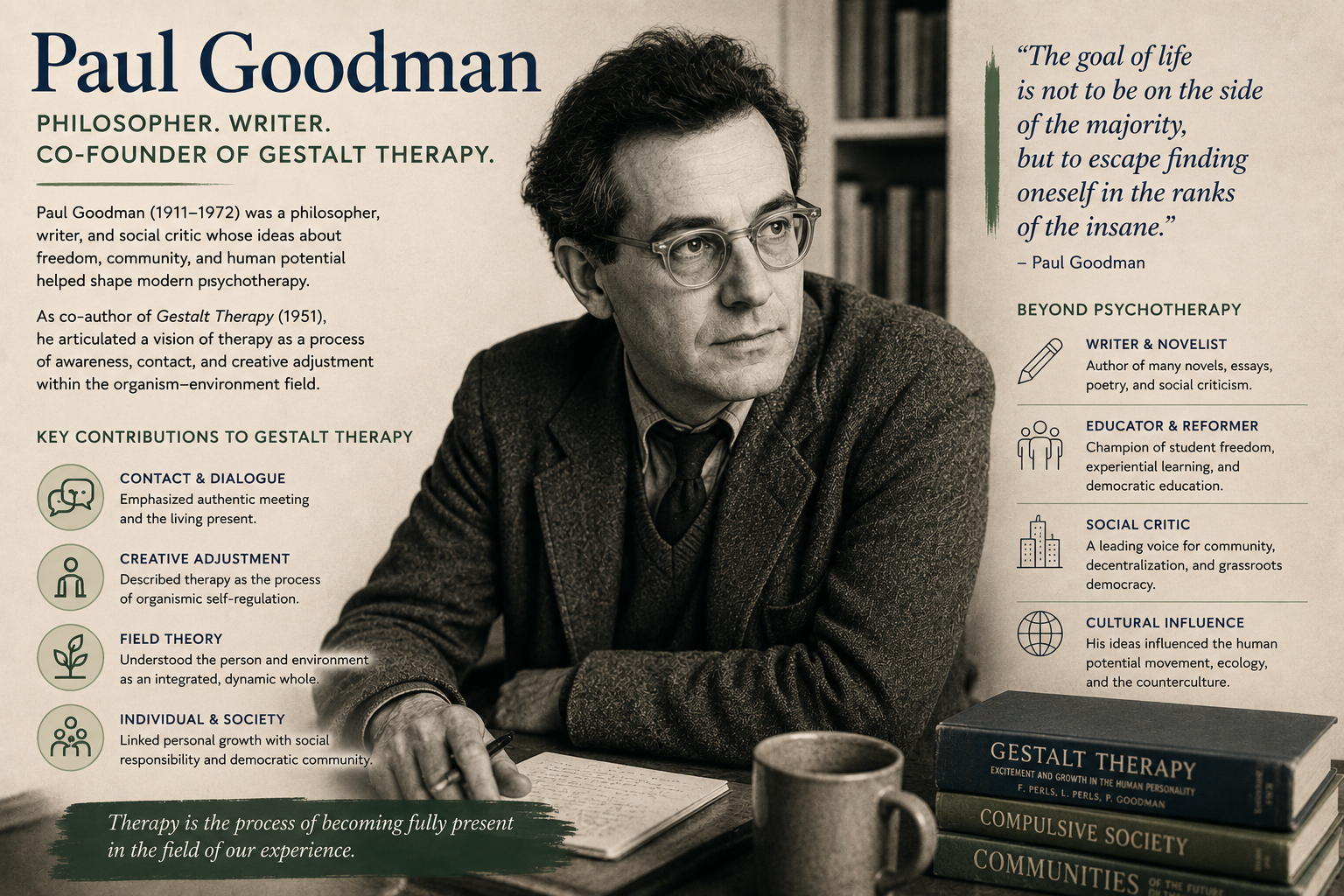
Paul Goodman (1911–1972) was a writer, poet, philosopher, social critic, and anarchist thinker who became, almost incidentally, one of the foundational theorists of Gestalt therapy. His contribution to the 1951 text Gestalt Therapy: Excitement and Growth in the Human Personality was not that of a clinician supplementing a therapist's insights — it was that of an independent intellectual bringing an entirely different tradition of thought to bear on what it means to be a human organism living in a social and political world. That contribution gave Gestalt therapy much of its theoretical depth, its philosophical coherence, and its distinctively political character.
GestaltReview.com · Biography & History · Founders
Paul Goodman Philosopher, Writer, and Co-Founder of Gestalt Therapy
The life, thought, and lasting influence of the thinker who gave Gestalt therapy its organism-environment field theory, its concept of creative adjustment, and its understanding that genuine human health requires not only therapeutic relationship but social conditions in which genuine contact is possible.
Born
9 September 1911, New York City
Died
2 August 1972, North Stratford, New Hampshire
Known for
Co-authoring Gestalt Therapy (1951); Growing Up Absurd (1960); anarchist social theory; educational reform; urban planning criticism
Fields
Philosophy, psychotherapy theory, literature, social criticism, education, urban planning, poetry
Introduction
Most accounts of Paul Goodman begin and end with the observation that he was one of the three co-authors of Gestalt Therapy: Excitement and Growth in the Human Personality (1951). This is accurate but deeply inadequate. Goodman was one of the most prolific, wide-ranging, and intellectually restless American writers and thinkers of the mid-twentieth century — a figure who published poetry, novels, short stories, literary criticism, urban planning analysis, educational theory, political philosophy, and social commentary, and who did so without ever settling into the institutional identity that would have made him easily categorisable by any of the disciplines he touched.
His contribution to Gestalt therapy was not that of a clinician who learned a new approach and helped systematise it. It was that of a fully formed independent intellect — with deep commitments to anarchist philosophy, to the importance of community and social conditions for genuine human wellbeing, and to the philosophical tradition of phenomenology and existentialism — who encountered the Perlses' clinical ideas and recognised in them the psychological equivalent of what he had been developing in his own philosophical and political work. The encounter produced one of the most remarkable collaborative intellectual achievements in psychotherapy's history.
Who Was Paul Goodman?
Paul Goodman was, before and beyond his contribution to Gestalt therapy, a public intellectual of the first rank — someone whose work was read, argued about, and taken seriously across an extraordinary range of fields simultaneously. He was taken seriously as a literary critic by the New York intellectual circles of the 1940s and 1950s, as a social critic by the New Left of the late 1950s and 1960s, as an educational theorist by alternative educators across North America and Europe, and as a political philosopher by the international anarchist tradition. He was not a specialist in any field; he was a generalist with a particular kind of systematic intelligence — the ability to see how the same principles, applied consistently, generated insights across apparently different domains.
The principle that generated most of Goodman's work was deceptively simple: that human beings flourish when they are genuinely connected to meaningful work, to authentic community, and to the exercise of real responsibility for their own lives — and that most of the social institutions that surround them systematically obstruct these connections in the name of efficiency, order, and administration. This insight animated his social criticism, his educational theory, his anarchist politics, and, eventually, his contribution to Gestalt therapy's organism-environment field theory. It was not so much a doctrine as a consistent cast of mind — one that asked, of any institution or social arrangement, whether it genuinely supported the conditions for human contact, creativity, and self-regulation, or whether it covertly undermined them.
Early Life and Education
Paul Goodman was born on 9 September 1911 in New York City. His father had abandoned the family before his birth, and he was raised primarily by his mother, Augusta, and his elder sister, who played a formative role in his intellectual development. The family was Jewish, working-class to lower-middle-class, and centred in the intellectually fertile world of New York's immigrant communities.
Goodman was an outstanding student who attended the City College of New York, then as now one of the most academically demanding public institutions in the country and the educational home of an extraordinary number of mid-twentieth-century New York intellectuals. He graduated in 1931 and subsequently studied for a doctorate in humanities at the University of Chicago, where he encountered a range of philosophical influences — including the neo-Aristotelian criticism of R. S. Crane and the broader intellectual world of the Chicago School — that shaped his approach to literary criticism and his understanding of the relationship between form and function in human activity.
His doctoral dissertation, on the Kantian aesthetics of the artist's method, was completed only in 1954 — after Gestalt Therapy had already been published. The long delay reflects both the unconventional trajectory of his intellectual development and the degree to which he consistently prioritised his own projects over institutional requirements. Throughout his career, Goodman's relationship with academic institutions was tense: he held occasional teaching positions but was never fully absorbed into the academic world, and this outsider status — which caused him significant financial difficulty throughout his life — was also the source of much of his intellectual freedom and his willingness to address audiences across disciplinary boundaries.
Goodman as Writer, Poet, and Novelist
By the time Goodman encountered the Perlses in the early 1940s, he had already established himself — in the world of New York's little magazines and intellectual journals — as a serious literary writer and critic. He had published short stories, poems, and novels, and had contributed criticism to journals including Partisan Review, New Directions, and Politics. His literary work was experimental, marked by a combination of naturalistic engagement with New York street life and philosophical ambition that resisted easy categorisation.
His fiction — including the multi-volume novel sequence The Empire City (published in parts from 1942 to 1959) and the earlier The Facts of Life (1945) — explored themes of community, sexuality, alienation, and the relationship between the individual and society that would remain central to his thinking across all his work. His poetry, published across several collections throughout his life, was similarly wide-ranging: lyric, direct, often philosophical in its engagement with questions of perception, presence, and the nature of experience.
Goodman's literary criticism brought a consistent theoretical perspective to bear on questions of form, function, and the relationship between aesthetic activity and social life. His 1954 book The Structure of Literature developed a neo-Aristotelian approach to literary analysis that connected formal aesthetic concerns to questions of organic wholeness and functional integrity — concerns that directly anticipated his Gestalt theoretical contributions. The 1962 collection The Community of Scholars extended these ideas into the domain of educational theory.
Political and Social Thought
Anarchism and Human Freedom
Goodman identified as an anarchist throughout his adult life, though his anarchism was more Kropotkin than Bakunin — more concerned with the positive construction of genuine community than with revolutionary destruction of existing order. His anarchist thought was grounded in an empirical claim about human nature: that people, given conditions that genuinely support meaningful work, authentic community, and real responsibility for their own affairs, are naturally self-regulating and capable of creating forms of social organisation that serve their actual needs. The pathological and destructive forms of human behaviour that opponents of anarchism cite as evidence for the necessity of strong authority are, on Goodman's account, largely products of the conditions that authority itself creates — of alienation, meaninglessness, and the systematic deprivation of genuine agency.
In his 1968 essay "The Black Flag of Anarchism," published in the New York Times, Goodman observed that the student movements of the 1960s were practising anarchist politics — decentralised, participatory, resistant to hierarchical organisation — largely without knowing it. His willingness to write for mainstream publications on anarchist themes without softening his theoretical commitments reflected his characteristic intellectual fearlessness and his belief that ideas, clearly stated, could reach audiences who had been taught to dismiss them.
Education and Social Critique
Goodman's educational thought was perhaps his most practically influential contribution to American culture. His 1960 book Growing Up Absurd: Problems of Youth in the Organized Society — rejected by seventeen publishers before it appeared in a small excerpt in Commentary magazine and was then immediately republished in full — became one of the most widely read and discussed social criticism texts of its decade, selling hundreds of thousands of copies and making Goodman a significant figure in the emerging counterculture.
The book's central argument was that young men in postwar American society were growing up into a world that offered them no genuinely meaningful occupation — no work that connected them to something real, that exercised their capacities, and that contributed to a community they could genuinely identify with. The result was not individual pathology but a rational, if destructive, response to a genuinely absurd situation: alienation, delinquency, and the withdrawal from social engagement that the society then treated as the individual's problem rather than recognising as the system's.
"Goodman's anarchism was not a doctrine of destruction but a claim about human nature: that people, given conditions that genuinely support meaningful work and authentic community, are naturally self-regulating."
His educational criticism — extended in books including Compulsory Miseducation (1964) and New Reformation: Notes of a Neolithic Conservative (1970) — consistently argued that mainstream educational institutions were organised around the needs of the institution rather than the developmental needs of children, and that genuine education required the creation of conditions in which young people could make real choices, engage in real work, and exercise real responsibility. These arguments were not merely theoretical; they were practically influential in the development of alternative education movements in the United States and beyond.
Goodman's urban planning criticism — developed in collaboration with his brother Percival Goodman in Communitas: Means of Livelihood and Ways of Life (1947/1960) — applied the same organic, community-centred principles to the built environment, arguing against the abstract bureaucratic rationalism of mainstream urban planning in favour of genuinely human-scaled communities that supported the kinds of contact, encounter, and improvised social life that modern planning systematically destroyed.
Meeting Fritz and Laura Perls
Goodman encountered Fritz Perls and Laura Perls in New York in the early 1940s. The encounter was facilitated by the overlapping intellectual and social worlds of the New York psychoanalytic and humanistic psychology communities, with whom Goodman was connected through his friendships with figures including William Reich, Lore Perls (Laura), and the circle around Dwight Macdonald's journal Politics.
The attraction was intellectual. Fritz Perls was working on ideas that, in Goodman's reading, were moving in essentially the same direction as his own philosophical and political thought — away from the intrapsychic reductionism of classical psychoanalysis, toward an understanding of psychological life as constituted through the organism's dynamic engagement with its environment, shaped by social and relational conditions, and fundamentally holistic rather than mechanistic. Goodman recognised in Perls' clinical insights the psychological instantiation of principles he had been developing in his social and political writing.
Laura Perls, who had direct philosophical training in phenomenology and existentialism — she had studied with Max Wertheimer and had read Heidegger and Buber — was a particularly significant intellectual interlocutor for Goodman. Her philosophical grounding complemented and deepened his own, and her understanding of the therapeutic encounter as a genuine dialogical meeting — an I-Thou encounter in Buber's sense — resonated directly with Goodman's thinking about community, contact, and the conditions of genuine human flourishing.
Writing Gestalt Therapy (1951)
The precise history of the composition of Gestalt Therapy: Excitement and Growth in the Human Personality (1951) has been the subject of some scholarly discussion, and the attribution of specific contributions is complicated by the collaborative nature of the project and by the different accounts that the three authors and their associates offered at different times. What is established is this: the book was published under the names of Frederick (Fritz) Perls, Ralph F. Hefferline, and Paul Goodman; Goodman wrote the second volume, which contains the systematic theoretical account of Gestalt therapy's foundations; and Hefferline contributed the first volume, which consists of awareness exercises drawn from his work as a psychology teacher at Columbia University who was testing the therapeutic ideas with his students.
Goodman's contribution — Volume Two, titled "Novelty, Excitement, and Growth" — is the theoretical heart of the book. It covers approximately 250 pages and develops the organism-environment field theory, the theory of contact and the contact boundary, the self-process, awareness, the contact cycle, creative adjustment, and the analysis of neurosis as a disruption of organismic self-regulation. It is dense, philosophically sophisticated, and still one of the most demanding texts in the psychotherapy literature. Philippson (2016) notes that Goodman's contribution "extended some of Fritz Perls' founding insights and further distanced the theory from its psychoanalytical underpinning," introducing the concepts of creative adjustment and the autonomous criterion that are central to a distinctively Gestalt — as opposed to psychoanalytic — perspective on self and health.
The book was not commercially successful on its initial publication and was largely ignored by the mainstream psychological and psychiatric communities for the first decade of its existence. It found its audience gradually, primarily among the humanistic psychology movement that emerged in the late 1950s and 1960s, and eventually became recognised as one of the foundational texts of experiential psychotherapy. Farrands (2016) describes how the theoretical architecture of the 1951 text — organised around what he terms two "twists" in being, the organism's defensive contraction and its movement toward genuine openness — remains a productive framework for contemporary Gestalt practice.
Goodman's Contribution to Gestalt Theory
The Organism–Environment Field
The most fundamental of Goodman's theoretical contributions to Gestalt therapy is the organism-environment field framework. Drawing on Kurt Lewin's field theory, Kurt Goldstein's holistic neurology, and his own anarchist-influenced understanding of the relationship between individual and society, Goodman developed an ontology in which the organism and its environment are not separate entities that interact but constitutive poles of a unified dynamic whole. There is no organism apart from an environment; there is no environment apart from the organisms that constitute and respond to it. Experience is not something that happens inside the organism — it happens at the contact boundary, the dynamic zone at which organism and environment meet.
Aylward (2022), in a study of Goodman's sociopolitical contributions to Gestalt therapy, identifies as particularly significant Goodman's concept of self-formation: the momentary creations of self are formed of rather than at the organism-environment boundary — a subtle but important distinction that positions selfhood as a process constituted from the field rather than as an entity that subsequently interacts with it. This field-theoretic understanding, as Michon (2019) notes, challenges the individualist and solipsistic view of the self in a way that has significant implications not only for therapeutic practice but for understanding the relationship between health and the social environment. For the full account of field theory in Gestalt clinical practice, see our article on Field Theory and Dialogue in Gestalt Therapy.
Creative Adjustment
The concept of creative adjustment — the organism's capacity to find the best available response to its environmental conditions with the resources available at the time — is among Goodman's most clinically important theoretical innovations. It reframes what psychoanalysis understood as defence mechanisms and what cognitive psychology understands as maladaptive cognitive patterns as, instead, intelligent and creative responses to actual field conditions. The neurotic symptom, on this account, is not primarily a failure or a pathology; it is a creative solution to a genuine problem — one that may persist beyond the conditions that generated it, but whose intelligence must be recognised before it can be worked with.
This reframing has significant clinical and ethical implications. It positions the therapist as someone who engages with the person's adaptive intelligence — however costly its current manifestations — rather than as an expert who corrects the person's deficits. It insists on the respect due to the organism's self-regulatory capacities. And it situates the therapeutic task not as the elimination of pathological patterns but as the creation of conditions in which the organism can discover that it has more options available than its current creative adjustments allow.
Goodman's Concept of the Autonomous Criterion
Alongside creative adjustment, Philippson (2016) highlights Goodman's introduction of the autonomous criterion — the idea that the organism has its own internal standard for what constitutes genuine health and flourishing, and that this standard is not imposed from outside by social convention, therapeutic theory, or moral prescription. Genuine health, on this account, is not compliance with external norms; it is the organism's own fullest engagement with its actual experience and with the conditions of its life. This concept gave Gestalt therapy a philosophical grounding for its resistance to normative prescriptions about what constitutes the "correct" outcome of therapy — a resistance that distinguishes Gestalt therapy from approaches that treat health as convergence toward a socially prescribed standard.
The Self-Process, Contact, and Awareness
Goodman's theory of the self — developed in Volume Two of the 1951 text — understands self not as a fixed entity or structure but as a process: the ongoing, integrating activity through which the organism constitutes its experience at the contact boundary. Self, in this account, is not something the person has; it is something the person does — or, more precisely, something that happens at the dynamic interface of organism and environment as experience is constituted moment by moment.
This process-based understanding of self has profound clinical implications. If self is a process rather than a structure, then psychological difficulties are not primarily failures of a fixed self-structure but disruptions of the self-process — specific ways in which the dynamic constitution of experience at the contact boundary has been restricted, habituated, or defended against genuine novelty and genuine contact. The therapeutic task is to restore the fluidity and creativity of this process, not to rebuild a damaged structure. For the clinical account of how contact functions in this framework, see our article on Contact and Withdrawal in Gestalt Therapy.
Individual and Society
Perhaps the most distinctively Goodmanian dimension of the 1951 text is its insistence that psychological health and social conditions are not separable concerns. Goodman understood that genuine organismic self-regulation requires not only adequate internal resources and a skilled therapist but an environment — social, political, institutional — that genuinely supports the conditions for contact, creativity, and authentic engagement. A person whose self-regulatory capacity is restored in the therapy room but who returns to a social environment that systematically denies genuine agency, meaningful work, and authentic community will not, in Goodman's account, reliably sustain therapeutic gains.
Aylward (2022) quotes Goodman's reflection on what Freud would have concluded had he lived longer: that "cure could not depend merely on talk, revival of affect, and reconsideration, but must also pass over into practical behavior, and therefore must involve a change of the social rules so as to make such curative behavior possible." This insight — that therapy is necessarily political, that individual psychology and social organisation cannot be treated as independent domains — was not fashionable in the psychotherapy of the 1950s and has never been fully mainstream. But it gives Gestalt therapy a social and political dimension that distinguishes it from approaches that treat the individual's internal world as the sole proper domain of therapeutic concern. For a fuller account of how this systemic dimension extends into contemporary Gestalt practice, see our article on Gestalt Therapy and Systems Thinking.
Goodman's Influence Beyond Psychotherapy
Influence on Education
Goodman's educational influence was enormous, particularly in the United States and the United Kingdom, where his ideas helped shape the free school and alternative education movements of the 1960s and 1970s. His core educational arguments — that compulsory mass education is organised around institutional convenience rather than genuine developmental need, that young people are capable of making real choices when given real alternatives, and that genuine learning requires meaningful work with real consequences — were adopted, adapted, and popularised by a generation of educational reformers including John Holt, Jonathan Kozol, and Ivan Illich, the last of whom extended Goodman's critique into a comprehensive analysis of what he called "deschooling society."
Influence on Community Psychology and Urban Planning
Goodman's emphasis on decentralised, human-scaled community as the proper environment for genuine human flourishing influenced the emerging field of community psychology and contributed to the critique of modernist urban planning. His Communitas (with Percival Goodman) offered a serious alternative framework for thinking about the built environment — one that prioritised the conditions for genuine human encounter and community life over the abstract rationalisms of Corbusian modernism. His influence is visible in the subsequent work of urban theorists including Jane Jacobs, whose 1961 The Death and Life of Great American Cities developed compatible arguments from a different disciplinary starting point.
Influence on the Counterculture
Growing Up Absurd made Goodman one of the most widely read and cited intellectuals in the counterculture of the early 1960s. He spoke on university campuses across North America and Europe, engaged directly with the student movements of the late 1960s, and was cited by student activists as a significant intellectual influence. His anarchist politics — non-violent, participatory, deeply sceptical of centralised organisational forms including both capitalist corporations and Leninist revolutionary parties — provided a theoretical framework that resonated with the democratic and participatory aspirations of the broader social movement.
Influence on Humanistic Psychology
Goodman's contribution to the 1951 text was one of the foundational documents of humanistic psychology — the movement, crystallising in the late 1950s and 1960s around Abraham Maslow, Carl Rogers, and the emerging encounter group culture, that positioned itself as a "third force" in psychology against both behaviourism and psychoanalysis. His organism-environment field theory, his non-pathologising understanding of human difficulties, his insistence on the whole person rather than isolated psychological mechanisms, and his emphasis on creativity and self-regulation as central features of human health all contributed to the intellectual framework within which humanistic psychology developed.
Major Publications
1947 / 1960
Communitas: Means of Livelihood and Ways of Life
Co-authored with Percival Goodman. A systematic critique of modernist urban planning and a series of alternative proposals grounded in genuine community and meaningful work.
1951
Gestalt Therapy: Excitement and Growth in the Human Personality
Co-authored with Perls and Hefferline. Goodman wrote the second volume — the theoretical foundation. One of the founding texts of humanistic psychotherapy.
1954
The Structure of Literature
Goodman's doctoral dissertation, developing a neo-Aristotelian approach to literary criticism grounded in organic form and functional integrity.
1959
The Empire City
Goodman's major work of fiction — a multi-volume novel sequence tracing New York life from the 1940s onward, exploring community, alienation, and the quest for meaningful existence.
1960
Growing Up Absurd
His most widely read work — a social critique of postwar American society's failure to provide young people with meaningful occupation, community, and genuine agency. Sold hundreds of thousands of copies.
1964
Compulsory Miseducation
A systematic critique of compulsory mass education — arguing that school as typically organised serves institutional rather than developmental needs. Widely influential in the alternative education movement.
1965
People or Personnel
A study of the relationship between centralised organisation and human alienation, arguing for the decentralisation of institutions as a condition of genuine human agency and community.
1970
New Reformation: Notes of a Neolithic Conservative
Goodman's engagement with the counterculture — simultaneously sympathetic and critical, arguing for the recovery of genuine values rather than merely anti-establishment gesture.
Goodman also published multiple collections of poetry throughout his career, including The Lordly Hudson (1962) and Homespun of Oatmeal Gray (1970), and his Collected Poems, edited by Taylor Stoehr, appeared posthumously in 1974. A selection of his literary essays appeared in Creator Spirit Come! (1977), and his five-volume Collected Works was compiled and edited by Stoehr after his death.
Criticisms and Controversies
Controversies and Limitations
Sexual behaviour and ethics. Goodman was bisexual and open about his sexual life in an era when this openness carried significant social and professional risk. He was also, by his own account and the accounts of others, sexually predatory with young men — a behaviour that his anarchist anti-authoritarianism did not extend to a recognition of the power dynamics involved in his own conduct. Contemporary readers, and particularly Gestalt therapists informed by contemporary understanding of boundaries and power in professional contexts, will read some aspects of his autobiographical writing on this topic with appropriate critical distance.
Gender. Goodman's social criticism was largely addressed to young men and largely ignored the specific circumstances of young women. Growing Up Absurd, for all its clarity about the absurdity of postwar American social organisation, treated the aspiration toward meaningful work and community as essentially a male aspiration and had little to say about the systematic exclusion of women from the public and professional worlds where such meaningful work was supposed to be possible. Feminist critics, beginning in his own lifetime, noted this significant limitation.
Theoretical obscurity. The second volume of Gestalt Therapy (1951) — Goodman's primary contribution — is notoriously difficult. Its density, philosophical demands, and idiosyncratic prose style have been cited by Gestalt therapists as a barrier to engagement with the theoretical foundations of their own approach, and there is a long-standing criticism within the Gestalt field that practitioners have been insufficiently engaged with the 1951 text as a result. Goodman's writing was never primarily oriented toward accessibility, and the theoretical sophistication of the volume comes at the cost of considerable readerly effort.
Scholarly attribution. The precise authorship of different sections of the 1951 text has been discussed by Gestalt scholars, and there are unresolved questions about the degree to which Fritz Perls' clinical ideas were modified, extended, or supplanted by Goodman's theoretical reframing. Some accounts hold that Goodman's theoretical contributions were more independent of Perls' clinical thinking than the collaborative authorship suggests; others emphasise the genuine integration of clinical and philosophical perspectives. These questions are important for the intellectual history of Gestalt therapy but are not definitively settled in the available historical record.
Goodman's Lasting Legacy
Goodman died on 2 August 1972, at the age of sixty, of a heart attack at his home in North Stratford, New Hampshire. He had been increasingly ill in his final years, and had also suffered — with characteristic public honesty — the grief of losing his son Mathew Ready in a mountain climbing accident in 1967, an event that marked him deeply and was reflected in the poetry of his final years.
His legacy within Gestalt therapy has been complex and somewhat ambivalent. For decades after the 1951 text's publication, the dominant public face of Gestalt therapy was Fritz Perls — whose dramatic, confrontational, technique-centred style at Esalen was the image most people associated with the approach — and Goodman's theoretical contribution was relatively underacknowledged within the tradition he had helped create. The revival of interest in the 1951 text from the 1980s onward — associated with scholars including Gary Yontef, Gordon Wheeler, and Malcolm Parlett — brought renewed attention to the theoretical depth of Goodman's contribution and to the ways in which the relational turn in Gestalt therapy was not a departure from but a recovery of the field-theoretic and dialogical dimensions that Goodman had built into the foundational text.
Calaca de Sa-Junior (2009) identifies Goodman's work as pointing to "possible paths of expansion, amplifying and updating the Gestalt approach" — noting that his contributions across literary criticism, urban planning, psychology, and political philosophy can be understood as located at the "contact boundary" of Gestalt therapy, pointing toward domains that the therapy has not yet fully explored. This reading positions Goodman not as a historical figure to be studied but as an ongoing resource — a thinker whose breadth of engagement with human experience in its social, political, aesthetic, and psychological dimensions continues to offer Gestalt therapy generative material for its own development.
Beyond Gestalt therapy, Goodman's influence persists across educational theory, urban studies, political philosophy, and literary criticism. He is recognised as one of the foundational thinkers of American anarchism and as a significant figure in the intellectual history of the New Left. His work continues to be read by students of education, social theory, and political philosophy who may not know his name but who encounter his ideas in the work of the thinkers he influenced.
Conclusion
Paul Goodman was not primarily a psychotherapist, and reducing him to "one of the founders of Gestalt therapy" significantly misrepresents both the man and his contribution. He was an intellectual of extraordinary breadth whose work in literature, political philosophy, social criticism, educational theory, and urban planning was animated by a consistent set of commitments: to the conditions necessary for genuine human contact and community; to the intelligence of the organism's self-regulatory capacity; to the inseparability of individual psychological health and social organisation; and to the importance of genuine freedom — not freedom from constraint alone, but freedom for meaningful engagement with real work, real community, and genuine encounter.
When Goodman encountered the Perlses' clinical ideas, he recognised in them the psychological expression of what he had been developing across all his other work. The organism-environment field theory, creative adjustment, the autonomous criterion, the self-process — these are not simply clinical concepts. They are philosophical positions that connect Gestalt therapy to a much broader tradition of thinking about what it means for a human being to flourish, and about what social conditions either support or obstruct that flourishing.
Gestalt therapy's theoretical depth — its anti-reductionist holism, its field-theoretic understanding of self and experience, its insistence that psychological health cannot be understood apart from social conditions — owes more to Goodman than to any other single thinker. Understanding who Goodman was — the full range and ambition of his intellectual project — is essential to understanding what Gestalt therapy is and what it could continue to become.
For a comprehensive introduction to Gestalt therapy and how Goodman's contributions are integrated into its contemporary practice, see our article on Gestalt Therapy: An Overview.