GestaltReview.com · Educational Essay · Clinical Theory
Deflection in Gestalt TherapyContact Interruption, Protective Process, and Clinical Engagement
Deflection is among the most pervasive and least confronted of the contact interruptions in Gestalt therapy. This article examines what deflection is, why people deflect, how it appears in clinical work, and how Gestalt therapists engage with it — with care, not confrontation.
Introduction
When something significant stirs in a therapy session — a memory that carries weight, a feeling that has been long avoided, a moment of genuine closeness with the therapist — something else often happens just before full contact is made. The client makes a joke. They trail off into abstraction. They change the subject. They fill the silence with reassuring words that somehow say nothing. The moment passes, and with it, the possibility of the contact that was just within reach.
This is deflection: the turning away from direct experience at the very point where contact becomes possible. It is not dramatic, not obviously resistant, and not easily named. It moves quickly, quietly, and — in many cases — without the client's awareness that it has happened at all. It is precisely this unobtrusive quality that makes deflection one of the most clinically significant and least straightforward of the contact interruptions described in Gestalt therapy.
This article traces deflection from its theoretical foundations in Gestalt field theory and the contact boundary framework through to its clinical manifestations, its relationship to anxiety and shame, its particular relevance in trauma-informed practice, and the careful, phenomenologically sensitive way that Gestalt therapists engage with it. Throughout, the aim is to understand deflection not as a pathological failure but as a learned relational strategy — one that once served a genuine protective function and that can be worked with gently, with curiosity, and without confrontation.
What Is Deflection in Gestalt Therapy?
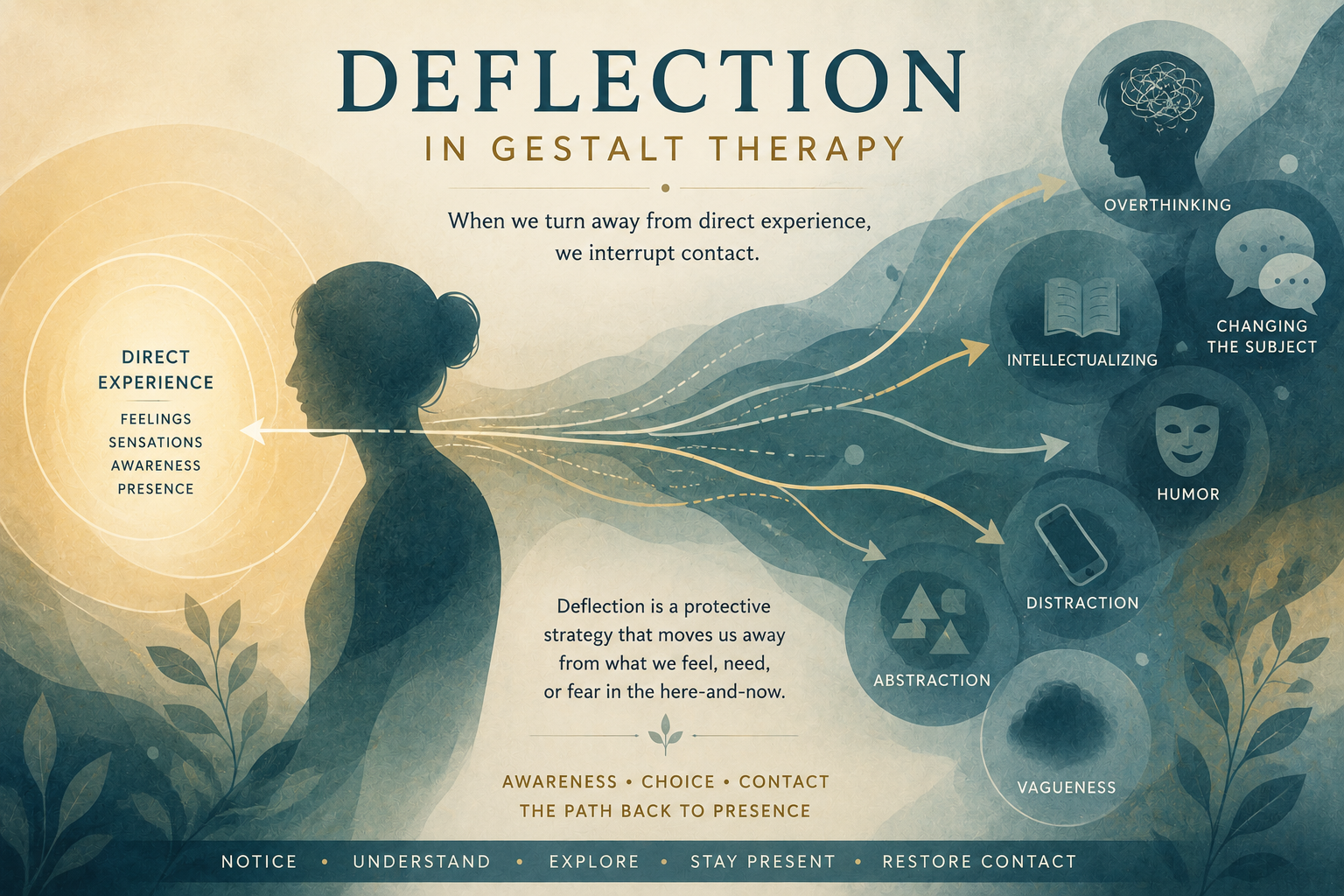
In Gestalt therapy, deflection refers to the process by which a person redirects, dilutes, or disperses their contact with present experience — with a feeling, a perception, a relationship, or a moment of direct encounter — in ways that prevent full contact from occurring. The deflecting person does not necessarily refuse contact outright; they approach it and then, at the last moment, turn aside. Awareness begins to form and is then dissolved. Emotion begins to build and is then released sideways into something safer.
The concept was elaborated within the Gestalt framework most fully by Erving and Miriam Polster in their 1973 text Gestalt Therapy Integrated. The Polsters described deflection as a way of "taking the heat out of contact" — a process that reduces the intensity and immediacy of relational or emotional experience to a level the person can manage without becoming overwhelmed. It is, in this sense, a form of self-protection operating at the contact boundary.
Deflection differs from other contact interruptions in an important way. Retroflection turns energy back against the self. Introjection absorbs the other's perspective wholesale. Projection attributes one's own experience to another. Confluence dissolves the distinction between self and other. Deflection does none of these things: it redirects the direction of contact, scattering it rather than reversing, absorbing, or projecting it. The person remains present, continues to engage, but their engagement is organized to avoid the very thing that is most charged, most significant, most alive in the moment.
For a comprehensive account of all the contact interruptions and their clinical significance, see our article on Contact Interruptions in Gestalt Therapy: A Relational Perspective.
Deflection as an Interruption of Contact
The concept of contact is central to Gestalt therapy's understanding of psychological health and disturbance. Contact, in the Gestalt sense, is not simply being in the presence of another person or being aware of an experience; it is the dynamic, full engagement of the organism with what is most significant in its environment at any given moment. Contact requires both the emergence of a clear figure — a need, a feeling, a perception — and the genuine meeting of that figure with whatever in the environment it calls toward. When contact is achieved fully, the figure can resolve and recede, and the person is free to attend to what emerges next.
Deflection interrupts this process at the point of meeting. The figure has emerged — the emotion is there, the relational significance is present, the moment of potential contact is real — but something intervenes before full meeting can occur. The person says something that moves the conversation elsewhere. They smile when they are about to cry. They become philosophical about something that deserves to be felt. They speak rapidly, filling the space that genuine contact would require.
In field-theoretic terms, deflection is a way of managing the field so that certain aspects of it — the most charged, the most significant, the most potentially overwhelming — remain in the background rather than emerging as figures. The organism, having learned that certain kinds of contact are dangerous, painful, or unwelcome, organizes the field to prevent them from coming fully into the foreground. This organizing activity is deflection. For a fuller discussion of the contact cycle and the rhythm of contact and withdrawal in Gestalt therapy, see Contact and Withdrawal: The Rhythm of Relationship in Gestalt Therapy.
The Contact Boundary and Avoidance of Direct Experience
Gestalt therapy understands experience as arising not inside the individual but at the contact boundary — the dynamic zone of interaction between organism and environment. What the person experiences is not simply a function of what is happening inside them or outside them, but of what occurs in the meeting between the two. The contact boundary is the site where the self is constituted moment by moment through its encounter with what is other.
Deflection operates specifically at this boundary. Rather than allowing the boundary to be a permeable, responsive site of genuine meeting, deflection reorganizes it into a semi-permeable filter — allowing some things through while redirecting others. The person remains in apparent contact with their environment while actually maintaining a studied distance from the most significant aspects of what they are encountering.
This is an important nuance: deflection is not withdrawal. In withdrawal, contact is diminished or terminated — the person moves back from the boundary. In deflection, the person remains at the boundary and continues to engage, but the engagement is organized to dissipate energy and attention before they can concentrate into genuine meeting. The result can be a kind of relational activity that looks like contact from the outside — the person is talking, responding, apparently engaged — but that, from the inside, has no real moment of meeting. The person is busy, but not present. Engaged, but not in contact.
For a detailed account of field theory and the contact boundary, see our article on Field Theory and Dialogue in Gestalt Therapy.
Common Examples of Deflection
Deflection takes many forms, and part of what makes it clinically elusive is that many of its forms are socially valued behaviors — politeness, humor, intellectual engagement, the capacity to see multiple perspectives. The clinical significance of these behaviors is not in the behaviors themselves but in their function: whether they open the person to more genuine contact with their experience, or move them away from it.
Why People Deflect
To understand deflection clinically, it is essential to understand it as a creative adjustment — a term central to Gestalt therapy that describes the ways in which people develop strategies of contact and protection in response to the specific field conditions of their early relational environment. The person who deflects is not being difficult or evasive for no reason. They are doing something that worked, or was necessary, in some earlier context — and that has become a habitual pattern applied across situations that may no longer require it.
A child raised in an environment where direct emotional expression was met with dismissal, ridicule, punishment, or overwhelming parental distress learns, often very young, to manage their emotional expression so that it does not produce these consequences. They learn to soften their intensity, to make jokes when they are sad, to talk past their feelings rather than through them. These adaptations are intelligent responses to the field conditions of their development. They are not failures; they are solutions to real problems.
The difficulty is that these solutions, having been learned in response to one set of field conditions, tend to persist into contexts where those conditions no longer obtain — including the therapy room, where direct emotional expression is not only safe but specifically invited. The person continues to deflect not because the current field is dangerous but because their organism has learned, at a level deeper than deliberate choice, that this kind of contact is risky. The learning is held in the body, in habitual patterns of breathing and posture and voice, in reflexive social behaviors that have become second nature.
Understanding deflection as a creative adjustment — as the organism's intelligent self-regulation under difficult conditions — is what allows the Gestalt therapist to approach it with genuine curiosity and care rather than as an obstacle to be overcome.
Deflection, Anxiety, and Shame
Deflection is rarely a purely cognitive process. It is typically organized around something felt — most often a form of anxiety or shame that the anticipated contact threatens to activate. Understanding what deflection is protecting the person from is as clinically important as observing the deflection itself.
Anxiety in the Gestalt framework is understood as a form of excitement that has lost its direction — energy mobilized toward contact that, at the moment of contact, becomes frightening rather than enlivening. The person moves toward an emotional truth, a relational moment, a significant experience — and at the threshold, something contracts. The breath shortens. The body tightens. A joke is made. Anxiety does not so much prevent the feeling as interrupt the transition from mobilizing energy to full contact with the experience. Deflection is one of the primary ways in which this interruption occurs.
The relationship between deflection and shame is particularly important, and particularly delicate. Many deflections are organized around the anticipation of shame — the fear that being fully seen, in one's feeling, one's need, or one's vulnerability, will produce judgment, rejection, or contempt. The person who makes a joke when they are about to cry is often, at some level, preemptively managing the shame of being seen crying. The person who intellectualizes about their experience is often protecting the rawer, less composed version of themselves from exposure.
This means that therapeutic engagement with deflection requires considerable sensitivity to the shame dynamics that may underlie it. Naming a deflection directly — "You seemed to be close to something just then, and then you made a joke" — can itself be experienced as shaming if it is not offered with warmth, genuine curiosity, and attention to the relational safety of the moment. For a comprehensive account of how shame operates in the therapeutic relationship, see our article on Shame and Self-Awareness in Gestalt Therapy.
"Deflection is often the shape that shame gives to self-protection — the way the person moves away from being seen before they can be judged."
Deflection and Trauma Considerations
In work with clients who have experienced significant relational or developmental trauma, deflection takes on particular clinical significance. For many trauma survivors, deflection is not merely a habitual relational pattern but a survival-level protective strategy. The capacity to move quickly and smoothly away from overwhelming experience — to stay in functional contact with the world while keeping the most charged material safely out of immediate awareness — may have been, in the literal sense, necessary for survival in an environment of threat or unpredictability.
This means that in trauma-informed Gestalt work, deflection should be approached with even greater caution and respect than in other contexts. The question is never simply "how do I help this person make more direct contact?" but "what relational and regulatory conditions would need to be present before fuller contact could be safely possible?" Premature engagement with deflected material — before the client has sufficient relational safety, sufficient affect regulation capacity, and sufficient trust in the therapeutic relationship — can risk retraumatization rather than integration.
The window of tolerance concept — drawn from interpersonal neurobiology and now widely used in trauma-informed practice — is relevant here. Deflection, in trauma contexts, may function to keep the person within their window of tolerance: maintaining enough distance from overwhelming material to remain within a functional arousal range. Working with deflection in these contexts means working gradually and relationally, attending carefully to the client's physiological signals, and being willing to honor the protective function of deflection rather than treating it as a problem to be solved.
Contemporary Gestalt trauma practice, informed by polyvagal theory and somatic approaches, increasingly understands deflection as a somatic regulatory strategy as well as a relational one — a pattern of bodily organization that maintains a certain distance from experience at the level of the nervous system, not only at the level of social behavior.
Deflection in the Therapy Room
Deflection appears in therapy sessions in forms that are easy to miss precisely because they are so socially normal. The skill is not in identifying deflection as a category but in noticing, in real time, the specific moment when a particular client, in a particular exchange, moves away from something that was approaching.
What signals might a Gestalt therapist attend to? The shift in quality is often more informative than the content. The client's voice that was becoming more hesitant suddenly becomes fluent and articulate again. The emotion that was building disperses as they laugh or launch into explanation. The eyes that were dropping toward something vulnerable dart back up to meet the therapist's gaze in a way that feels like social management rather than genuine contact. A brief silence that held something in it is filled, quickly, with words.
The therapist's own bodily experience is often an important signal. Many Gestalt therapists notice that deflection produces a particular quality of experience in themselves — a sense that something just slipped away, or that what was said was somehow beside the point, or that the conversation moved just as it was about to arrive somewhere. This embodied sense in the therapist is not merely personal but field data: information about what is happening in the relational field between them.
The therapist also notices what is not said or not done. Deflection frequently involves the absence of an expected response — the absence of feeling in a moment that would normally carry feeling, the absence of self-reference when the topic is clearly personal, the absence of a pause when something has just been shared that would typically require one.
For a broader account of how Gestalt therapists use their own embodied experience as clinical data, see our article on Embodied Awareness and the Body in Gestalt Therapy.
How Gestalt Therapists Work with Deflection
The Gestalt approach to working with deflection is characterized by several principles that distinguish it from more confrontational or directive interventions.
Support before contact
The foundational principle is that fuller contact with charged material requires adequate relational support. Before a therapist can usefully invite a client toward something they have been deflecting, the therapeutic relationship must be strong enough to hold what may emerge. This means the primary work is relational: building genuine contact, safety, and mutual trust — not as a preparation for the "real" work of confronting the deflection, but as the ground within which the deflection can be gently and curiously explored.
Naming with warmth rather than confrontation
When a therapist does name what they observe — "I noticed you smiled just then, just as you were talking about your father" or "Something happened there — you were right on the edge of something and then it seemed to pass" — the naming is offered as an observation, not an accusation. The tone is curious, not corrective. The intention is to bring the deflection into shared awareness so that it can be looked at together, not to pressure the client toward the experience they have been avoiding.
Staying with the deflection itself
Rather than trying to bypass the deflection to get to the "real" feeling underneath, skilled Gestalt therapists are often interested in the deflection as a phenomenon in its own right. What is it like to make that joke right now? Where does the urge to explain come from in this moment? What happens in the body when the subject changes? The deflection itself is part of the client's experience, and attending to it with genuine phenomenological curiosity often opens more than trying to push past it.
Phenomenological inquiry
Phenomenological inquiry — asking questions that invite the client to attend to their immediate, present-moment experience rather than to explain or analyze it — is a primary tool. "What are you noticing in your body right now?" "What happens if you stay with that for a moment?" "What do you want to say to them — not the polished version, just whatever is there?" These questions invite the client toward the experience that deflection was moving away from, without forcing or prescribing what should be found there.
Experiment
The Gestalt experiment — an invitation to try something different, in the moment, to see what becomes available — can be used with deflection. A client who habitually jokes when close to grief might be invited, as an experiment, to say the same thing without the joke and notice what happens. A client who tends to speak about their experiences in the abstract might be invited to try speaking in the first person, in the present tense, and to notice what shifts. These experiments are always offered as invitations, never imposed, and the outcome is always what the client actually discovers rather than what the therapist anticipated. For a detailed account of the empty chair and other Gestalt experiments, see our article on The Empty Chair Technique in Gestalt Therapy.
Awareness, Embodiment, and the Here-and-Now
Gestalt therapy's emphasis on present-moment, embodied awareness is directly relevant to working with deflection. Deflection typically involves a shift away from what is immediate and sensory toward what is more conceptual, more social, or more temporally distant. The therapist's invitation is always back toward the present — toward what is being felt, noticed, or experienced right now, in this body, in this moment.
Embodied awareness is particularly significant. Deflection has a somatic component: the body often retains the feeling that the verbal behavior is moving away from. A client who is making a joke about a painful memory may have tears in their eyes that they have not yet noticed. A client who is explaining their feelings intellectually may be holding their breath. A client who changes the subject just as they were approaching something significant may have their hands clasped tight on their lap.
Gently drawing attention to these somatic signals — not interpreting them, but inviting the client to notice them — can open a pathway back toward the experience that the deflection was organized to avoid. "I notice you're holding your breath as you say that" is an invitation, not a direction. It brings the body into the conversation and allows the client's own awareness to do the therapeutic work.
The here-and-now orientation of Gestalt therapy means that deflection is engaged not as a historical pattern to be explained or a character trait to be modified, but as something happening right now, in this moment, in this room. The question is not "why do you tend to deflect?" but "what is happening right now that makes it difficult to stay with this?" The historical understanding may emerge — but it emerges from present-moment inquiry, not from retrospective analysis.
Deflection vs. Healthy Adaptation
One of the most important clinical distinctions in working with deflection is between deflection as a contact interruption — something that prevents genuine meeting — and what might be called healthy flexibility: the organism's appropriate modulation of contact intensity in response to real field conditions.
Not every turn away from an experience is a deflection in the clinical sense. Sometimes a person needs to move away from something painful to find their ground before they can approach it again. Sometimes humor genuinely releases tension in a way that allows the conversation to deepen rather than dissipate. Sometimes intellectualizing a difficult experience is a way of metabolizing it — working it into understanding — rather than avoiding it. Context, timing, and the felt quality of the exchange are all relevant.
Healthy Flexibility
- The person moves away from intensity and then returns
- Contact remains present even as its form changes
- Humor or abstraction serves the conversation's depth
- The person is aware of what they are feeling, even if they choose not to express it fully right now
- The movement away feels like self-care, not self-abandonment
Deflection as Interruption
- The movement away is reflexive and out of awareness
- Contact is dissipated rather than modulated
- The feeling disappears rather than being held at a manageable distance
- The pattern is consistent: this type of material is always avoided
- The person is left less in contact with themselves after the exchange, not more
The clinically significant question is not whether deflection has occurred but what function it is serving. Is it organizing the person toward greater safety before they engage with what is difficult? Or is it maintaining a habitual distance from material that the person is ready, or nearly ready, to meet? The answer requires the therapist to attend carefully to the client's specific field — their current state, the quality of the therapeutic relationship, what has been building over recent sessions — rather than applying a general rule about the undesirability of deflection.
Clinical Examples
A client in his late thirties has been discussing, with quiet intensity, the moment he realized his marriage was ending. He describes arriving home to find the house half-emptied. His voice has become slower, more careful. There is something in the quality of his attention that the therapist recognizes as the approach of genuine grief.
Then he laughs. "Well, at least she left the coffee machine." The therapist laughs too — it is genuinely funny — but notices, simultaneously, that something has dispersed. The careful quality of attention is gone. The client is now lighter, looser, further from the thing that was just within reach.
The therapist does not correct the humor or name the deflection immediately. But a few minutes later, when the conversation has settled, she returns: "Earlier, when you were describing finding the house, something was happening in you — and then the joke came. I wonder if we could go back there for a moment." The client pauses. Then: "Yeah. I don't really want to go back there." "I know," says the therapist. "What would it be like to stay with that 'I don't want to' for just a bit?"
A client in her late twenties is a doctoral student in psychology. She is bright, articulate, and has considerable theoretical knowledge of therapy. When she begins to approach anything painful — her difficult relationship with her mother, her loneliness, her sense of being fundamentally different from everyone around her — she moves, almost instantaneously, into analysis. "I think what I'm experiencing is probably attachment anxiety, with some elements of the rejected child schema from Young's model."
The analysis is not wrong. But its function, the therapist has noticed, is to create a version of the experience that can be managed at arm's length. The concepts become a transparent shield: she can see the painful thing through them without it touching her.
The therapist interrupts gently: "Can I ask — what happens if you put the theory down for a moment? Not what it means, just: what are you feeling right now?" A longer silence than usual. "I don't know," she says. And then, more quietly: "Lonely, I think." "Can you say that again?" "Lonely." Her eyes are wet. Contact has been made.
A client describes a difficult conversation with his father without ever quite landing on anything specific. The words flow continuously — "it was just a lot, and there was stuff that happened, and I don't know, it's complicated, there were things said" — but nothing is named. The therapist notices that she cannot form a picture of what actually happened, and that this difficulty seems functional rather than accidental.
Rather than asking for more information about the content, she asks: "As you're talking about it right now, what are you noticing in your body?" He stops. Looks surprised. "My chest feels tight." "What's in the tightness?" A long pause. "Shame, I think. He said something that I still feel ashamed of." This is the first specific thing he has said.
Ethical Considerations
Clinical Caution
The identification of deflection in a client carries real ethical weight. Named carelessly, it can be experienced as criticism of how the person is managing themselves, as exposure of something they were protecting, or as pressure to feel or express things they are not ready for. The ethical use of the concept requires that the therapist attend as carefully to their own motivations as to the client's behavior.
Not everything that looks like deflection to the therapist is deflection from the client's perspective. Cultural differences in how emotional experience is expressed and regulated mean that what one cultural framework reads as deflection — indirectness, restraint, the use of humor to handle difficulty — may be a healthy and appropriate mode of contact within another framework. Therapists must be alert to the risk of imposing culturally specific norms of emotional expressiveness as if they were universal features of psychological health.
The concept of creative adjustment — the Gestalt understanding that contact patterns develop as intelligent responses to specific field conditions — should inform the therapist's entire stance toward deflection. The client who deflects is not failing at therapy; they are doing what they learned to do, in conditions that once required it. The therapist's task is to create field conditions in which the deflection becomes less necessary — not to remove it prematurely or to treat its presence as a therapeutic failure.
There is also a risk of what might be called therapeutic over-attention to deflection: the therapist who, having identified deflection as a pattern, begins to name it at every occurrence, or who organizes the therapeutic encounter around getting past it, may inadvertently create a relational dynamic in which the client feels perpetually observed and assessed. Therapeutic tact requires knowing when to note a deflection, when to hold the observation lightly and return to it later, and when to let it pass in the service of the relational contact that is the actual therapeutic medium.
Deflection in Contemporary Gestalt Therapy
Contemporary relational Gestalt therapy has continued to develop the understanding of deflection in ways that reflect the broader relational turn in psychotherapy. Several developments are worth noting.
The first is an increasing emphasis on the relational field in which deflection occurs. Deflection is not simply a property of the client; it is a field event that includes the therapist's own participation. A therapist who is uncomfortable with a particular kind of emotional intensity may inadvertently collude with a client's deflection — smiling at the joke, picking up the intellectual frame, allowing the vague description to pass without inquiry. The therapist's own tendency to deflect certain kinds of contact is a matter for personal therapy and ongoing supervision. Deflection in the therapeutic relationship is always, in some sense, co-created. For a discussion of how the therapeutic field is co-created, see our article on Field Theory and Dialogue in Gestalt Therapy.
The second development is a growing appreciation for the role of the therapist's genuine dialogical presence — their authentic self-expression, appropriate self-disclosure, and willingness to be moved — as what creates the conditions in which deflection can be gently released. A therapist who is genuinely curious, genuinely present, and genuinely not threatening to what the client is protecting creates a different field from one who is technically skilled but relationally distant. It is the quality of the meeting itself, as much as any specific intervention, that allows deflection to become unnecessary.
The third is the integration of somatic and neurobiological understanding into the Gestalt account of deflection. Understanding deflection as a nervous-system level regulatory strategy — not merely a social behavior but an embodied pattern of arousal management — deepens the clinical picture and opens richer possibilities for gentle, body-informed engagement.
For a comprehensive discussion of how field theory, self-regulation, and the organism-environment relationship inform contemporary Gestalt practice, see our articles on Gestalt Therapy and Systems Thinking and Contact and Withdrawal: The Rhythm of Relationship in Gestalt Therapy.
Conclusion
Deflection is, at its core, a way of staying close to something important while remaining safe enough not to be overwhelmed by it. It is intelligent, it is learned, and in many of the contexts in which it was developed, it was necessary. The person who deflects in therapy is not resisting the work; they are doing the work in the only way they have so far learned to manage what the work brings up.
The Gestalt therapist's task, in the face of deflection, is not to overcome it, dismantle it, or interpret it away. It is to create the conditions — relational safety, genuine presence, phenomenological curiosity, patient attention to the present moment — in which the deflection gradually becomes less necessary. When those conditions are present, and when the timing is right, the person often finds their own way toward what they have been deflecting. The therapist's most important contribution is not the clever intervention that names the deflection, but the quality of presence that makes the alternative to deflecting feel possible.
This is the Gestalt approach at its most characteristic: not technique applied to a problem, but genuine contact creating the conditions from which something new can emerge.