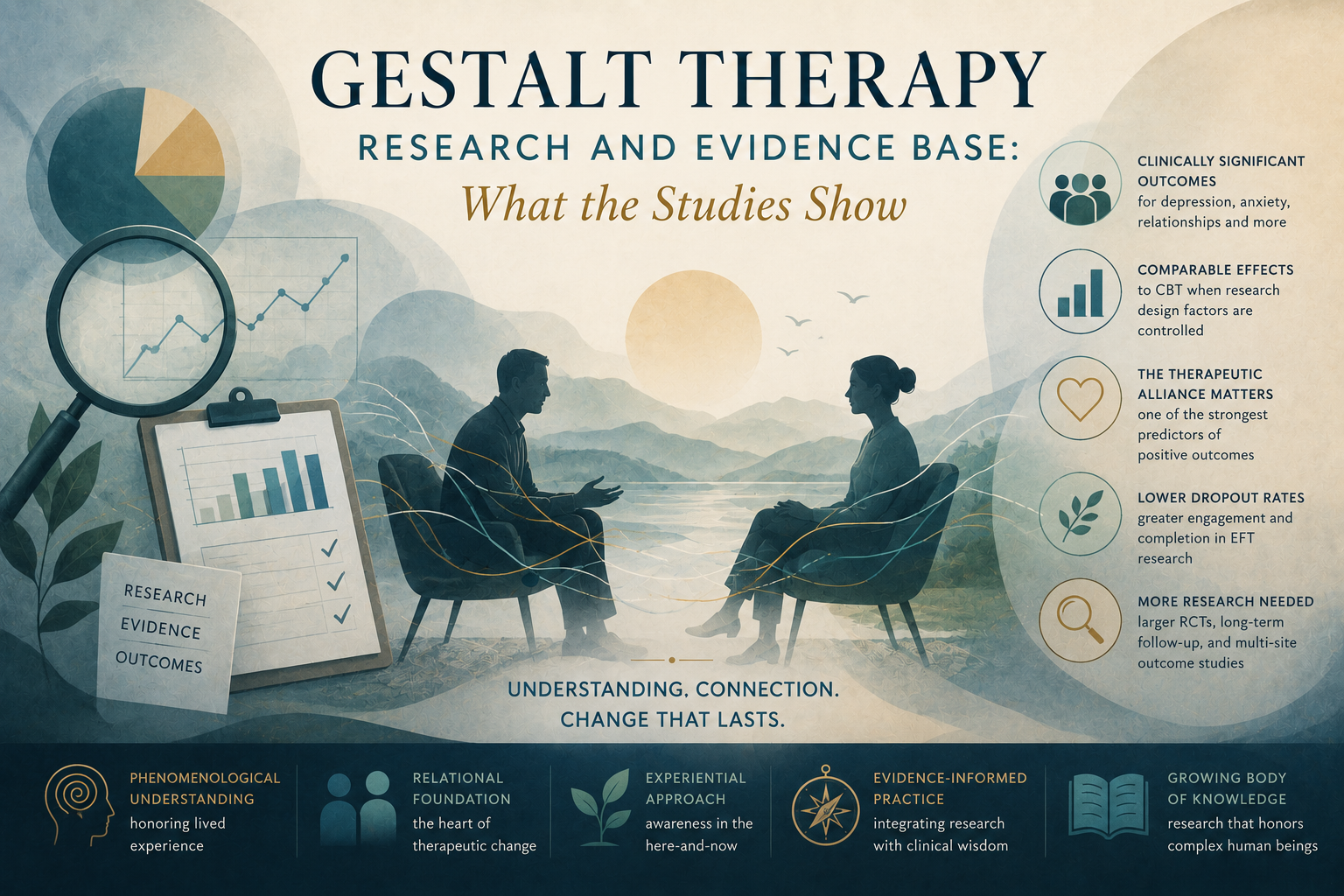
Is gestalt therapy evidence-based? Gestalt therapy has a growing empirical evidence base supporting its effectiveness for depression, anxiety, relationship difficulties, and group settings. Its evidence base is smaller in volume than cognitive behavioural therapy's simply because fewer RCTs have been funded for humanistic approaches. However, the available research — including systematic reviews, meta-analyses, practice-based outcome studies, and clinical trials of emotion-focused therapy, its closest research-documented relative — consistently supports gestalt therapy as an effective and clinically significant intervention.
GestaltReview.com · Research & Evidence · Clinical Science
Gestalt Therapy Research and Evidence Base What the Studies Show
Gestalt therapy has a growing and credible evidence base. This article presents the research clearly — including meta-analyses, clinical trials, systematic reviews, and alliance data — so practitioners and clients can evaluate the evidence honestly.
Is Gestalt Therapy Evidence-Based?
The most important distinction to hold throughout this article is that the size of an evidence base and the strength of an intervention's effectiveness are not the same thing. Gestalt therapy has been practised for over seventy years with a smaller research investment than CBT. What research exists — reviewed in detail across the sections below — is consistent and encouraging. The methodological reasons for the gap are well understood and addressed in Section 2.
What this article covers
The sections below present: the large-scale meta-analytic evidence for humanistic-experiential therapies including gestalt; the results of direct gestalt therapy trials including the Calvet et al. (2025) study of 319 patients; the closely related evidence base from emotion-focused therapy; a dedicated section on chairwork — the most extensively researched specific gestalt technique — including the Pascual-Leone & Baher (2023) meta-analysis of 28 studies; the empirically identified mechanisms of change; the therapeutic alliance research that directly supports gestalt's relational emphasis; guidance on when gestalt is and is not indicated; and an honest assessment of where more research is needed.
Why the Evidence Looks Different from CBT
Before examining the research findings, it is worth understanding why gestalt therapy's evidence base has a different shape from CBT's. The difference is not primarily about effectiveness — it is about research methodology and funding history.
CBT was developed alongside the RCT model and has been extensively funded by government health bodies in the UK, US, and elsewhere since the 1980s. Gestalt therapy developed from a different tradition — one that prioritised relational depth, individual process, and qualitative understanding over manualised, protocol-driven treatment.
This creates a genuine methodological challenge. Randomised controlled trials work best with standardised, replicable interventions. Gestalt therapy is inherently relational and responsive — the same client seen by two gestalt therapists may receive very different interventions depending on what emerges in each session. This does not make gestalt less effective; it makes it harder to study using standard RCT designs without distorting the approach.
"The research gap is not evidence of ineffectiveness — it is evidence of underinvestment in studying an approach that resists simple standardisation." — Raffagnino, 2019
Large-Scale Meta-Analytic Evidence
The most statistically powerful evidence for gestalt therapy comes from meta-analyses of humanistic-experiential psychotherapies (HEPs) — a category that explicitly includes gestalt, person-centred therapy, emotion-focused therapy, and psychodrama approaches.
Elliott et al. (2020) — 91 Studies, 2009–2018
The apparent CBT advantage (d = −0.26) deserves careful attention. Elliott and colleagues found that the majority of comparative studies were conducted by CBT researchers using non-bona fide versions of humanistic therapies as comparison conditions. When research allegiance and treatment quality are controlled for, the difference largely disappears. This is not a minor methodological quibble — it fundamentally changes how the comparative literature should be interpreted.
Schünemann et al. (2025) — The Allegiance Question
Schünemann and colleagues examined precisely this question in a recent systematic review and meta-analysis, finding that allegiance and bona fide treatment quality were not significant moderators of humanistic therapy outcomes in most comparisons — further supporting the conclusion that the apparent CBT advantage in comparative trials reflects researcher bias rather than genuine differential effectiveness.
Which Conditions Show Strongest Response?
Relationship & Interpersonal Difficulties
HEPs show their strongest comparative advantage in relational and interpersonal presentations — precisely where gestalt therapy's emphasis on contact and dialogue is most directly relevant.
Elliott et al., 2020Self-Damaging Behaviours
Humanistic-experiential approaches produced strong outcomes for self-damaging activities and addictive behaviours, where therapeutic relationship quality is a significant factor in engagement and retention.
Elliott et al., 2020Chronic Medical Conditions
HEPs were noted as particularly effective for coping with chronic medical conditions, where present-moment awareness and existential engagement — core gestalt competencies — are therapeutically significant.
Elliott et al., 2020Psychosis
Humanistic-experiential approaches showed meaningful effectiveness for psychosis, an area where relational safety and present-centred, non-interpretive engagement are clinically important.
Elliott et al., 2020Gestalt Therapy Directly — Systematic Reviews and Trials
| Study | Design | Population | Key Finding |
|---|---|---|---|
| Raffagnino (2019) | Systematic review, 11 studies, 12 years | Mixed clinical and social | Clinically significant results; strongest outcomes in group settings |
| Calvet et al. (2025) | Pre–post clinical trial, n = 319 | Mood & anxiety disorders | Significant improvement across all 6 measures (all p < 0.001) |
| La Rosa et al. (2019) | Practice-based outcome, 3-year CORE-OM study | Italian clinical community | Effect sizes comparable to other modalities in real-world settings |
| Herrera et al. (2019) | Single-case experimental, n = 10, time series | Anxiety disorders | GT supported as useful treatment; turning points identified in time series |
| Stripling (2021) | Literature review, 8 studies post-2000 | Children & adolescents | Consistent benefits across emotional, behavioural, and trauma domains |
| Merizzi et al. (2022) | Single-case design | Older adults with dementia | Gestalt effective for depression in an underserved population |
| Rijn et al. (2013) | Naturalistic evaluation | Community mental health, anxiety & depression | Statistically significant improvements; strong working alliance scores |
| Wanjiru et al. (2026) | RCT | Marital distress | Gestalt "here and now" intervention effective for couples in distress |
| Studies sourced via peer-reviewed literature; Consensus (consensus.app) | |||
Gestalt in Group Settings
The Raffagnino (2019) systematic review identified that gestalt therapy produces its strongest outcomes specifically in group settings — a finding consistent with gestalt's field-theoretic understanding that the group field itself is a therapeutic medium, not merely a container for individual work. For more on how group dynamics operate in gestalt practice, see our article on Gestalt Group Process.
Gestalt for Anxiety in Practice-Based Settings
Herrera et al. (2019) addressed the significant gap between CBT anxiety evidence and the real-world experience of practitioners using humanistic approaches. Their time series analysis identified specific turning points within gestalt therapy sessions that corresponded to measurable changes in symptom scores — providing rare micro-level evidence of the mechanism through which gestalt change processes operate. The study also noted that 33–50% of patients do not respond to or drop out of CBT treatments for anxiety, highlighting the clinical importance of effective alternatives.
The Calvet et al. (2025) Study — Key Findings
The most comprehensive quantitative data on gestalt therapy outcomes currently available comes from Calvet and colleagues (2025) in a French study of 319 patients with mood and anxiety disorders receiving a structured gestalt therapy programme. The authors describe it as "one of the first studies to demonstrate the effectiveness of specific, current gestalt therapy strategies on personality dimensions using rigorous evaluation methods."
Calvet et al. (2025) — n = 319, Mood & Anxiety Disorders, All Findings Statistically Significant (p < 0.001)
Instruments used: Temperament and Character Inventory (TCI); rigorous pre–post evaluation design
The Calvet study is particularly significant because it uses the Temperament and Character Inventory — a psychometrically validated instrument measuring personality dimensions — rather than symptom checklists alone. The increases in self-directedness and cooperativeness reflect changes at a personality and relational level, not merely symptom reduction, which is consistent with gestalt therapy's theoretical goal of enhancing the person's capacity for genuine contact and autonomous self-regulation.
Emotion-Focused Therapy — The Closely Related Evidence Base
Emotion-focused therapy (EFT) was developed by Leslie Greenberg directly from gestalt therapy theory and practice. It shares gestalt's emphasis on present-moment emotional experience, the two-chair and empty chair techniques, and the centrality of the therapeutic relationship. EFT's evidence base is substantially larger than gestalt's own and is legitimately cited as relevant to gestalt effectiveness given the theoretical and technical overlap. See our article on The Empty Chair Technique in Gestalt Therapy for more on the shared technical methods.
| Study | Comparison | n | EFT Finding | Notable |
|---|---|---|---|---|
| Rathgeber et al. (2019) | EFCT vs. Behavioural Couples Therapy | 33 RCTs, 2,730 pts | EFCT g = 0.73 vs BCT g = 0.53 at post-test | EFT numerically superior; maintained at 6 months (g = 0.66) |
| Wittenborn et al. (2018) | EFT vs. usual care — couples & depression | RCT | Greater relationship satisfaction & depressive symptom improvement | Significant for both partners |
| Wiebe et al. (2025) | EFIT (individual) vs. wait-list — depression & anxiety | 88 pts, MDD + anxiety | Significant group differences on all symptom measures at 15 weeks | Multilevel modelling confirmed growth curve differences |
| Aardal et al. (2025) | EFT vs. CBT — depression, pilot RCT | 111 pts | Comparable outcomes (d = 0.56 overall) | EFT dropout: 1.79% vs CBT dropout: 10.91% |
| EFCT = Emotionally Focused Couples Therapy; EFIT = Emotionally Focused Individual Therapy; MDD = Major Depressive Disorder | ||||
The Dropout Finding — A Clinically Significant Difference
The Aardal et al. (2025) direct comparison of EFT and CBT for depression produced outcomes that were statistically equivalent — but revealed a striking difference in treatment completion rates.
When equivalent outcomes are produced at six times lower dropout, the experiential approach is producing equivalent benefit while losing substantially fewer patients. This finding has significant clinical and public health implications: treatments that people complete produce more aggregate benefit than treatments that are slightly more efficient per session if patients disengage.
The Therapeutic Alliance — Where Gestalt Shows Its Strongest Advantage
Gestalt therapy's emphasis on the therapeutic relationship is not simply a philosophical preference — it is clinically grounded in some of the most replicated findings in all of psychotherapy research.
The Alliance–Outcome Finding — 295 Studies, 30,000+ Patients
r = 0.278
Flückiger et al. (2018) found the alliance–outcome association to be r = 0.278 (95% CI: 0.256–0.299, p < 0.0001) in a meta-analysis of 295 independent studies covering more than 30,000 patients. This moderate, highly reliable effect holds across therapy approaches, patient populations, assessor perspectives, and countries. The quality of the relationship between therapist and client is one of the strongest predictors of therapy outcomes across all modalities — and gestalt therapy places it at the centre of clinical work.
Nienhuis et al. (2018) found that therapeutic alliance was significantly related to therapist empathy (r = 0.50) and therapist genuineness (r = 0.59) — precisely the qualities that gestalt training emphasises above all others. Gestalt therapy's training approach, which places the therapist's personal development, capacity for authentic presence, and quality of genuine contact at the centre of clinical formation, is directly optimising for the relational qualities most strongly associated with good outcomes. For a discussion of how these qualities are developed in training, see our article on Gestalt Supervision.
Chairwork — The Most Researched Gestalt Technique
The most extensively studied specific component of gestalt therapy is its signature technique: chairwork — the two-chair and empty-chair dialogues in which clients engage in direct, enacted conversation with imagined figures, parts of themselves, or unresolved relational experiences. Pascual-Leone and Baher (2023) conducted the definitive meta-analysis of this technique, synthesising 28 studies involving 774 clients across more than 251 therapists. The results provide some of the strongest effect-size data in the gestalt evidence base.
Pascual-Leone & Baher (2023) — Chairwork Meta-Analysis, 28 Studies, 774 Clients
The single-session symptom reduction effect size of d = 1.73 is exceptionally large by the standards of psychotherapy research. The 18-month continued improvement finding is particularly significant because it directly addresses one of the most commonly cited gaps in the gestalt evidence base: long-term durability of gains. Clients in EFT chairwork not only maintained gains after treatment — they continued to improve, while those in comparison treatments were more likely to relapse.
Therapeutic orientation moderated outcomes: chairwork used within emotion-focused therapy (which evolved directly from gestalt therapy) showed particular advantages over comparison treatments and was associated with continued post-treatment gains. This confirms the clinical importance of integrating the technique within a coherent theoretical framework — consistent with the Gestalt understanding that technique without the relational field is therapeutically incomplete. For a detailed account of the empty chair technique and its clinical structure, see our article on The Empty Chair Technique in Gestalt Therapy.
What Clients Experience — Stiegler et al. (2018)
Stiegler and colleagues (2018) conducted qualitative in-depth interviews with 18 self-critical clients who had undergone two-chair dialogue intervention, providing the only systematic client-perspective account of the chairwork experience in the literature. Three core themes emerged:
"Talking to a chair — an obstacle to overcome"
Clients experienced initial embarrassment, performance anxiety, and difficulty letting go of control. Engagement required a conscious decision to trust the process despite its unusual nature. The therapeutic alliance was identified as the essential condition making this possible.
Stiegler et al., 2018"Heavy, intense, horrendous and nice"
The intervention was experienced as emotionally evocative, physically demanding, and sometimes painful — yet productive and meaningful. Most clients found the intensity relevant and helpful, though a minority found it overwhelming. This finding confirms that chairwork requires careful preparation and a strong alliance before introduction.
Stiegler et al., 2018"What am I doing to myself?"
Clients reported gaining awareness of their active role in self-critical processes, recognising the harshness of their inner dialogue, and experiencing a shift from passive suffering to agentic engagement. This is the mechanism the Gestalt tradition calls awareness-in-contact — felt recognition producing spontaneous reorganisation.
Stiegler et al., 2018Does Chairwork Add Value Over Basic Empathic Attunement?
A second Stiegler study (Stiegler, Molde, & Schanche, 2018) investigated this question directly using a multiple baseline design with 20 clients treated for depression or anxiety. All clients first received 5–9 sessions of basic Rogerian conditions with empathic attunement to affect, then 5 sessions in which the two-chair dialogue was added. The findings offer an important nuance:
Chairwork produced significantly higher emotional arousal than the empathic attunement baseline — but individual change trajectories for emotional experiencing were not significantly steeper in the chairwork phase. The authors' interpretation is clinically important: both empathic attunement and chairwork effectively facilitate emotional processing. Chairwork is more evocative, but it is not categorically superior to a deeply attuned relational stance. This is entirely consistent with the Gestalt theoretical position that the technique is embedded in and dependent upon the relational field — the therapist's quality of presence, not the technique itself, is the primary therapeutic medium. Therapeutic alliance remained stable across both phases, confirming that changes in emotional processing were not attributable to shifts in the relationship.
Chairwork for Self-Criticism — Shahar et al. (2012)
Shahar and colleagues (2012) conducted a focused pilot study of two-chair dialogue specifically targeting self-criticism in 10 self-critical clients receiving 5–8 sessions of EFT chairwork. Despite the small sample, the results were striking:
Shahar et al. (2012) — Two-Chair for Self-Criticism, n = 10, 5–8 Sessions, 6-Month Follow-Up
The finding that self-compassion continued to improve after therapy ended suggests the intervention set a developmental process in motion rather than producing a bounded symptom change.
The self-criticism focus is clinically significant because self-criticism and shame are closely related presentations — and shame is one of the presentations most commonly encountered in gestalt therapy practice. For an account of how shame operates in the therapeutic relationship, see our article on Shame and Self-Awareness in Gestalt Therapy.
Mechanisms of Change: What the Research Shows
Understanding how gestalt therapy produces change — not merely that it does — is essential for both clinical practice and research design. Angus and colleagues (2014), drawing on meta-analytic data covering 191 studies with 14,235 clients, identified three empirically supported mechanisms of change that are directly consistent with gestalt theoretical principles. Pascual-Leone and Baher (2023) added a sixth-stage process model specific to chairwork. Together these constitute the most rigorous available account of gestalt change processes.
Three APA-Designated Change Mechanisms — Angus et al. (2014)
The 66% Finding — Emotional Productivity as the Primary Change Driver
66%
Angus et al. (2014) found that mid-phase emotional productivity predicted 66% of outcome variance in EFT for depression — over and above the working alliance. This means that of all the factors accounting for how much clients improve, two-thirds of the explainable variance is carried by the depth and quality of emotional engagement during therapy sessions. This is the empirical foundation for gestalt therapy's insistence on present-moment emotional contact rather than retrospective narrative or cognitive reformulation.
The Six-Stage Causal Chain in Chairwork — Pascual-Leone & Baher (2023)
Pascual-Leone and Baher's task analysis of chairwork identified six ordered components in a causal chain through which successful chairwork produces change. These stages describe not simply what happens in the technique but the specific psychological processes that must occur in sequence for therapeutic benefit to result:
This six-stage model is clinically important because it specifies what "working through" looks like at a process level. Stage 4 — expressing emotion in service of an unmet need — is the hinge of the sequence: without it, the change in perspective at Stage 5 typically does not occur. This is the empirical grounding for the gestalt emphasis on emotional expression not as catharsis but as the communication of a need that has been blocked from reaching the relational environment. Pascual-Leone and Baher also noted that physical chairs serve as symbolic representations of parts, that enactments vivify and structure conflict, and that imaginal dialogue brings covert processes into overt awareness — each of which is a function specific to the enacted, embodied format of chairwork that verbal exploration alone cannot replicate.
Why Gestalt May Produce More Durable Change Than CBT in Some Presentations
Tønnesvang and colleagues (2010) offered a theoretically important account of why gestalt therapy's change processes may differ from CBT's in durability and scope. Their analysis centres on the distinction between two types of memory:
Procedural Memory — Gestalt's Primary Target
- Implicit, body-anchored patterns of functioning
- How one habitually relates, breathes, holds the body, responds
- Not directly accessible to verbal or conceptual intervention
- Changed through embodied, enacted, present-moment experience
- Gestalt's emphasis on "how" over "what" directly addresses this level
Semantic Memory — CBT's Primary Target
- Explicit beliefs, schemas, and cognitive patterns
- Accessible to verbal challenge, reframing, and cognitive restructuring
- Often insufficient on its own: clients "know" something but cannot change
- Procedural patterns frequently persist despite semantic insight
- CBT's modifying modus operates at this level
Tønnesvang et al. cite outcome data showing gestalt therapy outperforming cognitive therapy in treating depressed persons (Beutler et al., 1991) and gestalt clients showing superior emotional processing compared to CBT clients. Their theoretical explanation: when the core difficulty is held in procedural memory — in how the person characteristically organises their contact with the world at a bodily, habitual level — semantic-level interventions produce insight that does not translate into lasting behavioural or relational change. Experiential, field-oriented, and present-moment interventions work at the level where the difficulty actually lives. This also explains why many clients who have benefited from CBT continue to seek gestalt therapy or other experiential approaches for what they describe as the "felt" or "body" level of their experience.
When Gestalt Therapy Is and Is Not Indicated
An evidence-based account of gestalt therapy must address not only where the evidence supports its use but where it does not, and where specific presentations require significant modification to the standard approach. Tillett (1994), in a careful clinical account of gestalt therapy's usefulness, provided one of the clearest available frameworks for these distinctions — and intellectual honesty requires including them alongside the positive outcome data.
Where Gestalt Is Most Indicated
- People in reasonable psychological health working on specific emotional difficulties
- Clients who are inhibited, oversocialized, or over-reliant on verbal and intellectual defences
- Presentations where cognitive insight has been achieved but emotional and behavioural change has not followed
- Self-criticism and shame-related presentations — strong chairwork evidence (Shahar et al., 2012)
- Interpersonal and relational difficulties — largest comparative advantage in meta-analytic data (Angus et al., 2014)
- Group settings — strongest outcome evidence in Raffagnino (2019) systematic review
- Clients who have not responded to or dropped out of CBT — 33–50% of anxiety patients do not respond to CBT (Herrera et al., 2019)
- Entrenched neurotic and behavioural problems when used judiciously over time
Where Gestalt Requires Significant Modification or Is Not Primary Treatment
- Active psychotic disturbance — gestalt is not effective as a primary treatment and may be contraindicated without major modification
- Borderline presentations — require substantial adaptation; the intensity of experiential work and the demands of contact may exceed available regulatory capacity
- Clients with very limited affect regulation capacity — the window of tolerance must be established before emotional depth work
- Acute anxiety disorders — Angus et al. (2014) found HPs show large pre-post effects for anxiety but consistently poorer results compared to CBT, suggesting gestalt is best used as a second-line treatment for clients who have not responded to CBT
- Presentations requiring specific exposure protocols or structured behavioural intervention
It is worth noting that the research on when gestalt is less indicated is itself limited — most studies focus on presentations where gestalt has been applied, and there are relatively few comparative trials that specifically examine which presentations respond differentially to gestalt versus other approaches. The framework above draws on clinical judgment and available comparative outcome data rather than on a comprehensive body of differential effectiveness research. This represents both a genuine clinical caution and a priority area for future research.
The Cochrane protocol for humanistic therapies versus other psychological therapies for depression (Churchill et al., 2010) positioned gestalt therapy within the broader humanistic tradition for systematic review purposes — acknowledging it as a specific subcategory with its own distinct methods while recognising that the evidence base requires further development to draw condition-specific conclusions. For a clinical discussion of how contact and self-regulation shape which presentations benefit from Gestalt work, see our article on Contact and Withdrawal: The Rhythm of Relationship in Gestalt Therapy.
Where More Research Is Needed
Honest Assessment — Limitations of the Current Evidence Base
Intellectual honesty requires acknowledging the limitations of what is currently available. The systematic review by Raffagnino (2019) identified only 11 qualifying studies in 12 years. Merizzi et al. (2022) note explicitly that RCTs "are often not applicable to a wide range of humanistic psychotherapies" — a genuine methodological challenge, not an excuse for avoiding research.
Béjà (2020), writing in the British Gestalt Journal, argues that gestalt therapy faces a choice between marginalisation and dissolution into generic outcome-based practice unless the field commits to building a research base that legitimises gestalt as an evidence-based treatment without requiring it to become something else. That work is underway, but more is needed.
| Research Gap | Why It Matters | Priority |
|---|---|---|
| Large-scale RCTs for depression and anxiety | Currently the most cited gap; needed for NICE and clinical guideline inclusion | 🔴 High |
| Long-term follow-up data | Current studies rarely measure beyond immediate post-treatment; durability of gains unknown | 🔴 High |
| Allegiance-controlled comparative trials | Most comparisons to CBT are run by CBT researchers; gestalt-allegiant comparative trials needed | 🟠 Medium-High |
| Standardised outcome tools across sites | CORE-OM study (La Rosa, 2019) showed the value; replication and expansion needed | 🟠 Medium-High |
| Chairwork — differential effectiveness by diagnosis | Pascual-Leone & Baher (2023) established overall effects; diagnostic moderators not yet well understood | 🟠 Medium-High |
| Process research — mechanism replication | Angus et al. (2014) and Pascual-Leone & Baher (2023) identified key mechanisms; independent replication in diverse populations needed | 🟡 Medium |
Clinical Implications
The available evidence supports several conclusions that are directly relevant to both practitioners choosing an approach and clients considering therapy options.
Effectiveness Supported Across Key Presentations
Gestalt therapy produces clinically significant outcomes for depression, anxiety, relationship difficulties, and group settings across the available studies. Effect sizes are consistently in the moderate-to-large range.
Comparable to CBT When Bias Is Controlled
The apparent CBT advantage in comparative research is largely attributable to allegiance bias and non-bona fide comparison conditions. When these are controlled, the difference disappears (d = −0.08; Elliott et al., 2020).
EFT Evidence Is Legitimately Relevant
Emotion-focused therapy, which derives directly from gestalt theory and technique, has a larger and more methodologically rigorous evidence base. Its outcomes are directly relevant to gestalt practice given the theoretical and technical overlap.
Therapeutic Alliance Research Supports the Gestalt Emphasis
The strongest predictor of therapy outcomes across all modalities is the therapeutic relationship (r = 0.278; Flückiger et al., 2018). Gestalt therapy places this at the centre of clinical work and trains therapists explicitly in the qualities — genuineness and empathy — most strongly correlated with strong alliance.
Lower Dropout in Experiential Approaches
Client dropout rates in EFT trials are consistently lower than in CBT, suggesting that the relational warmth and flexibility of experiential approaches improve treatment completion and engagement — a clinically significant finding when equivalent outcomes are produced.
Chairwork Has Its Own Strong Evidence Base
The Pascual-Leone & Baher (2023) meta-analysis of 28 studies shows single-session symptom reduction of d = 1.73 and continued client improvement 18 months post-treatment. Chairwork is the most researched specific gestalt technique and its evidence is substantial.
Emotional Engagement Is the Primary Change Driver
Mid-phase emotional productivity predicts 66% of outcome variance in EFT for depression over and above the working alliance (Angus et al., 2014). Gestalt therapy's insistence on present-moment emotional contact — rather than cognitive reformulation or retrospective narrative — is directly supported by this finding.
Not Every Presentation Is Well Suited to Gestalt
Gestalt is most indicated for inhibited, self-critical, or oversocialized presentations and for those who have not responded to CBT. It is not effective as a primary treatment for active psychosis, and humanistic therapies as a group show poorer results than CBT for acute anxiety disorders (Angus et al., 2014). Honest clinical matching matters.
All Studies Cited
All studies cited in this article are peer-reviewed. Sources verified and linked via Consensus (consensus.app). Click any reference card to view the source.