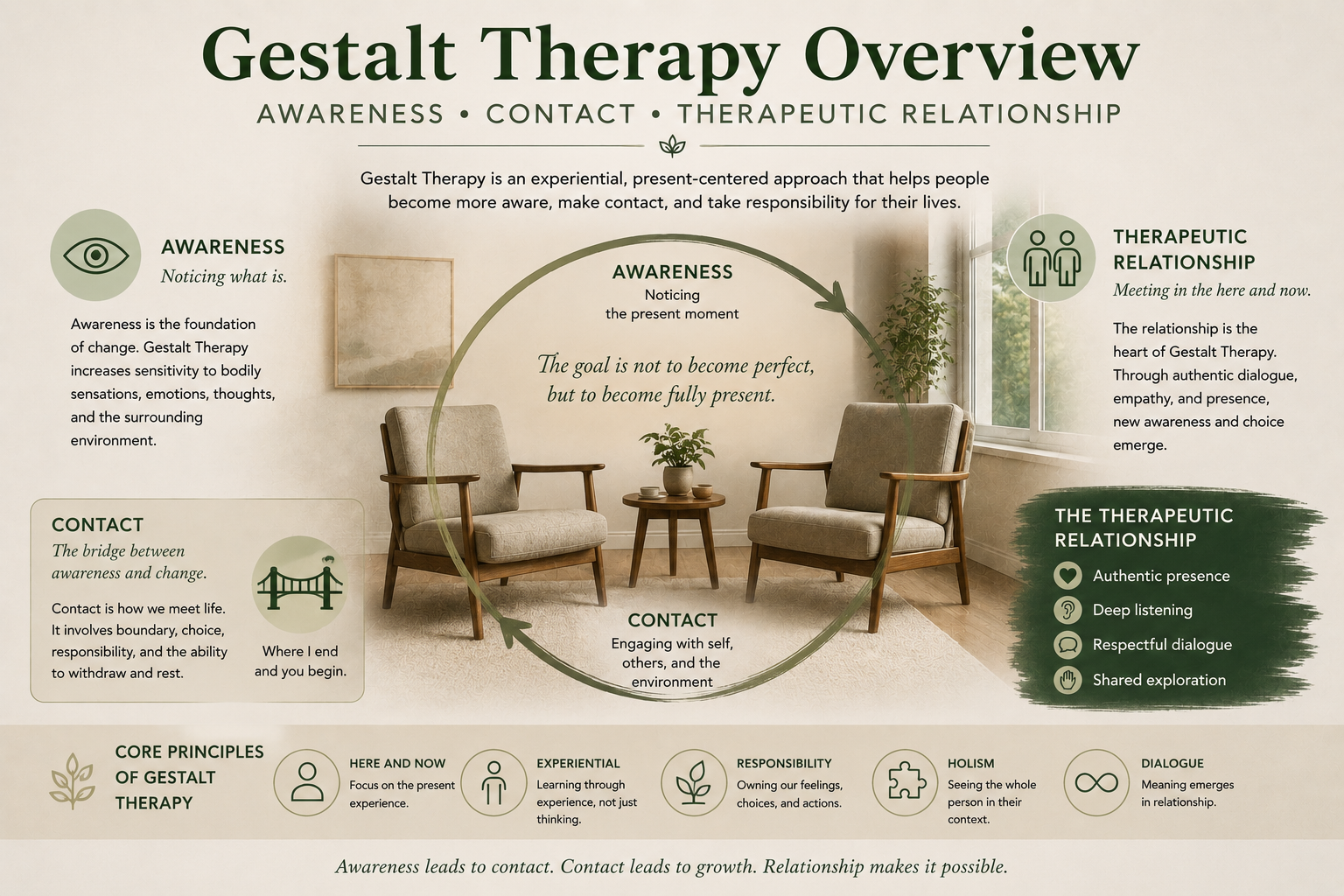
Gestalt therapy is an evidence-supported humanistic psychotherapy that places present-moment awareness, embodied experience, and genuine therapeutic relationship at the centre of psychological change. Developed in the 1940s and 1950s by Fritz Perls, Laura Perls, and Paul Goodman, it draws on phenomenological philosophy, field theory, and existential thought to offer a framework for understanding and addressing the full range of human psychological experience — one that has continued to develop and deepen over seventy years of clinical practice and research.
GestaltReview.com · Foundational Overview · Gestalt Therapy Explained
Gestalt Therapy: An Overview What It Is, Where It Came From, How It Works, and What the Evidence Shows
A comprehensive introduction to Gestalt therapy — its history, theoretical foundations, clinical practice, and current evidence — for students, clinicians, and anyone wanting to understand what Gestalt therapy actually is.
Introduction
Gestalt therapy is one of the most distinctive and intellectually rich traditions in contemporary psychotherapy — yet it is also one of the most frequently misunderstood. Ask someone what they know about it and you may hear about the "empty chair," about Fritz Perls' confrontational style in the Esalen workshops of the 1960s, about shouting at cushions, or about some vague emphasis on "the now." These impressions, though not without basis in history, bear about as much resemblance to contemporary Gestalt therapy as a 1960s encounter group bears to a modern CBT clinic.
Gestalt therapy today is a sophisticated, theoretically grounded, evidence-informed approach to psychotherapy. It has been developed and refined across seventy years of clinical practice, theoretical elaboration, and — more recently — empirical research. It is taught in accredited training programmes on every continent, practised by thousands of clinicians worldwide, and is generating an increasingly robust evidence base that places it alongside other well-established humanistic and experiential therapies.
This article provides a comprehensive introduction to Gestalt therapy: what it is, where it came from, what its central concepts mean, how it works in clinical practice, how it has evolved, and what the current research evidence shows. It is written for students, clinicians, researchers, and anyone seeking a clear, honest, and thorough account of one of psychotherapy's most generative traditions.
What Is Gestalt Therapy? A Brief Definition
Gestalt therapy is a humanistic, phenomenological, and relational psychotherapy that places present-moment awareness, embodied experience, and the quality of the therapeutic relationship at the centre of psychological change. It understands psychological distress not primarily as a collection of symptoms caused by internal pathology but as a disruption of the person's capacity for genuine, present-moment contact with their own experience and with the people and situations that constitute their world.
The foundational assumption is straightforward, though its implications are far-reaching: awareness — the quality of a person's contact with their own present experience — is itself therapeutic. When a person is genuinely aware of what they are feeling, sensing, wanting, and doing in the present moment, the organism's natural self-regulatory capacity tends to move them toward what they need and away from what is harmful. Most psychological difficulties arise, in Gestalt therapy's account, from the ways in which people have learned to interrupt, manage, or avoid their own present-moment experience — often for good historical reasons, as intelligent adaptations to environments that did not support full awareness or genuine contact.
Gestalt therapy therefore does not work primarily by explaining a person's history to them, by challenging and replacing their cognitions, or by prescribing behaviour change. It works by creating the conditions — through the therapeutic relationship, through phenomenological inquiry, through experiential experiments — in which genuine, present-moment, embodied awareness becomes available, and through which the person's own self-regulatory wisdom can guide movement toward wellbeing.
What Does "Gestalt" Mean?
"Gestalt" is a German word with no exact English equivalent. It is most often translated as "whole," "form," "configuration," or "organised pattern." The key insight the word points to is this: the whole is different from the sum of its parts. A melody is not simply a sequence of notes — it is an organised pattern that gives each note its meaning through its relationship to the others. Remove one note, change its position, or play them in a different order, and you no longer have the same melody, even if you have the same notes. The melody is the gestalt — the organised whole whose properties cannot be reduced to its components.
This insight, developed by the Gestalt psychologists of the early twentieth century, has deep implications for how Gestalt therapy understands persons. A human being is not a collection of psychological components — cognitions, behaviours, emotions, bodily states — each operating independently and each best understood in isolation. A human being is an organised whole whose functioning can only be understood in relation to the total context — the field — in which it occurs. This anti-reductionist, holistic orientation runs through every aspect of Gestalt therapy's theory and practice.
It is worth noting at the outset that Gestalt psychology — the perceptual science of Wertheimer, Köhler, and Koffka — and Gestalt therapy are historically related but not the same thing. Gestalt therapy borrowed the name and several key concepts from Gestalt psychology, but it is not a direct application of it. For a detailed account of this relationship, see our article on Gestalt Psychology vs Gestalt Therapy.
Historical Origins and the Founders
Gestalt therapy emerged in the late 1940s and early 1950s from the collaboration of three remarkable figures, each bringing a distinctive intellectual tradition to the enterprise.
Fritz Perls
1893 – 1970
Psychiatrist and psychoanalyst, trained with Wilhelm Reich. Primary clinical innovator and public face of Gestalt therapy. His demonstrations at Esalen made Gestalt internationally visible — and also generated the dramatic, confrontational image that contemporary Gestalt has substantially revised.
Laura Perls
1905 – 1990
Psychologist and philosopher trained directly in phenomenology and existential philosophy. Less publicly visible than Fritz but equally foundational. Her orientation toward relational depth, support, and contact gave Gestalt therapy much of its dialogical character — and provides a direct counterweight to Fritz's more confrontational style.
Paul Goodman
1911 – 1972
Writer, anarchist philosopher, and social critic. Author of the central theoretical section of the 1951 foundational text. His organism-environment field ontology — the understanding that organism and environment are not separate entities but poles of a unified dynamic whole — gave Gestalt therapy its theoretical depth and its political dimension.
The three collaborated on the foundational text, Gestalt Therapy: Excitement and Growth in the Human Personality (1951), which remains one of the most intellectually rich and demanding texts in psychotherapy's history. The book's first part consists of a series of awareness experiments inviting the reader to discover the therapy's key insights experientially; its second part provides the theoretical grounding. Read more about the founders in our dedicated articles on Fritz Perls and Paul Goodman.
The intellectual genealogy of Gestalt therapy includes: psychoanalysis (from which Perls departed critically but productively); Wilhelm Reich's body-centred character analysis; Kurt Goldstein's holistic neurology of the organism; Gestalt psychology's account of organised perceptual experience; Edmund Husserl's and Maurice Merleau-Ponty's phenomenological philosophy; Martin Buber's existential philosophy of dialogue and the I-Thou relation; and Kurt Lewin's field theory.
The Three Pillars: Phenomenology, Existential Philosophy, and Field Theory
Contemporary Gestalt therapy is built on three interlocking philosophical foundations — what Robert Resnick has described as the tripod of Gestalt therapy's theoretical support. Paruzel-Czachura and colleagues (2020) confirm this tripartite structure in their review of Gestalt terminology across seventy years of practice, identifying phenomenological method, field theory, and dialogue as the foundational pillars.
Phenomenology
Phenomenology, as developed by Husserl and extended by Merleau-Ponty, is the philosophical discipline of describing experience as it actually presents itself in its first-person, lived form — prior to theoretical interpretation, prior to scientific explanation, prior to the assumptions that usually filter our encounter with what is actually present. In clinical practice, phenomenological method involves the therapist setting aside their preconceptions and theories about what a client's experience must mean, and attending with genuine curiosity to what is actually there — what the client is actually seeing, feeling, sensing, and doing — in this present moment. The phenomenological inquiry begins not with "what does this mean?" but with "what is this, as it is actually experienced?"
This philosophical commitment generates Gestalt therapy's distinctive clinical question: not "why are you feeling this?" but "what are you noticing right now, as you feel this?" The difference is not merely stylistic. It reflects the foundational conviction that direct, present-moment contact with one's own experience — supported by the therapist's genuine, curious, non-interpretive attention — is itself therapeutic, in ways that explanation and interpretation alone are not.
Existential Philosophy and Dialogue
The existential philosophy informing Gestalt therapy draws most directly on Martin Buber's distinction between I-Thou and I-It relating. In I-Thou relating — genuine, present-moment, mutually affecting encounter — the other is met as a full subject rather than as an object to be analysed, managed, or used. In I-It relating, the other becomes an object: observed, categorised, explained, but not genuinely met. Buber held that genuine human being occurs in dialogue — in the quality of genuine meeting between persons — rather than in the isolated individual.
This philosophical commitment shapes Gestalt therapy's understanding of the therapeutic relationship: not as a technical alliance established to deliver an intervention, but as a genuine encounter between two persons — one of whom brings professional skill and theoretical knowledge, and both of whom are genuinely present and genuinely affected by the meeting. The therapist is not a neutral, blank-screen expert but a genuinely present, responsive, embodied person whose own presence is an active clinical instrument.
Field Theory
Field theory — developed by Kurt Lewin in social psychology and adapted by Goodman and the Gestalt therapy founders into a comprehensive organism-environment ontology — insists that the organism and its environment are not separate entities that subsequently interact, but constitutive poles of a unified dynamic field. There is no organism apart from an environment, and no environment apart from the organisms that constitute and respond to it. The field is always already a relational whole.
For Gestalt therapy, this field-theoretic orientation means that psychological functioning cannot be adequately understood by looking at the isolated individual. A person's characteristic ways of organising their experience, managing their contact boundary, and relating to others are always field phenomena — shaped by the relational, social, cultural, and environmental contexts in which they developed and currently occur. Francesetti and colleagues (2020) describe field theory as the conceptual framework that allows Gestalt therapists to modulate their presence in clinical practice — attending to what is occurring in the shared relational field of the therapeutic encounter, rather than treating the client as an isolated object of study. For a full account, see our article on Field Theory and Dialogue in Gestalt Therapy.
Core Theoretical Concepts
How Gestalt Therapy Works
The paradoxical theory of change — that genuine awareness of what is actually present, rather than effort toward what should be — is the primary mechanism of therapeutic change, has significant clinical implications. It means that Gestalt therapy does not pursue symptom reduction as its direct target; it pursues the expansion of genuine awareness and contact, trusting that the organism's own self-regulatory wisdom, restored to fuller functioning, will move the person toward wellbeing.
In practice, this means that the Gestalt therapist's primary orientation is phenomenological: they are genuinely curious about what is actually happening in the client's present-moment experience, and they direct their attention — and invite the client's attention — toward what is actually present rather than toward explanation, interpretation, or history. The question "what are you noticing right now?" is asked with genuine curiosity, not as a technique.
Sønderland and colleagues' (2023) systematic review and meta-analysis of emotional change processes in psychotherapy found that "experiencing in psychotherapy" — depth of emotional processing, the quality of contact with one's own present emotional experience — predicted therapy outcomes for depression with a correlation of r = 0.44. This finding, from a broad psychotherapy research tradition, directly supports what Gestalt therapy holds clinically: that the depth and quality of in-session contact with one's own experience is a primary mechanism of change, not merely a stylistic feature of humanistic approaches.
The therapeutic relationship — the quality of genuine encounter between therapist and client — is not simply the context within which technique is delivered. It is itself the primary medium of change. Baier and colleagues' (2020) systematic review found that therapeutic alliance mediated therapeutic outcomes in 70.3% of studies examined, establishing alliance as a genuine mechanism of change rather than merely a correlate of it. For Gestalt therapy, which has always positioned the quality of genuine relational contact as central to its theory of change, this research provides important empirical grounding for a theoretical commitment that long predated its investigation.
Common Techniques and Methods
Gestalt therapy does not primarily operate through techniques. Its methods are better understood as experimental invitations — opportunities to try something different in the present moment and notice what becomes available — grounded in the therapeutic relationship and guided by phenomenological inquiry. Paruzel-Czachura and colleagues (2020) make this point clearly: using techniques alone is not equivalent to conducting Gestalt therapy; the necessary conditions are contact with a holistically perceived client, awareness (including bodily awareness), and working in the present moment. The techniques serve these conditions; they do not replace them.
The Empty Chair Technique
Gestalt therapy's best-known clinical method: an empty chair or a second chair is used to represent an absent person, a part of the self, or a dream figure, with the client engaging in present-tense dialogue across the chairs. The physical movement between chairs supports the psychological movement between identified positions, facilitating access to material that purely verbal dialogue does not reliably reach. Geniola and colleagues (2025) summarise a recent meta-analysis by Pascual-Leone and Baher (2023) showing that chairwork, when used across multiple sessions, accumulates a significant effect (d = 0.40) compared to treatments that do not use it. For a full account, see our article on The Empty Chair Technique in Gestalt Therapy.
Dream Work
Gestalt therapy approaches dreams not through symbolic interpretation but through direct enactment: the dreamer retells the dream in the present tense, then becomes — in turn — each figure, object, and atmosphere in the dream, speaking and acting from that position. The dream is understood as a projection of the dreamer's own experience, with every element representing a disowned aspect of self available for re-integration through enacted dialogue. For a full account, see our article on Dream Work in Gestalt Therapy.
Embodied Awareness and Somatic Tracking
The Gestalt therapist attends continuously to the client's body — posture, breath, gesture, voice quality, movement — as primary clinical data. Questions like "what are you noticing in your body right now?" direct the client toward interoceptive awareness, accessing material that verbal narration alone frequently does not reach. See our article on Embodied Awareness and the Body in Gestalt Therapy.
Experiments
Gestalt experiments are specific invitations to try something different in the present moment — to exaggerate a gesture, to give voice to an impulse that has been arrested, to change posture and notice what shifts, to address an absent person directly rather than describing them. They are offered, not prescribed, and the client's freedom to modify, refuse, or end any experiment is foundational to the ethical conduct of the work.
Phenomenological Inquiry
The primary clinical orientation: attending carefully to what is actually present in the client's experience — what is figural, what is in the ground, what is being said and what is being managed — with genuine curiosity and without premature interpretation. "What are you noticing right now?" is a phenomenological question. "Your tense shoulders suggest you're anxious about your mother" is an interpretation. The former invites the client toward their own direct knowing; the latter substitutes the therapist's account for it.
How Gestalt Therapy Differs from Other Approaches
Applications of Gestalt Therapy
Gestalt therapy has been applied across a broad range of clinical presentations, populations, and settings. Elliott and colleagues' (2020) updated meta-analysis of humanistic-experiential psychotherapies — which includes Gestalt therapy alongside person-centred and emotion-focused approaches — found that HEPs are particularly effective with relationship and interpersonal difficulties, self-damaging activities, and coping with chronic medical conditions. Results were more mixed for depression and anxiety, though positive outcomes were reported across these domains too.
Clinical applications include depression; anxiety disorders; trauma and PTSD; attachment and relational difficulties; shame and self-esteem; couples and relationship counselling; child and adolescent mental health (through the Violet Oaklander model); group therapy; grief and loss; addiction recovery; burnout and occupational stress; psychosomatic difficulties; and existential and life transition concerns. Gestalt therapy is also used in coaching, organisational development, and supervision.
For a comprehensive account of applications, evidence, strengths, and limitations across each domain, see our article on Applications of Gestalt Therapy.
Trauma-Informed Gestalt Therapy
Trauma is one of the domains where Gestalt therapy's embodied, relational, present-centred approach has the most distinctive clinical contribution to offer. The understanding of trauma not primarily as a memory to be processed but as a persisting reorganisation of the organism-environment field — a lasting change in how the person organises their contact with their world — is both theoretically distinctive and clinically productive.
Gestalt therapy addresses trauma through embodied awareness, careful titration of contact with overwhelming material within the window of tolerance, the co-regulatory safety of the therapeutic relationship, and the gradual restoration of the organism's capacity for genuine contact with experience it has been organised to avoid. The approach has particular relevance for complex developmental trauma, pre-verbal trauma, and relational trauma — presentations where purely verbal, exposure-based, or cognitively focused approaches may have limited reach.
For a full account of trauma-informed Gestalt practice and its evidence base, see our article on Gestalt Therapy and Trauma.
Gestalt Therapy and Neuroscience
Contemporary neuroscience — particularly research on interoception, predictive processing, attachment neurobiology, and the default mode network — is increasingly converging with Gestalt therapy's foundational clinical commitments. The finding that interoceptive awareness (the sensing of internal bodily states) is foundational to emotional regulation and self-experience; the predictive processing account of how the brain generates and updates its models of the causes of experience; and the interpersonal neurobiology understanding that mind and self are constituted relationally — all provide biological grounding for clinical practices that Gestalt therapy developed independently, on phenomenological and clinical grounds, over seventy years ago.
Cannavò and colleagues (2025), in a recent paper on Gestalt therapy's approach to psychosomatic disorders, describe the approach's "relational and intersubjective body work, focusing on mind-body holism and biopsychosocial integration" as directly consistent with contemporary neuroscientific understanding of how somatic and psychological experience are constitutively linked. This convergence is genuine and significant — though the honest account also notes that direct neuroimaging research on Gestalt-specific techniques remains essentially absent. For a full account, see our article on Gestalt Therapy and Neuroscience.
Gestalt Therapy and Mindfulness
The relationship between Gestalt therapy and mindfulness is one of substantive convergence and genuine difference. Both traditions share a commitment to present-moment, non-judgmental, embodied awareness as therapeutically central. Both are sceptical of purely verbal, cognitively mediated approaches. Both have arrived at the conclusion that direct contact with present experience — rather than explanation, narrative, or analysis — is the primary vehicle of change.
The differences are equally real. Gestalt therapy is relational and field-theoretic: it understands awareness as always already relational, occurring at the contact boundary between organism and environment, shaped by the quality of genuine encounter rather than cultivable through solitary practice alone. Mindfulness, in its primary MBSR and MBCT clinical forms, is oriented toward the individual cultivation of attentional and acceptance skills — valuable and well-evidenced, but addressing a different dimension of experience than the dialogical meeting that Gestalt therapy holds to be foundational. Gestalt therapy also predates MBSR by three decades, having developed its own account of present-moment awareness as therapeutic mechanism independently from the Buddhist contemplative traditions that informed Kabat-Zinn's work. For a full comparative account, see our article on Gestalt and Mindfulness: Parallel Paths to Presence.
Current Research Evidence
The research evidence for Gestalt therapy is growing, though it remains smaller and less methodologically uniform than the evidence base for CBT-based approaches. Intellectual honesty requires presenting this evidence clearly — including both what it supports and what remains to be established.
What the Evidence Currently Shows
Elliott and colleagues' (2020) meta-analysis of 91 humanistic-experiential psychotherapy studies found large pre-post client change (d = 0.86), large gains relative to no-therapy (d = 0.88), and statistical equivalence to other therapies in comparative studies. HEPs were identified as particularly effective for relationship difficulties and self-damaging activities. Raffagnino's (2019) systematic review of Gestalt-specific studies identified 11 peer-reviewed studies all reporting significant positive outcomes across group therapy, self-esteem, wellbeing, and emotional functioning.
The Italian CORE-OM outcome project (La Rosa et al., 2019) — using a widely validated clinical outcome measure across clients receiving Gestalt therapy within two major Italian Gestalt organisations — found effectiveness comparable to studies conducted in other countries with different therapeutic modalities. Duffy and colleagues' (2023) meta-analysis of humanistic-experiential therapies for depression found that HEPs significantly outperformed treatment-as-usual at post-treatment and were comparable to active alternatives. Kamal and colleagues' (2025) quasi-experimental study found significant improvements in self-perception and eudaimonic wellbeing in breast cancer patients receiving Gestalt therapy versus controls.
Kaisler and colleagues' (2025) interpretative phenomenological analysis of clients' experiences of Gestalt therapy found that emotional and relational growth consistently occurred — though deeper structural transformation in personality functioning was more limited — and that tailoring therapeutic approach to the client's level of personality integration was identified as important for outcome.
For the most comprehensive account of the Gestalt therapy evidence base — including what it can and cannot currently claim — see our article on the Gestalt Therapy Research and Evidence Base.
Strengths of Gestalt Therapy
Relational depth and genuine encounter. Gestalt therapy's commitment to the therapeutic relationship as primary medium — not simply supportive backdrop — generates a quality of genuine, attuned, person-to-person contact that is particularly valuable for presentations where relational history is central to the difficulty.
Embodied, trans-diagnostic access. The phenomenological, body-centred approach reaches material — somatic, emotional, pre-verbal — that purely verbal or cognitively mediated approaches frequently cannot. This is clinically significant across presentations where somatic holding of psychological experience is prominent.
Non-pathologising framework. Understanding difficulties as creative adjustments rather than disorders or deficits — as intelligent responses to specific field conditions — supports genuine clinical respect for the person's experience and avoids the shame-reinforcing effects of diagnostic frameworks that locate the problem firmly inside the individual.
Trans-diagnostic flexibility. Because Gestalt therapy targets awareness and contact rather than disorder-specific symptoms, it is inherently adaptable across presenting concerns without requiring disorder-specific protocols. This makes it particularly suited to the complex, comorbid presentations that are the norm in clinical practice rather than the exception.
The paradoxical theory of change. The recognition that genuine awareness of what is — rather than effort toward what should be — generates change more reliably than direct attempts to produce change reduces the therapeutic encounter's characteristic power dynamics and positions the client's own experience as the authority.
Common Criticisms and Limitations
Honest Limitations
Evidence base gap. Gestalt therapy's evidence base, while growing positively, remains smaller and less methodologically rigorous than CBT's. Clinicians, trainees, and clients deserve honest communication about this gap — it reflects research investment patterns and methodological challenges more than clinical effectiveness, but it is a real limitation for practice contexts requiring evidence-based justification.
Resistance to manualisaton. The relational, phenomenological, moment-to-moment responsive character of Gestalt therapy makes it inherently difficult to manualize and therefore difficult to investigate through standard RCT methodologies. This is not straightforwardly a failure but it does create evidentiary challenges.
Historical misrepresentation. Fritz Perls' dramatic, often confrontational demonstration style at Esalen created an impression of Gestalt therapy that does not represent the field's theoretical foundations or its contemporary practice — but that impression persists in some clinical and public contexts and requires active correction.
Training variability. The quality of Gestalt therapy training varies considerably across training institutions and national contexts. The absence of a single governing body for international Gestalt therapy standards means that significant variation exists in what practitioners are actually trained to do — which complicates research and creates quality assurance challenges.
Misconceptions About Gestalt Therapy
"Gestalt therapy means shouting at an empty chair." The empty chair is one technique among many, and its dramatic presentation in Perls' Esalen demonstrations does not represent how it is used in contemporary clinical practice — which is collaborative, carefully paced, and employed within a grounded therapeutic relationship rather than as spectacle.
"Gestalt therapy is just about expressing feelings." Emotional expression is one dimension of Gestalt work, but it is neither its only dimension nor its goal. The aim is awareness — which may involve approaching avoided feelings, but equally may involve attending to cognitive patterns, relational dynamics, somatic experience, or existential concerns. Emotional expression is a by-product of awareness, not its purpose.
"Gestalt therapy ignores the past." Gestalt therapy works in the present — but the past is always present in the person's current patterns of awareness, contact, and self-regulation. The question is not whether the past matters but how it is worked with: through the present-moment residue it leaves in current experience, not through historical reconstruction as the primary mode of clinical work.
"Gestalt therapy is the same as mindfulness." Both cultivate present-moment awareness, but the theoretical frameworks, clinical methods, and understanding of what change requires are genuinely different. Gestalt therapy's relational, field-theoretic, dialogical approach is not equivalent to the individual attentional practice of mindfulness, and treating them as equivalent obscures what each tradition has to offer.
"Gestalt therapy has no evidence base." This was more defensible twenty years ago than it is today. A growing body of research supports Gestalt therapy's effectiveness, its mechanisms of change align with what process research across therapies identifies as active ingredients, and the broader humanistic-experiential evidence base provides converging support across many domains.
How Contemporary Gestalt Therapy Has Evolved
Contemporary Gestalt therapy looks significantly different from the Perlsian approach of the 1960s demonstrations, and the differences represent genuine theoretical development rather than simply a softening of technique.
The relational turn — the progressive development of an understanding of therapeutic change as occurring within and through the relational field of the therapeutic encounter, not simply through the therapist's technique applied to the client — has transformed both theory and practice. Hosemans (2021) conducted interpretative phenomenological analysis with eight clients who had participated in extended Gestalt therapy, finding three main themes describing the relational experience: embodiment, the "in-between" space of the therapeutic encounter, and the development of awareness. Crucially, the study found that awareness developed specifically through increased relationality — supporting the theoretical claim that the quality of genuine encounter is not separate from but constitutive of therapeutic awareness.
The integration of contemporary attachment and developmental research has enriched understanding of how contact disturbances originate and why they persist, providing developmental and relational context for the clinical phenomena Gestalt therapy observed and addressed.
The development of trauma-informed approaches — incorporating somatic experiencing, polyvagal theory, and window-of-tolerance principles — has significantly refined how Gestalt therapy approaches traumatic presentations, replacing the early, sometimes confrontational style with carefully titrated, relationally grounded, body-centred work.
The growth of Gestalt therapy research methodology — including Spagnuolo Lobb's (2024) development of a phenomenological, aesthetic, field-oriented research framework specifically suited to Gestalt therapy's epistemological commitments — represents a significant methodological advance. Rather than simply adapting RCT methodology from a CBT context, this framework develops research approaches that are congruent with Gestalt therapy's own understanding of what is happening in therapy and how it can be studied.
For the full account of how systems thinking and field theory inform contemporary Gestalt practice, see our article on Gestalt Therapy and Systems Thinking.
Who Might Benefit from Gestalt Therapy?
Gestalt therapy is particularly suited to people who want to understand and change not just their symptoms but their underlying patterns — the characteristic ways they organise their experience, manage their contact with others, and relate to themselves. Its strengths are most clearly expressed in presentations where relational patterns are central, where somatic and emotional dimensions of experience are important, where the therapeutic relationship itself is expected to be a primary vehicle of change, and where the presenting concern is complex, chronic, or not fitting neatly into a diagnostic category.
People who are curious, reflective, and willing to explore their experience directly tend to find Gestalt therapy's experiential approach engaging. So do people whose difficulties are primarily relational — in intimacy, in professional relationships, in the relationship with themselves. People who have found purely cognitive approaches insufficient — who can understand their patterns intellectually without that understanding producing genuine change — may find Gestalt therapy's embodied, experiential orientation provides access to a different level of their experience.
Gestalt therapy is not the automatic first choice for every presentation. For specific, circumscribed symptom presentations where exposure-based or cognitively targeted protocols have the strongest evidence — specific phobias, OCD, some anxiety disorders — other approaches may be more efficient. The most useful question is not "is Gestalt therapy better than other approaches?" but "for this person, with this presentation, in this context, what approach is most likely to provide what they most need?"
Conclusion
Gestalt therapy is, at its core, an invitation. An invitation to pay attention — genuinely, curiously, without the habitual rush to explain or fix — to what is actually present in this moment: in the body, in the relational field, in the space between what is being said and what is being felt. It is an invitation to discover, through direct experience rather than through instruction, that this quality of genuine attention tends to generate movement — toward what is needed, away from what is not, in the direction of a more grounded, more contact-full, more genuinely self-regulating way of being in the world.
This apparently simple orientation — awareness as the primary vehicle of change — turns out to have profound theoretical implications, rich clinical applications, and a growing body of research support. It generates a distinctive approach to the therapeutic relationship, to the body, to trauma, to creativity, to the social and relational field within which all human experience occurs. And it continues to develop, seventy years after the foundational text was written, as a living tradition engaged with contemporary clinical challenges, neuroscientific developments, and the ongoing project of understanding what genuinely helps human beings grow.
GestaltReview is dedicated to that project. The articles linked throughout this overview — and the many more available across the site — offer deeper exploration of every dimension of Gestalt theory and practice that this overview has introduced. We invite you to explore further.