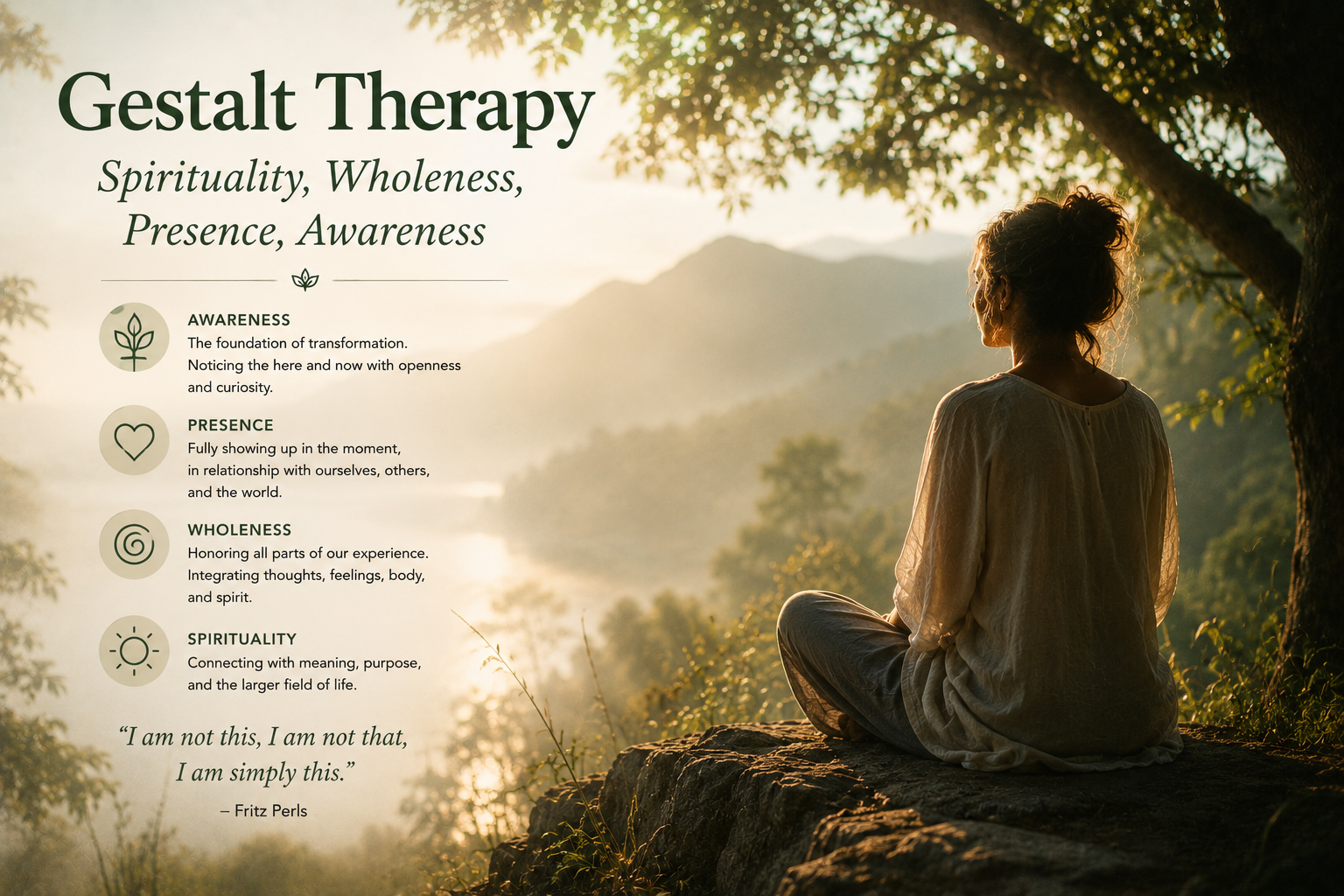
Gestalt therapy has engaged with spirituality as part of its understanding of the whole person since its earliest foundations — drawing on Zen Buddhism, Taoism, existential philosophy, and Eastern thought from the very beginning, and positioning awareness, contact, and the organism-environment field as concepts that naturally accommodate the dimensions of experience that both clinicians and clients describe as spiritual. This is not a fringe position within Gestalt theory; it is built into its philosophical architecture.
GestaltReview.com · Theory & Contemporary Contexts · Spirituality
Gestalt Therapy and Spirituality Wholeness, Presence, and the Deeper Dimensions of Awareness
What Gestalt therapy's theoretical framework offers as a way of understanding spiritual experience — from its historical roots in Eastern philosophy to the contemporary research on synchronicity, inter-brain resonance, and the boundaries of the organism-environment field.
Introduction: Psyche and Soul
The word psychology contains, embedded in its Greek roots, a term it has spent most of its history trying to ignore: psyche, which meant, before it meant mind or self, the soul. The discipline that emerged from the Enlightenment's drive to make the study of human inner life scientifically respectable largely set aside the soul — its unprovability, its resistance to quantification, its refusal to fit within the mechanistic frameworks that science found most productive. What remained was the mind, then the brain, and finally the neural correlate of the specific cognition or emotion being studied.
Gestalt therapy, emerging in the mid-twentieth century from a very different intellectual lineage, never fully accepted this reduction. From its earliest formulations, it insisted on attending to the whole person — not the cognitive person, not the behavioural person, not even primarily the emotional person, but the organism in full: sensing, feeling, perceiving, relating, and — for many people and in many moments of genuine therapeutic depth — experiencing something that they can only describe in terms that sound, to scientifically cautious ears, spiritual.
This article examines what Gestalt therapy's theoretical architecture actually offers as a way of understanding spiritual experience — not by simply baptising everything spiritual that happens in the therapy room, but by examining carefully how the approach's foundational concepts relate to what both clinicians and clients recognise as the deeper dimensions of awareness, connection, and meaning that genuine therapeutic depth sometimes reaches.
The Historical Connection: Gestalt Therapy and Eastern Philosophy
The influence of Eastern philosophy on Gestalt therapy is not a later development or a peripheral addition to the approach — it is woven into its foundational intellectual fabric. Boyalı (2022), in the most comprehensive recent account of Gestalt therapy's view of spirituality, identifies Eastern religions and spirituality among the explicit influences on Gestalt therapy's development alongside psychoanalysis, Gestalt psychology, existential philosophy, phenomenology, field theory, and psychodrama. This is not an external retrospective association; it reflects what the founders themselves drew on.
Fritz Perls' engagement with Zen Buddhism is the most documented of these connections. He spent time studying Zen directly in Japan, and his later clinical demonstrations at Esalen — with their emphasis on immediate, present-moment experience over historical analysis, their suspicion of conceptual overlay, and their trust in the organism's own wisdom over the therapist's interpretive authority — carry visible Zen influences. Steggles and colleagues' (1983) bibliography of Gestalt therapy and Eastern philosophies, covering 52 items published between 1947 and 1979 alone, establishes that this connection has been a sustained theme in the Gestalt literature for as long as the approach has existed.
Pereira (2021), writing in a Brazilian Gestalt-therapy phenomenological journal, traces these connections carefully: "Gestalt therapy emerges amidst the dialogue of Western sciences with various oriental influences," he notes, situating the approach at a cultural crossroads where Western scientific and clinical traditions were in genuine dialogue with Buddhist psychology, Taoist philosophy, and the contemplative traditions that the postwar interest in Eastern thought made newly available to Western intellectuals. His paper specifically examines the interface between Gestalt and Zen Buddhism, concluding that "meditation and Gestalt therapy are distinct paths, but some likenesses denote the possibility of these methodologies being complementary to one another for personal development."
Laura Perls' influences were different but equally relevant: her formation in existential philosophy and her engagement with the thought of Martin Buber — whose I-Thou philosophy carries a deeply spiritual dimension in its insistence that genuine meeting between persons participates in something larger than either person alone — gave Gestalt therapy a dialogical philosophy with explicit spiritual resonances. Paul Goodman's anarchist humanism carried its own quasi-spiritual dimension: a trust in the organism's natural wisdom, a hostility to institutional constraint, and an insistence on genuine creative freedom that has parallels in Taoist and anarchist spirituality alike.
How Gestalt Theory Accommodates Spiritual Experience
Gestalt therapy does not need to borrow spiritual categories from outside itself in order to accommodate the dimensions of experience that clients describe as spiritual. Its own foundational concepts are already capacious enough — because they were designed to encompass the whole person rather than a theoretically manageable subset of human experience.
The Organism-Environment Field and the Dissolution of Boundaries
The organism-environment field framework — Paul Goodman's most fundamental contribution to Gestalt theory — insists that organism and environment are not separable entities but constitutive poles of a unified dynamic whole. Experience does not happen inside the organism or outside in the environment but at the contact boundary between them. This is a philosophically radical position, and one of its implications is precisely that the boundary between self and world is not fixed, not absolute, and not the final word on where experience occurs.
Many of the experiences that people describe as spiritual — a sense of expanded boundary, of connection to something larger than the individual self, of participation in a field that extends beyond the skin — fit naturally within a framework that has always held the boundary between organism and environment to be dynamic, permeable, and constituted anew in every moment of genuine contact. What the Cartesian framework treats as the impermissible dissolution of a fixed boundary between inside and outside is, for Gestalt theory, simply a variation in how the contact boundary is constituted — one that certain conditions, including deep therapeutic work, naturally facilitate.
Wholeness as a Spiritual and Therapeutic Category
Boyalı (2022) identifies "wholeness" as the point of deepest convergence between Gestalt therapy and spirituality. Gestalt therapy "evaluates the client as a whole on the premise that the whole is not the sum of its parts, but rather the fine coordination of all of them." This holistic framework is not merely a theoretical preference but a commitment to including everything that constitutes a person's actual experience — including, as Boyalı explicitly argues, their spiritual and religious dimensions.
Spirituality within the Organism-Environment Field
When a client experiences a sense of transcendence, of profound connectedness, of contact with something larger than themselves — whether in prayer, meditation, nature, or in moments of deep therapeutic encounter — Gestalt therapy's framework does not require this experience to be explained away as projection, regression, or cognitive distortion. It can be understood as a specific mode of contact at the organism-environment boundary: one in which the usual degree of differentiation between organism and environment is reduced, and the experience of participation in a larger field becomes figural. This is not mysticism dressed in clinical language; it is an honest application of Gestalt's own foundational framework to experiences that framework is actually equipped to accommodate.
Greene (2024), in a British Gestalt Journal literature review of contemporary spirituality within Gestalt therapy and wider psychotherapy, identifies "definitional barriers" as one of the main obstacles to productive engagement between therapy and spirituality — the way that both fields erect terminological walls that make dialogue difficult. Her paper argues that Gestalt therapy is particularly well placed to offer "a 'way out' of the restrictive binaries of traditional either/or thinking" — the binary between spiritual and psychological, between transcendent and immanent, between subjective experience and clinical evidence. The Gestalt both/and orientation — the capacity to hold apparent opposites as parts of a larger pattern — is as relevant here as anywhere in clinical theory.
Awareness, Meditation, and the Here and Now
The convergence between Gestalt therapy's emphasis on present-moment, non-judgmental awareness and the contemplative traditions' cultivation of the same quality of attention is one of the most substantive and most studied connections between Gestalt therapy and spiritual practice. It is not coincidental — the founders drew directly on Zen and Taoist traditions in articulating what they meant by awareness, and the contemplative traditions drew on decades of practice in developing precisely the quality of present-moment attending that Gestalt therapy holds to be its primary therapeutic mechanism.
Mendonça and colleagues (2023), in a recent examination of the relationship between Gestalt therapy, mundane phenomenology, and yoga philosophy, propose that yoga offers Gestalt therapy and phenomenology "a broader perspective on contemplative somatic praxis" — and that conversely, phenomenology and the Gestalt approach "can provide solid ground for an articulation with Yoga philosophy." This is not a claim that Gestalt therapy and yoga are the same thing, but a recognition that both are sophisticated contemplative and somatic practices oriented toward the deepening of present-moment, embodied awareness — and that they have substantive things to offer each other.
For long-term Gestalt therapy clients, the deepening of awareness that sustained therapeutic work supports often manifests in a growing naturalness with contemplative practice. This is theoretically predicted: if Gestalt therapy restores access to the organism's direct sensory and felt experience, and if meditation is a practice of sustained present-moment attending to exactly this quality of experience, then the two practices are not merely compatible but mutually reinforcing. One opens the territory that the other explores; both cultivate the same fundamental capacity for genuine present-moment contact with experience. For the full account of the awareness concept in Gestalt therapy, see our article on Awareness in Gestalt Therapy.
Contact, Connectedness, and the Experience of Transcendence
Contact — genuine, present-moment, embodied meeting between organism and environment or between persons — is the basic unit of Gestalt therapy's account of human experience. And contact, when it occurs fully, has a quality that transcends the ordinary: it is not the managed, defended, socially calibrated interaction that passes for connection in most of everyday life, but a genuine meeting in which both parties are genuinely present, genuinely affected, and genuinely changed by the encounter.
This quality of full contact — what the founders called confluent in the healthy sense, what Buber called I-Thou, what contemplative traditions call moments of genuine presence — is recognised across cultures and across traditions as carrying a quality that people consistently describe in terms that exceed ordinary psychological vocabulary. People speak of these moments as sacred, as grace, as touches of something larger than themselves. The Gestalt framework does not require us to take a position on the metaphysical status of these experiences — on whether they reflect genuine contact with a dimension of reality that transcends the individual organism — but it does take their phenomenological reality with complete seriousness.
"Contact, when it occurs fully, has a quality that transcends the ordinary — what Buber called I-Thou, what contemplative traditions call presence, what many people simply call the sacred."
The three defining attributes of spirituality that Weathers and colleagues (2016) identify in their concept analysis — connectedness, transcendence, and meaning in life — are, notably, not foreign to Gestalt therapy's own theoretical vocabulary. Connectedness maps directly onto the contact framework. Transcendence maps onto what happens at the contact boundary when the ordinary degree of self-other differentiation relaxes — a well-documented phenomenological event in deep therapeutic encounters. Meaning maps onto what the Gestalt contact cycle generates when it completes fully: the sense of satisfaction, wholeness, and orientation that the organism experiences when genuine need has been met in genuine contact.
Synchronicity in the Therapeutic Relationship
Among the experiences that clients and therapists sometimes describe as spiritual within psychotherapy, synchronicity — meaningful coincidence between an inner event (a thought, feeling, image, or dream) and an external event occurring simultaneously or at a later point in time — holds a particular place. These experiences are not rare curiosities confined to spiritually oriented therapeutic approaches; they are documented across mainstream clinical practice.
Research Evidence — Synchronicity in Psychotherapy
Roxburgh and colleagues' (2016) survey of 226 therapists drawn from the membership lists of the British Association for Counselling and Psychotherapy, the British Psychological Society, and the United Kingdom Council for Psychotherapy found that 44% reported experiencing synchronicity in the therapeutic setting, and 67% felt that synchronistic experiences could be useful for therapy. These are not fringe practitioners; these are mainstream clinicians from major professional bodies. The survey also found statistically significant differences between practitioner types in their interpretations of synchronistic experiences, but no differences in their perception of when such experiences were likely to occur — suggesting that the experience itself crosses theoretical orientation, while the framework for understanding it varies.
Roesler and colleagues (2021), reviewing Jungian psychotherapy's engagement with synchronicity, present an empirical study on the occurrence of synchronistic events specifically within psychotherapy sessions, documenting how therapists integrate these experiences and use them to support the therapeutic process. While Jungian psychotherapy's theoretical framework is distinct from Gestalt therapy's, the documentation of these phenomena in psychotherapy more broadly — and the finding that experienced clinicians across orientations report and work with them — establishes their presence as a real clinical phenomenon regardless of the theoretical framework used to understand them.
Russo-Netzer and colleagues (2023) validated a Synchronicity Awareness and Meaning-Detecting Scale across two studies (n = 198 and n = 440), finding that synchronicity awareness and meaning-detecting were significantly associated with meaning in life and life satisfaction. Synchronicity awareness mediated the relationship between search for meaning and meaning-detecting, and both optimism and presence of meaning in life partially mediated the relationship between meaning-detecting and life satisfaction. The implication is that the capacity to notice and find meaning in meaningful coincidences is not merely a marker of credulous or non-rational thinking but a feature of how individuals construct meaning — and that it is associated with psychological wellbeing.
How does Gestalt therapy's framework accommodate synchronistic experience? The field-theoretic account is relevant here: if organism and environment are constitutive poles of a unified field rather than separate entities that occasionally interact, then the question of whether a meaningful coincidence between an inner state and an outer event is "merely coincidence" or something more becomes somewhat different from how it appears within a framework that treats inner and outer as fundamentally separate domains. A field that is genuinely unified may generate events that appear, from a reductionist perspective, to be improbably coincidental — because the reductionist framework misses the field-level organisation that connects them. This is not a definitive account of synchronicity, and intellectual honesty requires acknowledging that — but it is a framework within which such experiences can be taken seriously rather than dismissed.
The Neuroscience of Resonance and Connection
Contemporary neuroscience has begun to document, in biological terms, aspects of the therapeutic relationship that practitioners have long described in terms that sound, to scientifically cautious ears, almost mystical: the sense of genuine meeting, of two persons somehow in contact below the level of explicit communication, of the therapist knowing something about the client that the client has not yet said. The research on inter-brain synchrony and physiological resonance provides biological grounding for experiences that might otherwise seem clinically unspeakable.
Lucherini Angeletti and colleagues' (2025) systematic review of intersubjective synchrony in psychotherapy, covering 32 studies, found that physiological synchrony between therapist and patient — measured across interoceptive and behavioural channels — was associated with therapeutic alliance and emotional resonance, with exteroproprioceptive (behavioural) synchrony particularly linked to alliance and interoexteroceptive (physiological) synchrony linked to moment-to-moment emotional experience. The implication is that therapist and client are genuinely physiologically coupled during sessions — that what happens in one person's body affects what happens in the other's, below the level of conscious awareness and intention.
Koole and Tschacher's (2016) Interpersonal Synchrony model proposes that the therapeutic alliance is "grounded in the coupling of patient and therapist's brains" — that movement synchrony helps establish inter-brain coupling, which in turn gives therapist and patient access to each other's internal states. Sened and colleagues (2022) propose inter-brain plasticity — a process by which recurring exposure to high inter-brain synchrony produces lasting changes in the capacity to synchronise — as a biological mechanism of change in psychotherapy.
For long-term therapy clients, these findings are recognisable from the inside: the sense of being understood before words have been spoken, the way the therapeutic relationship develops over years into something that feels qualitatively different from ordinary interpersonal encounters, the heightened somatic sensitivity and attunement that deep therapeutic work seems to cultivate — these are not mere subjective impressions but correspond to documented biological phenomena of increasing inter-brain and physiological coupling. What might once have been described in spiritual terms as a deepening of presence or a thinning of the boundary between persons has, in contemporary neuroscience, a biological substrate. For the fuller account of these convergences, see our article on Gestalt Therapy and Neuroscience.
Spirituality as Creative Adjustment
Within Gestalt therapy's theoretical framework, spiritual experience — the cultivation of contemplative practice, the development of a sense of connection to something larger than the individual self, the experience of meaning-making through transcendence — can be understood as a form of creative adjustment: the organism's intelligent, context-responsive engagement with the dimensions of its experience and its world that support wholeness and self-regulation.
Borges (2020), writing in a Brazilian Gestalt-therapy journal, explicitly frames spirituality as "a creative adjustment strategy" — using the same vocabulary that Gestalt therapy uses for all healthy organism-environment contact. On this account, spiritual practice and experience are not separate from the organism's natural self-regulatory intelligence but an expression of it: the organism that cultivates meditation, prayer, or other contemplative practices is doing something analogous to what the organism does when it seeks any other form of genuine contact that genuinely nourishes it.
This framing has a significant clinical implication. If a client's engagement with spiritual practice is a creative adjustment — an intelligent response to genuine needs for meaning, transcendence, and connection — then the appropriate clinical orientation is not to explain it away or to treat it as a symptom of something else, but to attend to it with the same phenomenological curiosity and respect that Gestalt therapy brings to any other dimension of the client's experience. The question is not "is this spiritual experience real?" but "what does this experience mean for this person, in this field, at this time — and how does it connect to the organism's genuine self-regulatory movement toward wholeness?"
The Gestalt Therapist and Spiritual Dimensions of Client Experience
The question of how a Gestalt therapist receives and works with a client's spiritual experience is not simply a question of theoretical framework — it is a question of the therapist's own relationship to these dimensions of experience, and of the degree to which their clinical training and personal development have prepared them to engage with the spiritual dimensions of human life without either dismissing them as mere psychology or colluding uncritically with every experience the client describes as spiritual.
Greene (2024), in her review of contemporary spirituality within Gestalt therapy, emphasises "epistemic humility" as the essential quality — the capacity to approach experiences that exceed the familiar categories of clinical theory with genuine openness rather than with the defensive certainty of either dismissal or uncritical acceptance. This epistemic humility is entirely consistent with the phenomenological stance that characterises good Gestalt clinical work more broadly: suspending premature interpretation, attending to what is actually present, and resisting the rush to categorise experience before it has been genuinely received.
Halonen and colleagues (2024), in a study of psychotherapists' interoception, found that psychotherapists showed significantly higher interoceptive awareness than their clients, with a large effect size. This finding is relevant here: the therapist's own somatic attunement — their developed capacity to receive and process the subtle signals of the therapeutic field, including their own body's responses — may be precisely the clinical instrument through which the resonance, attunement, and occasional transcendent moments of long-term therapy work become available to clinical attention. What appears spiritually to the client as a sense of being genuinely known may be, in biological terms, a consequence of a therapist whose somatic receptivity is highly developed through years of therapeutic training and personal work.
For a comprehensive account of how phenomenological inquiry operates clinically in Gestalt therapy, see our article on Phenomenology and Gestalt Therapy.
Gestalt Therapy and Other Contemplative Traditions
The relationship between Gestalt therapy and specific contemplative traditions has been explored across several traditions in the scholarly literature, with Zen Buddhism the most extensively discussed, followed by Taoism, yoga, and the Abrahamic mystical traditions.
Zen Buddhism
Pereira's (2021) account of the Gestalt-Zen interface identifies the most substantive convergences: the emphasis on present-moment experience over historical explanation; the distrust of conceptual overlay of direct experience; the trust in the organism's (or the practitioner's) own wisdom; and the use of experiential encounter — whether the therapeutic experiment or the Zen koan — as the primary vehicle of insight. He also identifies real differences: "Meditation and Gestalt therapy are distinct paths" whose complementarity requires genuine understanding of both rather than easy conflation. Zen's goal of liberation from the self as ordinarily constituted differs from Gestalt therapy's goal of the fuller engagement of the self in genuine contact — these are related but not identical visions of human flourishing.
Yoga Philosophy
Mendonça and colleagues (2023) propose a three-way dialogue between Gestalt therapy, mundane phenomenology, and yoga philosophy, finding that yoga offers "a broader perspective on contemplative somatic praxis" that enriches both the Gestalt framework and the phenomenological account of embodied experience. Their analysis identifies convergences in the treatment of embodied awareness, somatic intelligence, and the relationship between practice and insight — convergences that are theoretically grounded rather than merely superficially similar.
Taoist Thought
Taoist philosophy's concept of wu wei — effortless action, acting in accord with the natural flow of things rather than against it — has clear resonances with Gestalt therapy's paradoxical theory of change: genuine change occurs not when the person strives against their current state but when they allow themselves to be fully what they already are. The Taoist emphasis on the natural wisdom of organismic process, on the danger of excessive deliberate control, and on the value of yielding to rather than fighting the natural field conditions of one's life are all recognisable Gestalt themes.
Skorupka (2021) draws direct comparisons between Gestalt psychotherapy and both Zen Buddhism and recentivism, concluding that "philosophy and psychology should benefit from their individual achievements, but not in order to develop eclectic theories." This is an important caution: the richness of the connections between Gestalt therapy and Eastern philosophical traditions does not mean that they are equivalent, or that a Gestalt therapist is practising Zen, or that a Zen practitioner is doing Gestalt therapy. Each tradition has its own integrity, its own specific methods, and its own specific goals — and genuine respect for all of them requires maintaining these distinctions while remaining open to genuine dialogue.
The Ecological and Transpersonal Dimensions
The organism-environment field framework that constitutes Gestalt therapy's ontological foundation extends, in principle, well beyond the human-human encounters that dominate clinical practice. Skelding and colleagues (2023), in a recent British Gestalt Journal paper, examine how Gestalt theory can support the shift from an anthropocentric to an ecocentric perspective — positioning humans as "but one member of a vast ecological 'family of things'" rather than as the measure of all things. Their paper draws on the same organism-environment field concept to argue that the field is not limited to the human organism's immediate interpersonal environment but extends to the more-than-human world in which all human life is embedded.
This ecological extension of the field-theoretic framework has direct spiritual resonance: many contemplative and indigenous traditions understand the human being as embedded in a web of relationship that extends to the natural world, to ancestors, to future generations, and to dimensions of reality that exceed the individual organism. The Gestalt framework does not simply endorse all of these claims, but it does provide a theoretical architecture that is, in principle, hospitable to a much wider understanding of the field than clinical practice has typically explored.
Adams (2019), in a chapter on embodied relational Gestalt ecopsychology, argues that "alienation from our vital, sentient bodies and alienation from the rest of nature are interrelated" — and that "direct experiential attunement with our embodied (inter)existence can foster attunement with and care for the rest of nature." This is a transpersonal extension of Gestalt therapy's core commitment to embodied awareness and genuine contact: if deep contact with one's own somatic experience opens contact with the immediate human field, it may also open contact with the larger ecological field in which human life participates.
Important Distinctions and Cautions
Necessary Cautions
Therapy is not spiritual direction. The therapeutic relationship has a specific professional context with specific ethical obligations that spiritual direction, religious guidance, or contemplative teaching do not have in the same form. Gestalt therapists who work with spiritual dimensions of client experience must remain clear about the boundaries of their role and competence, and must respect the diversity of clients' spiritual and religious traditions without imposing their own orientations.
Spiritual experience is not immune from psychological distortion. Experiences described as spiritual can also be symptomatic: grandiosity, dissociation, manic states, delusional ideation, and psychotic experiences can all present with spiritual content. Epistemic humility in the face of clients' spiritual experiences requires both genuine openness and careful clinical discernment — not an uncritical acceptance of every experience described in spiritual terms as inherently healthy or exempt from therapeutic exploration.
The connections between Gestalt therapy and Eastern philosophy are genuine but not equivalences. Gestalt therapy shares important theoretical territory with Zen, Taoism, and yoga philosophy — but it is not a Western form of these traditions, and practitioners of any of them would rightly object to easy conflation. Each tradition has its own specific methods, goals, and cultural roots that deserve respect and careful differentiation.
The neuroscience of synchrony is promising but not definitive. The research on inter-brain coupling, physiological resonance, and physiological synchrony in psychotherapy is genuine and important — but it does not yet constitute a complete account of what happens in moments of deep therapeutic contact, and it certainly does not resolve the metaphysical questions that synchronicity raises. These findings are offered as converging evidence that the phenomena are real, not as their complete explanation.
Conclusion
Gestalt therapy has never needed to become something other than itself in order to engage with spirituality. Its foundational commitments — to the whole person, to present-moment awareness, to the dynamic field of organism-environment contact, to genuine dialogical encounter, and to the natural wisdom of the organism's self-regulatory intelligence — already create the theoretical space within which spiritual experience can be taken seriously, received with genuine curiosity, and worked with clinically without either dismissal or uncritical acceptance.
The historical connections are real: Zen Buddhism, Taoism, existential philosophy, and Eastern thought were explicitly present in Gestalt therapy's founding — not as peripheral influences but as significant intellectual streams that shaped how the founders understood awareness, contact, and the organism's relationship with its world. The contemporary research on synchronicity in therapeutic settings, on physiological and inter-brain resonance, on the relationship between awareness cultivation and the deepening of field sensitivity, provides converging evidence for aspects of therapeutic experience that practitioners have long described in terms that exceed ordinary clinical vocabulary.
And the word at the root of the discipline — psyche, which once meant soul — reminds us that what we are working with in therapy has always been larger and stranger and more irreducible than the scientific frameworks we use to study it. Gestalt therapy, at its best, has always known this. The willingness to stay with the genuine mystery of human experience — present, curious, non-defensive, alive to what cannot yet be fully explained — is not a departure from good clinical practice. It is, in a very recognisable sense, the definition of it.