GestaltReview.com · Educational Essay · Founders & History
Fritz Perls: Life, Theory, and the Making of Gestalt TherapyA Biographical and Intellectual History
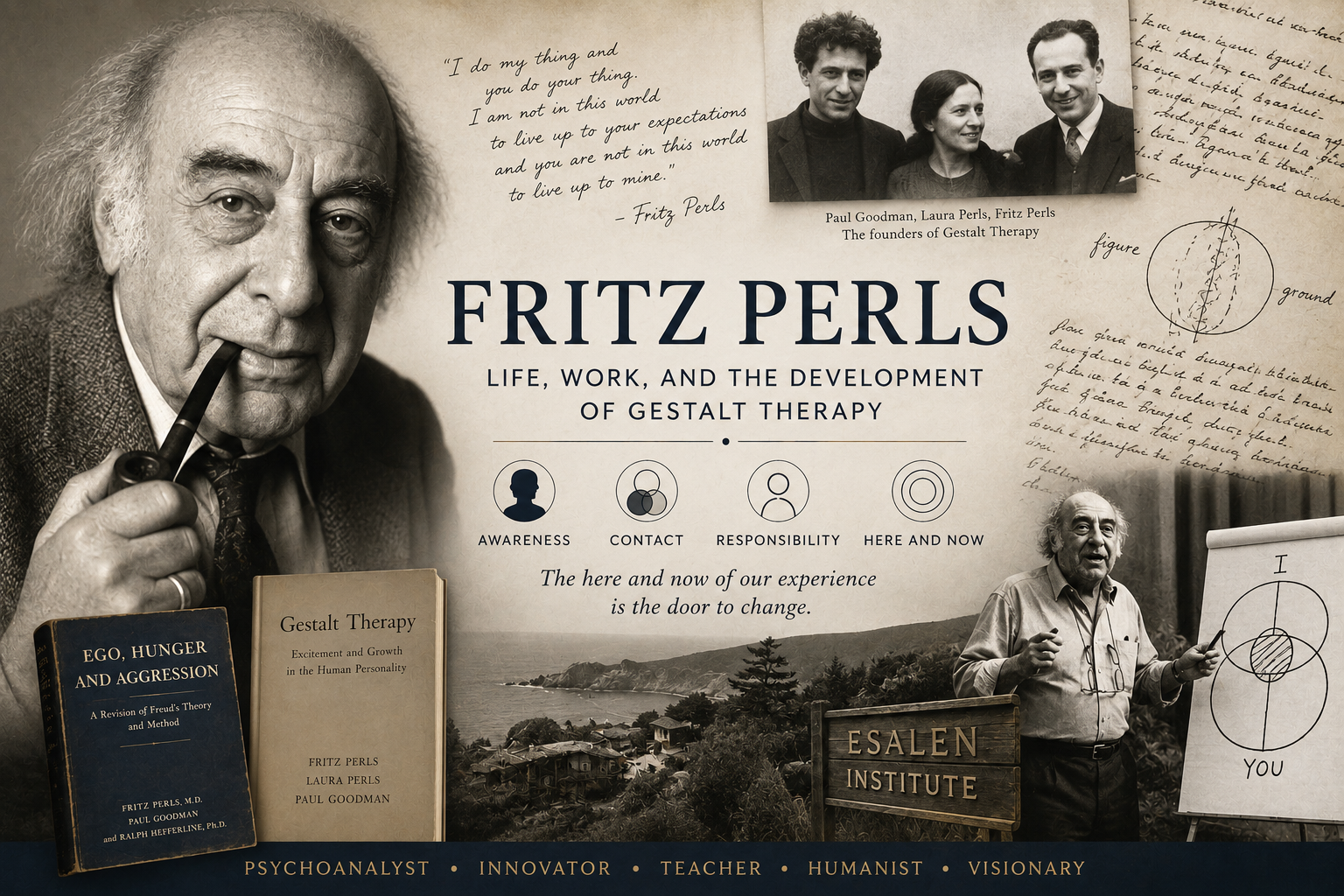
Fritz Perls was among the most original and disruptive figures in twentieth-century psychotherapy. His life — spanning exile, reinvention, and late celebrity — was as dramatic as the clinical method he created. This article traces his intellectual development from Weimar Berlin to the California coast, and places his work within the collaborative context that shaped it.
Introduction: A Complicated Legacy
Friedrich Salomon "Fritz" Perls (1893–1970) occupies a singular position in the history of psychotherapy. He is widely credited as the founder of Gestalt therapy, one of the most original and enduring contributions to twentieth-century clinical psychology. He is also a figure whose personal reputation — flamboyant, confrontational, sexually transgressive by the standards of the clinical world — has made it difficult, at times, to see his intellectual achievement clearly.
Part of the difficulty is that Perls himself worked against clarity. He was, by temperament and conviction, an improviser rather than a systematizer — more comfortable demonstrating than explaining, more interested in the present moment than in theoretical consistency. The dramatic workshop style he developed at the Esalen Institute in the 1960s became the face of Gestalt therapy to the broader public, but it represented only one expression of an approach whose theoretical foundations were considerably richer and more carefully constructed than the Esalen footage suggests.
A full account of Perls' contribution requires separating several things that are often conflated: the intellectual development of his ideas across three decades; the collaborative nature of that development, particularly the roles of Laura Perls and Paul Goodman; his complicated and productive relationship with the psychoanalytic tradition he left; and the distinction between his personal clinical style and the approach that subsequent generations of Gestalt therapists have developed from his foundational work.
This article attempts that fuller account — biographical, intellectual, and critical — with the aim of making Perls' contribution available to contemporary readers in its genuine complexity.
Berlin: Early Life and Formation
Friedrich Salomon Perls was born on 8 July 1893 in the Moabit district of Berlin, the third child of Nathan Perls, a wine merchant and Freemason, and Amalia Rund. The family was secular Jewish, middle-class, and culturally aspiring — qualities representative of a particular stratum of Wilhelmine German society that placed enormous value on education, culture, and professional achievement.
The Berlin of Perls' youth was one of the most intellectually fertile cities in Europe. The city that would produce, within a single generation, the Gestalt psychology of Wertheimer, Köhler, and Koffka; the sociology of Georg Simmel and Max Weber; the political theory of Rosa Luxemburg and Karl Liebknecht; and the psychoanalytic culture that would eventually reach Perls was a place of extraordinary creative tension. The cafés, journals, theatres, and universities of Weimar Berlin — which Perls inhabited as a young adult through the 1920s — formed an intellectual environment of unusual density and freedom.
By his own account, Perls was a difficult and rebellious child — expelled from his Gymnasium for poor behavior, subsequently enrolled in a more liberal school, and deeply ambivalent toward his father, whom he experienced as both admirable and emotionally withholding. These early relational dynamics — the tension between authority and autonomy, the difficulty of authentic male intimacy, the complicated legacy of an admired but frustrating father — appear and reappear throughout his life and work with a persistence that suggests their formative significance.
His earliest passion was for the theatre. As a young man in Berlin, Perls worked briefly with the expressionist director Max Reinhardt, who emphasized the actor's full embodied presence in performance — the use of the body, voice, and immediate physical environment as expressive instruments. This theatrical formation left lasting marks on Perls' clinical style: his sense of the dramatic possibilities of the therapy room, his attention to bodily expression, and his understanding of the therapist as a kind of improvisational performer, responding in the present moment to what the session offered.
Medical Training, the First World War, and Psychoanalytic Apprenticeship
Perls studied medicine in Berlin, receiving his MD in 1920 after a period of military service that interrupted his studies. His wartime experience — serving as a medical officer in the trenches — brought him into direct encounter with the psychological devastation of industrial warfare, including the shell shock that would later become the focus of early trauma theorists. The war confirmed something he had sensed from childhood: that the official categories of psychological normality and pathology were less stable, and the human capacity for suffering more profound, than prevailing frameworks acknowledged.
After qualifying, Perls moved into psychiatry and neuropsychology, and it was in this context that he encountered Kurt Goldstein, whose work on brain-damaged soldiers at the Frankfurt Neurological Institute proved decisive. Goldstein's holistic neurology — his argument that the organism must be understood as a unified whole responding to its total environment, rather than as a collection of discrete functions mapped onto distinct neural regions — gave Perls a biological and philosophical framework for the dissatisfaction he had been feeling with mechanistic accounts of mind and behavior. Goldstein's concept of self-actualization — the organism's inherent tendency to realize its full potential within the constraints of its environment — would later be taken up by Abraham Maslow and become central to the humanistic psychology movement; for Perls, it remained a foundational biological premise rather than an aspiration.
The psychoanalytic training followed. Perls underwent personal analysis with Karen Horney in Berlin, then with Wilhelm Reich — an experience that proved more formative than the orthodox Freudian analysis he also received. Reich's insistence on the body's role in psychological experience, his concept of character armor (the somatic muscular patterns through which psychological defenses are physically held), and his emphasis on the organic, biological ground of psychological life all found their way into Perls' developing thinking. Later, Perls continued his analytic training with Eugen Harnik, Otto Fenichel, and — significantly — with Helene Deutsch. He was also a member of the Frankfurt and Vienna psychoanalytic societies, where he attended seminars and encountered the mainstream of Freudian clinical thinking at close range.
Perls also met Sigmund Freud himself, at the International Psychoanalytic Congress in Berlin in 1936 — an encounter he would describe for the rest of his life as brief, dismissive, and formative. Freud, absorbed in other conversations, gave Perls what seemed a perfunctory four minutes before turning away. Whether or not Perls' memory of the encounter was strictly accurate, its psychological significance for him is unmistakable: it crystallized his sense of rejection by the psychoanalytic establishment and intensified the ambivalence — between discipleship and rebellion — that would drive his intellectual development for the next two decades.
Perls and Psychoanalysis: Disciple and Dissident
Perls' relationship with psychoanalysis is one of the defining intellectual dramas of his life, and understanding it is essential to understanding what Gestalt therapy is and what it is not. He was not simply a practitioner who happened to come from an analytic background and then moved in a different direction. He was, for the most part of his formative years, a committed psychoanalyst — trained, analyzed, supervised, and practicing within the analytic tradition — who arrived at a fundamental theoretical disagreement that forced him out of it.
The disagreement crystallized in his first major theoretical work, Ego, Hunger and Aggression, written in South Africa and first published in Durban in 1942 (with the subtitle A Revision of Freud's Theory and Method). The book was not a rejection of psychoanalysis so much as a sustained argument that Freud's theoretical framework rested on a fundamental error: the privileging of the verbal-symbolic register of experience at the expense of the bodily, sensory, and immediate. Perls argued that Freud had correctly identified the centrality of the oral and aggressive drives but had misunderstood their nature — treating them as instinctual energies to be discharged or repressed rather than as expressions of a fundamentally biological and relational process of engagement with the environment.
Perls proposed in their place a theory of psychological functioning grounded in the organism's biological relationship to its environment — what he called the process of hunger in the extended metaphorical sense: the organism's need to take in, metabolize, and assimilate what it needs from its environment, and to reject what is toxic. Psychological disturbance, on this account, arises not from the repression of libidinal energy but from the interruption of this metabolic contact process — particularly from the introjection of experience that has not been genuinely assimilated (swallowed whole, as it were, without being chewed and digested). The dental aggression Perls described — the capacity to bite into experience, to break it down, to metabolize it genuinely — became a central metaphor for the psychologically healthy contact process.
"Perls was not rebelling against Freud from the outside. He was arguing from within the tradition that Freud had made a foundational error about what kind of thing the mind is."
Several other specific departures from psychoanalytic orthodoxy are worth noting, because they map directly onto what became distinctive about the Gestalt clinical approach:
Laura Perls: The Essential Partner
Lore Posner, known professionally as Laura Perls (1905–1990), was born in Pforzheim, Germany, into a prosperous Jewish family. She studied psychology at the University of Frankfurt, where she encountered the Gestalt psychology of Wertheimer and Koffka directly, and completed her doctorate under Adhémar Gelb and Kurt Goldstein — the same Goldstein who had so profoundly influenced Fritz. She was thus not a student of Fritz Perls who subsequently became his collaborator; she was an independent scholar with her own grounding in Gestalt psychology, phenomenology, and existential philosophy before she and Fritz met.
Laura and Fritz met in Frankfurt in the late 1920s, married in 1930, and began an intellectual partnership that would last, despite significant personal difficulties, until Fritz's death in 1970. Their marriage was complicated by Fritz's repeated infidelities, his periodic abandonment of the family, and his profound difficulty with genuine intimacy — the very quality his clinical theory celebrated. Laura's assessment of this contradiction was unsentimental: she acknowledged it directly and continued to develop her own clinical and theoretical work on her own terms, eventually founding and directing the New York Institute for Gestalt Therapy largely independently of Fritz.
Laura's contributions to Gestalt therapy have been consistently and seriously underestimated in the historical literature, in part because her style of working and theorizing was the antithesis of Fritz's: careful rather than dramatic, relational rather than confrontational, long-term rather than episodic. Where Fritz favored the intensive workshop demonstration as his primary clinical and pedagogical form, Laura worked in sustained individual and group therapy over years, developing a depth of relational attunement that the demonstration format rarely permitted.
Her theoretical contributions are equally significant. Laura brought to the Gestalt project a grounding in existential philosophy — particularly Martin Buber's dialogical thinking and Paul Tillich's theology of being — that Fritz did not have to the same degree. The dialogical dimension of Gestalt therapy, which later theorists have identified as one of its most distinctive and clinically important features, owes at least as much to Laura's philosophical formation as to Fritz's. It was Laura who most consistently held the relational context of the work: the idea that healing occurs not through technique applied to an individual but through genuine meeting between two people.
Laura also contributed the concept of support as a therapeutic category. For Fritz, the therapeutic emphasis was primarily on challenge — on confronting the client's avoidances, pushing toward the avoided feeling or awareness. For Laura, the capacity for genuine contact depended on adequate support: bodily support (the ground beneath one's feet, the breath in one's body), relational support (the felt security of the therapeutic relationship), and environmental support (the conditions in the broader field that sustain the person's capacity for engagement). This concept of support as a prerequisite for genuine contact, rather than a softening concession to the client's fragility, is one of Laura's most important theoretical additions to the Gestalt framework.
For a discussion of embodied awareness and the somatic dimension of Laura Perls' contribution, see our article on Embodied Awareness and the Body in Gestalt Therapy.
Exile: South Africa and Ego, Hunger and Aggression
The rise of National Socialism in Germany, and the accelerating persecution of Jews that accompanied it, made remaining in Berlin impossible. Fritz and Laura fled Germany in 1933 — first briefly to the Netherlands and then to South Africa, where Fritz established a psychoanalytic practice in Johannesburg in 1935. Laura followed with their two children, Renate and Stephen.
The South African years (1935–1946) were in some respects the most productive of Fritz's intellectual life, even as they were personally turbulent. Isolated from the European psychoanalytic mainstream, freed from the professional pressures of belonging to an established analytic community, and stimulated by the intellectually vibrant multi-racial Johannesburg milieu — which included, among others, the writer and anti-apartheid activist Jan Smuts, whose concept of holism influenced both Perls' thinking and the broader South African intellectual climate — Fritz worked through the theoretical ideas that had been forming since his years with Goldstein and Reich.
The result was Ego, Hunger and Aggression: A Revision of Freud's Theory and Method, first published in Durban in 1942. The book is important for several reasons beyond its specific theoretical arguments. It represents the first sustained attempt by Perls to articulate a theoretical framework that departed from psychoanalytic orthodoxy while remaining in critical dialogue with it. It introduced the oral-dental metaphor that would structure his later thinking about contact and assimilation. And it shows, in its combination of theoretical ambition and clinical observation, the characteristic Perls style: bold, somewhat undisciplined, willing to make large claims on the basis of clinical intuition rather than rigorous argument, but genuinely creative in the problems it identifies and the directions it suggests.
The book was also, from the beginning, a collaborative project. Laura Perls contributed significantly to its content — she is sometimes credited as a co-author, and her influence on the book's phenomenological and existential dimensions is clear. That her name did not appear on the title page is a fact that she later noted with measured understatement.
New York and the Founding Circle
Fritz and Laura emigrated to New York City in 1946, settling in a community of European émigrés — analysts, philosophers, artists, political thinkers — who had similarly fled the devastation of fascism and war. New York in the late 1940s was, like Weimar Berlin in the 1920s, a crucible of intellectual energy, and the Perls entered it at a propitious moment.
The founding circle of what would become Gestalt therapy was remarkable in its intellectual breadth. It included, in addition to Fritz and Laura Perls: Paul Goodman, social theorist, anarchist, poet, and novelist; Ralph Hefferline, an academic psychologist from Columbia University; Isadore From, a philosopher and clinician; Elliott Shapiro and Paul Weisz, both psychoanalytically trained; and, peripherally, figures from the broader New York intellectual and artistic world including the abstract expressionist painter Julian Beck and the composer John Cage, both of whom were drawn to the Gestalt workshop atmosphere.
The New York Institute for Gestalt Therapy was founded in 1952, a year after the publication of the foundational text, and it became the primary institutional home of the new approach — developed by Laura Perls, who remained centrally committed to it while Fritz became increasingly peripatetic through the 1950s and early 1960s.
Gestalt Therapy (1951): The Book and Its Architecture
Gestalt Therapy: Excitement and Growth in the Human Personality, published in 1951 by Julian Press, is the foundational text of Gestalt therapy and one of the most unusual books in the history of psychotherapy. Its structure is itself an expression of the Gestalt commitment to direct experience: the first volume (Volume One in the original edition, labelled "Novelty, Excitement and Growth") consists of a series of structured awareness experiments designed for the reader to perform as they read — an attempt to introduce the reader to the Gestalt approach through direct phenomenological engagement rather than through abstract description. The second volume (Volume Two, "Theoretical") contains the systematic theoretical elaboration of the approach.
The experiments of Volume One were developed primarily by Ralph Hefferline, based on work done in seminars at Columbia University. They remain among the most innovative pedagogical devices in the psychological literature — an attempt to make the reader's own experience the primary text, rather than simply describing a therapeutic method to be applied to others. The theoretical Volume Two was written primarily by Paul Goodman, with contributions from Fritz Perls and, unacknowledged in the text, from Laura Perls.
The book's theoretical framework integrates several distinct intellectual traditions:
The 1951 text is not easy reading. Its theoretical sections are dense, compressed, and assume familiarity with several distinct philosophical traditions. It has been characterized, not unfairly, as simultaneously one of the most original and one of the least accessible texts in the psychotherapy literature. Subsequent decades produced more accessible introductions to the approach — Perls' own Gestalt Therapy Verbatim (1969) and In and Out the Garbage Pail (1969); Erving and Miriam Polster's Gestalt Therapy Integrated (1973); and Joseph Zinker's Creative Process in Gestalt Therapy (1977) among them — but the theoretical depth of the original has never been superseded.
For a detailed discussion of the book's field-theoretic and phenomenological framework, see our articles on Field Theory and Dialogue in Gestalt Therapy and Gestalt Therapy and Systems Thinking: From Field Theory to Complexity Science.
Paul Goodman's Theoretical Contribution
Paul Goodman (1911–1972) was, by any measure, one of the most original public intellectuals of twentieth-century America — poet, novelist, social critic, anarchist theorist, and, in the context of the 1951 text, the primary architect of Gestalt therapy's theoretical framework. Understanding his contribution requires understanding what kind of thinker he was: not a clinician working from clinical experience, but a social theorist and philosopher working from a deep engagement with phenomenology, Gestalt psychology, developmental theory, and the anarchist tradition.
Goodman wrote the theoretical volume of the 1951 text — what became, in the revised single-volume edition, the bulk of the book's theoretical content. His concept of the contact boundary — the dynamic zone of interaction between organism and environment where experience is constituted, not a wall separating two pre-existing entities but the ongoing event of their mutual constitution — is one of the most philosophically original contributions in the Gestalt literature. His account of the self as a process rather than a structure — the self as the integrative activity occurring at the contact boundary, not as a container with fixed contents — anticipated by decades the relational and process-oriented theories of self that have become dominant in contemporary psychotherapy.
His anarchist social theory gave Gestalt therapy a political dimension that distinguished it from the prevailing therapeutic individualism of mid-century American psychology. For Goodman, neurosis was not simply an individual psychological disturbance; it was a social and political event — the internalization of a social order that systematically frustrated authentic human development. Therapy that addressed the individual without attending to the social field conditions sustaining their distress was, at best, partial and, at worst, an accommodation to pathogenic conditions.
Goodman later became famous for a quite different kind of writing — Growing Up Absurd (1960) established him as a major voice of the American New Left — and his involvement with Gestalt therapy was largely confined to the period of the 1951 text. But his theoretical contributions to that text are foundational, and their implications continue to be elaborated by contemporary Gestalt theorists.
Core Concepts of the Gestalt Approach
The theoretical framework developed in the 1951 text, and elaborated through the subsequent decades of Gestalt clinical practice, rests on a cluster of interconnected concepts that distinguish the approach from both psychoanalysis and the behavioral and cognitive approaches that came to dominate academic clinical psychology. Understanding these concepts is essential for understanding both what Perls contributed and how subsequent generations have built on and, in some respects, corrected it.
For a detailed account of how these concepts connect to broader frameworks in perceptual psychology, see Consciousness and Perception in Gestalt Psychology. For the contact disturbances that interrupt healthy organismic self-regulation, see Contact Interruptions in Gestalt Therapy: A Relational Perspective.
Gestalt Therapy and Humanistic Psychology
Gestalt therapy emerged at precisely the moment that humanistic psychology was crystallizing as a recognizable movement in American psychology — and the two developments are deeply entangled, though the relationship is more complicated than the simple categorization of Gestalt therapy as "a humanistic approach" suggests.
The humanistic psychology movement, associated above all with Abraham Maslow and Carl Rogers, emerged in the late 1950s and early 1960s as an explicit alternative to what its founders saw as the two dominant and inadequate paradigms of mid-century psychology: the determinism of psychoanalysis (which located the sources of human behavior in unconscious forces beyond rational control) and the mechanism of behaviorism (which denied the relevance of inner experience entirely). Against both, humanistic psychology asserted the primacy of subjective experience, the human capacity for growth and self-actualization, and the value of the therapeutic relationship as a medium of genuine human encounter rather than a technical procedure.
Gestalt therapy shared all of these commitments, and its founders were participants in the humanistic psychology conversation from its earliest stages. Fritz Perls was among the presenters at the first meetings of what became the Association for Humanistic Psychology, and the 1951 text was recognized from the beginning as a significant contribution to the emerging humanistic paradigm. Maslow's concept of self-actualization — the organism's inherent drive toward the full realization of its potential — was, as noted, directly influenced by Goldstein, who had also influenced Perls.
But Gestalt therapy also departed from humanistic psychology in important respects. Where Rogers' client-centered therapy emphasized the therapist's unconditional positive regard, empathic understanding, and congruence as the primary therapeutic conditions, Perls was more interested in the quality of genuine contact — which might involve challenge, confrontation, or the therapist's authentic expression of frustration or impatience — than in the therapist's consistent warmth. Where Maslow's framework emphasized peak experiences and the positive pole of human potential, Perls was equally interested in what is avoided, split off, and disowned — in the darker, more defended aspects of experience that the therapeutic encounter must be willing to engage.
The more substantive distinction between Gestalt therapy and mainstream humanistic psychology lies in theoretical depth. Gestalt therapy's grounding in field theory, phenomenological philosophy, and the biology of organism-environment interaction gives it a theoretical sophistication that the more intuitively compelling but theoretically thinner humanistic frameworks of Rogers and Maslow do not achieve. This theoretical depth has allowed Gestalt therapy to engage more productively with subsequent theoretical developments — in systems theory, complexity science, interpersonal neurobiology, and relational psychoanalysis — than approaches whose theoretical foundations are less explicitly articulated.
The Esalen Years: Fame, Demonstration, and Controversy
The Esalen Institute, founded in Big Sur, California in 1962 by Michael Murphy and Dick Price, became the primary institutional context for the "human potential movement" — the loosely organized cultural formation that drew on humanistic psychology, Eastern contemplative traditions, somatic disciplines, and the general cultural ferment of the 1960s counterculture. Fritz Perls arrived at Esalen in 1964 and quickly became its most celebrated resident teacher, conducting workshops that attracted therapists, students, artists, and intellectuals from across the United States and from Europe.
The Esalen workshops featured Perls working with volunteers in what he called the "hot seat": a chair placed opposite his own, in which willing participants engaged in intensive Gestalt work while others observed. These demonstrations were recorded on film and widely distributed, and they became the primary means through which Gestalt therapy became known to the broader therapeutic world. The films show Perls at his most characteristic: quick, dramatic, confrontational, often dazzling in his perceptiveness, occasionally brutal in his directness, and capable of facilitating shifts in awareness that are visible even to viewers decades later.
"The Esalen footage shows what Perls could do at his best. It does not show what Gestalt therapy is."
Several aspects of the Esalen period require careful critical attention:
The demonstration format and its distortions
The hot seat format was not a clinical setting. It was a demonstrational and pedagogical format in which a volunteer engaged in intensive, usually brief, emotionally charged work before an audience of students and practitioners. The therapeutic alliance, built over time in the sustained privacy of an ongoing therapeutic relationship, was absent. The social pressure of public demonstration was present in ways that had no equivalent in ordinary clinical practice. The kinds of change that could be achieved in a one-time demonstrational encounter — however vivid and apparently real — were not the same as the kinds of change achievable in sustained therapeutic work.
Perls was aware of this distinction, at least in his earlier writing. But by the Esalen period, the distinction had largely collapsed in his practice and his self-presentation. The demonstration had become, for Perls, not merely a pedagogical device but his primary clinical form. This collapse had consequences: it shaped how subsequent generations of practitioners understood Gestalt therapy, and it was one of the primary targets of the critical response from practitioners — including Laura Perls — who had maintained a more relational, sustained, and less theatrical approach.
The confrontational style and its ethical dimensions
Perls' Esalen style was frequently confrontational in ways that later practitioners have questioned on ethical grounds. His directness could slide into contempt for what he called "bullshit" — the client's self-protective presentations — and his willingness to challenge and provoke did not always distinguish between the challenge that serves the client's growth and the challenge that serves the therapist's need for dramatic effect. Several accounts by participants in his workshops describe experiences of shame and exposure that did not feel therapeutically productive.
The ethical questions raised by this style are serious and remain relevant to how Gestalt therapy is taught and practiced. The risk of confusing therapeutic confrontation with personal power, or mistaking the production of emotional intensity for genuine therapeutic change, is a real one. For a fuller discussion of how shame dynamics operate in the therapeutic relationship, see our article on Shame and Self-Awareness in Gestalt Therapy.
The counterculture context
Esalen in the 1960s was not only a psychotherapy training setting; it was a site of cultural experimentation — in sexuality, consciousness, community, and political organization — that was broadly continuous with the counterculture of the period. Perls was not merely a clinical teacher at Esalen; he was a cultural figure, and his influence at this period was as much cultural as clinical. The equation of Gestalt therapy with the 1960s counterculture — with encounter groups, sensitivity training, emotional catharsis, and the general loosening of social conventions — stuck in the popular imagination and has been one of the most persistent sources of misunderstanding of the approach.
A practitioner trained primarily through exposure to Perls' Esalen demonstrations may develop a picture of Gestalt therapy as essentially confrontational, catharsis-oriented, and brief. A practitioner trained in the New York Institute tradition — the tradition of Laura Perls, Isadore From, and subsequently Gordon Wheeler, Joseph Zinker, and Lynne Jacobs — will have a substantially different picture: long-term, relationally attentive, theoretically grounded, and as interested in the quality of present contact as in any particular emotional event. Both lineages trace back to the same foundational text and the same founding circle. The difference lies in which aspects of the approach have been emphasized and developed.
Historical Gestalt Therapy and Contemporary Relational Practice
One of the most important distinctions in contemporary Gestalt therapy is between the historical approach — the Gestalt therapy of Perls' own clinical practice and the early period of the approach's development — and the contemporary relational Gestalt therapy that has developed through the work of subsequent theorists and practitioners over the past four decades. Understanding the nature and significance of this distinction is essential for anyone seeking to engage seriously with the current state of the field.
| Dimension | Historical Gestalt (Perls era) | Contemporary Relational Gestalt |
|---|---|---|
| Primary emphasis | Individual awareness, authenticity, self-support | Relational field, co-created experience, mutual influence |
| Therapist role | Active director of awareness experiments, challenger of resistances | Present participant in the therapeutic field, witness and co-creator |
| View of the self | A bounded entity achieving autonomy and self-support | A field process constituted at the contact boundary; verb not noun |
| Theory of change | Awareness leads to change; insight and experimentation are primary | Change emerges from field conditions, including the quality of the therapeutic relationship |
| Format preference | Intensive workshop, hot seat demonstration, brief encounter | Sustained individual or group therapy; ongoing supervisory and training relationships |
| Body and embodiment | Bodily signals as primary data; somatic expression encouraged | Embodied intersubjectivity; mutual somatic attunement between therapist and client |
| Primary influences | Goldstein, Reich, existentialism, phenomenology, Gestalt psychology | Above, plus Buber's dialogical philosophy, Lewin's field theory, complexity science, interpersonal neurobiology |
| Social dimension | Present (Goodman) but not always foregrounded in clinical practice | Increasingly central; social, cultural, and political field conditions attended to explicitly |
This evolution does not represent a repudiation of Perls' contributions; it represents their development. The theoretical foundations of the 1951 text — the field-theoretic ontology, the contact boundary, the figure-ground model, the paradoxical theory of change — are as central to contemporary relational Gestalt therapy as they were to the historical approach. What has changed is the emphasis placed on different aspects of those foundations, and the integration of subsequent philosophical and scientific developments that the founders could not have anticipated.
Gordon Wheeler's reconceptualization of the self as a field process, Philip Brownell's work on phenomenological field theory, Malcolm Parlett's account of field conditions, and the dialogical work of Richard Hycner and Lynne Jacobs all represent elaborations of the 1951 foundation that Perls would have recognized as continuous with his own theoretical commitments, even if they differed substantially from his personal clinical style. For a full account of these contemporary developments, see our article on Field Theory and Dialogue in Gestalt Therapy.
Fritz Perls: A Chronology
- 1893
Born 8 July in Berlin-Moabit. Third child of Nathan and Amalia Perls.
- 1913–20
Studies medicine in Berlin; military service as medical officer in World War I; receives MD, 1920.
- 1920s
Works with neurologist Kurt Goldstein at Frankfurt Neurological Institute. Undergoes psychoanalytic training and personal analysis with Karen Horney, Wilhelm Reich, Eugen Harnik, and others. Member of Berlin and Vienna Psychoanalytic Societies.
- 1926
Moves to Frankfurt; meets Lore Posner (later Laura Perls), then a doctoral student under Goldstein.
- 1930
Marries Laura Perls (née Posner).
- 1933
Flees Nazi Germany. Brief period in the Netherlands, then emigrates to South Africa.
- 1935
Establishes psychoanalytic practice in Johannesburg. Begins theoretical work departing from Freudian orthodoxy.
- 1936
Presents a paper at the International Psychoanalytic Congress in Marienbad; the brief, seemingly dismissive encounter with Freud proves a formative personal and intellectual experience.
- 1942
Ego, Hunger and Aggression published in Durban — the first sustained theoretical departure from psychoanalysis, developed in close collaboration with Laura Perls.
- 1946
Emigrates to New York City with Laura. Enters the circle of European émigré intellectuals that will become the Gestalt founding group.
- 1951
Gestalt Therapy: Excitement and Growth in the Human Personality published, co-authored with Ralph Hefferline and Paul Goodman.
- 1952
New York Institute for Gestalt Therapy founded by Laura Perls, Fritz Perls, Paul Goodman, and colleagues.
- 1960s
Perls becomes increasingly peripatetic — living and working in Los Angeles, Japan, Israel, and Canada — while the New York Institute is maintained primarily by Laura Perls.
- 1964
Arrives at Esalen Institute, Big Sur, California; becomes its most celebrated resident teacher over the following six years.
- 1969
Publishes Gestalt Therapy Verbatim and the autobiographical In and Out the Garbage Pail. Moves to Vancouver Island, British Columbia, where he begins establishing a Gestalt community.
- 1970
Dies 14 March in Chicago, aged 76, following surgery. The Vancouver Gestalt community he had begun does not survive him.
Legacy and Influence
Fritz Perls died in March 1970, in Chicago, at the age of seventy-six. He had lived long enough to see Gestalt therapy become an internationally recognized approach with training institutes on multiple continents, but not long enough to see the theoretical development that has made it most significant in the contemporary therapeutic landscape.
His legacy operates on several distinct levels. At the level of clinical technique, the methods he developed and popularized — the empty chair technique, the two-chair dialogue, the phenomenological experiment, the directive attention to bodily expression — have been taken up across therapeutic modalities well beyond the Gestalt tradition. Emotion-Focused Therapy, schema therapy, somatic approaches, and various trauma-informed methods all draw on elements of the Gestalt clinical repertoire.
At the theoretical level, the framework he co-developed with Goodman and Perls in the 1951 text has proven more durable and generative than the personality of its most flamboyant advocate might have suggested. Contemporary Gestalt therapy — theoretically sophisticated, relationally sensitive, engaged with complexity science and interpersonal neurobiology — is recognizably continuous with the 1951 text in ways that, say, the Esalen hot seat is not. The theoretical depth of the original work has allowed the approach to develop and remain intellectually vital across seven decades.
At the cultural level, Perls' influence is harder to trace precisely because it is so diffuse. The emphasis on authenticity, present-moment awareness, personal responsibility, and the value of direct sensory experience that characterizes the Gestalt approach has become part of the broader cultural common sense of psychotherapy and personal development in ways that rarely acknowledge their Gestalt provenance. The Gestalt idea that awareness per se can be curative — that there is something therapeutically transformative about being fully present to what is, without immediately analyzing or managing it — has influenced mindfulness-based approaches, coaching, contemplative-informed therapy, and the broader culture of psychological self-care.
For a survey of how these influences operate across clinical and organizational contexts, see our article on Applications of Gestalt Therapy. For the specific contribution of the empty chair technique, see The Empty Chair Technique in Gestalt Therapy.
Frequently Asked Questions
Did Fritz Perls found Gestalt therapy alone?
No. Gestalt therapy was a collaborative creation. The foundational 1951 text was co-authored by Fritz Perls, Ralph Hefferline, and Paul Goodman, with significant contributions from Laura Perls that were not formally acknowledged in the original publication. Laura Perls was an independent scholar with her own grounding in Gestalt psychology and existential philosophy before she and Fritz began working together, and her theoretical and clinical contributions — particularly regarding dialogue, support, and the relational dimensions of the therapeutic encounter — are as foundational as Fritz's own.
Was Fritz Perls a psychoanalyst?
Yes, for the first half of his career. Perls received formal psychoanalytic training, underwent personal analysis with multiple analysts (including Karen Horney and Wilhelm Reich), and practiced as a psychoanalyst for approximately fifteen years before his theoretical disagreements with Freudian orthodoxy led him to develop the Gestalt approach. Understanding Gestalt therapy requires understanding what aspects of psychoanalysis it was arguing against — it is not simply an alternative to psychoanalysis but a systematic critique and revision of it.
What is the relationship between Gestalt psychology and Gestalt therapy?
Gestalt therapy borrowed its name and several foundational concepts — particularly the figure-ground distinction, the concept of organized wholes, and the perceptual field — from the academic Gestalt psychology of Wertheimer, Köhler, and Koffka. However, it is a distinct discipline. Gestalt psychology was a school of experimental perceptual psychology; Gestalt therapy is a clinical psychotherapy. They share theoretical commitments to holism and contextual determination but have different methods, different subject matters, and different goals. Fritz Perls was influenced by Gestalt psychology through his work with Kurt Goldstein, but he did not formally study with the Gestalt psychologists.
Is contemporary Gestalt therapy the same as what Fritz Perls practised at Esalen?
No, and this distinction is important. The dramatic, confrontational, hot-seat demonstration style of Perls' Esalen period represents one expression of the approach — one that many contemporary Gestalt therapists regard as a distortion as much as an illustration. Contemporary relational Gestalt therapy is characterized by sustained relational engagement, attention to the co-created therapeutic field, sensitivity to the dynamics of shame and power in the therapeutic relationship, and a dialogical rather than directive orientation. It is theoretically richer, ethically more careful, and clinically more nuanced than the Esalen footage suggests.
What was Fritz Perls' main criticism of psychoanalysis?
Perls' central criticism was that psychoanalysis had made a foundational error about what kind of thing the mind is. By privileging the verbal-symbolic register, focusing on the reconstruction of the developmental past, and treating the therapeutic relationship as a vehicle for the analysis of transference rather than as a genuine present-moment encounter, psychoanalysis systematically bypassed the embodied, sensory, present-tense quality of experience that Perls regarded as primary. His proposed alternative was an approach grounded in immediate awareness — bodily, sensory, and relational — rather than in retrospective interpretation and verbal reconstruction.
What is the empty chair technique and did Perls invent it?
The empty chair technique — inviting a client to speak to an imagined person or part of themselves placed in an empty chair, and to switch chairs and respond as that figure — is among the most recognized methods in Gestalt therapy. Perls popularized it extensively through his Esalen workshops, but its origins are partly in Jacob Levy Moreno's psychodrama, which used enacted dialogue with absent others as a therapeutic device from the 1920s onward. Perls adapted this tradition within the Gestalt theoretical framework, grounding it in the concepts of present-centered awareness, contact, unfinished business, and the paradoxical theory of change.
Conclusion
Fritz Perls was an extraordinary and contradictory figure: a man whose personal difficulties with intimacy, fidelity, and sustained commitment were in sharp tension with the clinical and theoretical framework he helped to create — a framework that placed authentic contact, relational presence, and the courage to be genuinely affected by another at the center of therapeutic work. The tension between the person and the theory is not simply a biographical irony; it reflects something genuine about the nature of creative intellectual contribution. Perls understood, at a theoretical level, things that he struggled to enact at a personal level. His contribution was to articulate and demonstrate those understandings in ways that others could build on.
What he co-created with Laura Perls, Paul Goodman, and the broader founding circle is a framework for understanding human experience that has proven more durable, more theoretically generative, and more clinically sophisticated than its popular image suggests. The Gestalt therapy that emerged from the Esalen demonstrations is a simplified and in some respects distorted version of the approach developed in the 1951 text and elaborated by subsequent generations of practitioners and theorists. The fuller version — field-theoretic, phenomenological, relational, embodied, systemically aware — remains one of the most intellectually rich frameworks available for understanding what happens when two people meet in the hope that something can change.
Perls himself, in one of his most quoted formulations, said: "I do my thing and you do your thing. I am not in this world to live up to your expectations, and you are not in this world to live up to mine." It is a statement that captures something important about the Gestalt commitment to authentic self-expression and the refusal of confluence. But the fuller Gestalt position — developed by Laura Perls, Goodman, and the relational theorists who followed — is that genuine meeting requires more than each party doing their own thing. It requires the willingness to be genuinely present to the other, to be moved and changed by them, and to find, in that encounter, something that neither could have arrived at alone.