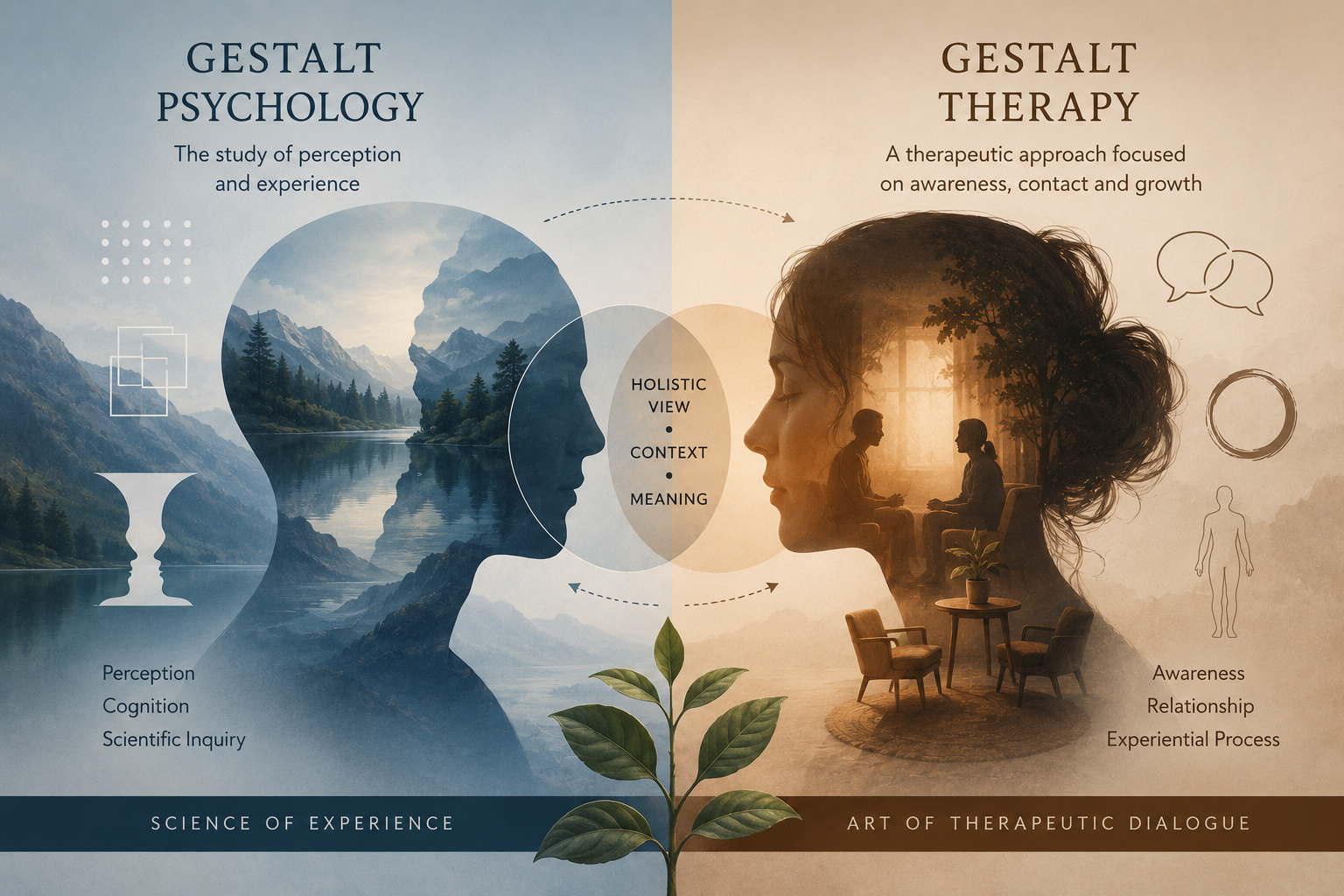
Gestalt Psychology and Gestalt Therapy: A Definitional Summary
Gestalt Psychology
A school of experimental psychology founded in Germany around 1910–1912 by Max Wertheimer, Wolfgang Köhler, and Kurt Koffka. It studies perception, consciousness, and cognitive organisation, arguing that the mind organises sensory experience into structured wholes — Gestalten — that cannot be understood by analysing their individual components. Its central finding is that perceptual experience is inherently organised: figures stand against grounds, elements group according to proximity and similarity, and the whole is other than the sum of its parts.
Gestalt Therapy
A humanistic, phenomenological, and experiential psychotherapy developed in the 1940s–1950s by Fritz Perls, Laura Perls, and Paul Goodman. It is a clinical approach to psychological health and disturbance, grounded in field theory, existential philosophy, and the phenomenology of awareness and contact. It treats the person in their environmental context, attends to present-moment experience, and works with the organism–environment field rather than isolated internal mechanisms.
Gestalt psychology and Gestalt therapy are distinct disciplines that share a name and some intellectual heritage but differ fundamentally in their subject matter, methods, founders, and goals. Gestalt psychology is an academic school of experimental perceptual psychology; Gestalt therapy is a humanistic clinical psychotherapy. Understanding their relationship — and the ways in which it is frequently overstated — is essential for anyone engaging seriously with either tradition.
GestaltReview.com · History & Foundations · Reference Essay
Gestalt Psychology vs Gestalt Therapy Origins, Differences, and Common Misconceptions
A definitive educational reference tracing the historical and intellectual genealogy of two distinct traditions — their genuine connections, their fundamental differences, and the common errors that arise when they are conflated.
Introduction
Few confusions in psychology are as persistent, and as consequential, as the assumption that Gestalt psychology and Gestalt therapy are either the same thing or continuous developments of a single tradition. Students encounter the term Gestalt in courses on perceptual psychology and assume it refers to the same body of ideas they encounter in courses on humanistic psychotherapy. Clinicians trained in Gestalt therapy frequently invoke Gestalt psychology's perceptual principles in ways that import more theoretical continuity than the historical record supports. And general readers, encountering the word Gestalt in two quite different contexts, reasonably but incorrectly assume they must be dealing with one thing.
The confusion is understandable. Both traditions use the same word. Both share a commitment to understanding experience as organised and contextual rather than atomistic and mechanical. Both were shaped, directly or indirectly, by the German intellectual culture of the early twentieth century. And there are genuine intellectual connections — particularly through the figure of Kurt Lewin, whose field theory sits between the two traditions and influenced both.
But the connections should not obscure the differences. Gestalt psychology is a school of experimental perceptual psychology founded in Germany around 1910. Gestalt therapy is a humanistic clinical psychotherapy developed in New York and South Africa in the 1940s and 1950s. They have different founders, different theoretical commitments, different methods, and different subject matters. Fritz Perls, the primary founder of Gestalt therapy, was not a student of Wertheimer, Köhler, or Koffka. He borrowed from their tradition selectively and acknowledged that borrowing explicitly — but he built Gestalt therapy on foundations that are primarily psychoanalytic, phenomenological, existential, and field-theoretic rather than perceptual-psychological.
This article aims to provide a definitive account of both traditions, their genuine intellectual connections, and the distinctions that are most commonly elided. It is written as a reference document: historically accurate, conceptually precise, and suitable for academic citation.
What Is Gestalt Psychology?
Gestalt psychology is a school of experimental psychology that emerged in the German-speaking world in the early twentieth century, primarily concerned with the psychology of perception, consciousness, and cognitive organisation. Its central claim — that the mind organises sensory experience into structured wholes that cannot be understood by analysing their individual components — represented a fundamental departure from the dominant structuralist and associationist frameworks of its time.
The word Gestalt is a German noun that translates approximately as form, shape, or configuration. It was used by the Austrian philosopher Christian von Ehrenfels in 1890 to describe what he called Gestaltqualitäten — form-qualities that are present in a whole but not reducible to its parts. A melody, for example, retains its identity when transposed to a different key, even though every individual note has changed. The form-quality — the melodic pattern — is something above and beyond the individual components. This observation of von Ehrenfels became the philosophical seed from which Gestalt psychology grew.
Gestalt psychology's contribution was to take this observation and develop it into a systematic experimental science of perception and cognitive organisation, grounded in laboratory research, and directed against the elementarism that had dominated psychology since Wilhelm Wundt's establishment of the first experimental psychology laboratory in Leipzig in 1879.
The Origins of Gestalt Psychology
The founding moment of Gestalt psychology is conventionally placed in 1912, when Max Wertheimer published his account of the phi phenomenon — the perception of apparent motion produced by flashing two stationary lights in rapid succession. When the interval between the flashes is correctly timed, observers perceive not two discrete events but a single light moving continuously through space. No actual movement occurred in the stimulus; the experience of movement was a product of the perceptual system's organisation of the input.
This observation was theoretically explosive. Structuralist psychology — the framework that dominated experimental psychology at the time — held that complex mental experiences could be explained by decomposing them into elementary sensations and the associative laws that combined them. Wertheimer's phi phenomenon could not be explained on this basis: neither of the component sensations contained the experience of movement, and no associative combination of them could produce it. The experience arose from the configuration of the stimuli — from the relationship between them — not from any property of either considered alone.
The paper was written in Frankfurt, where Wertheimer worked alongside Wolfgang Köhler and Kurt Koffka, both of whom served as subjects in his experiments. These three men formed an intellectual partnership that would define Gestalt psychology for the next three decades. Their shared theoretical orientation was shaped by the phenomenological tradition of Franz Brentano and Edmund Husserl, by the physical field theories of Faraday and Maxwell, and by the broadly anti-reductionist intellectual climate of the Berlin and Frankfurt universities where they worked.
Von Ehrenfels introduces the concept of Gestaltqualitäten — form-qualities present in organised wholes but not derivable from their elements. Provides the philosophical seed for the movement.
Wertheimer publishes the phi phenomenon paper — the conventional founding moment of Gestalt psychology as an experimental research programme.
Köhler publishes The Mentality of Apes, demonstrating insight learning in chimpanzees — extending Gestalt principles from perception into problem-solving and cognition.
Wertheimer publishes the laws of perceptual grouping, systematising the principles — proximity, similarity, good continuation, closure, common fate — through which the perceptual system organises visual elements into coherent wholes.
Köhler publishes Gestalt Psychology, the major English-language theoretical statement of the movement. Lewin, working in parallel at Berlin, develops field theory — a conceptual bridge that will later influence Gestalt therapy.
The Nazi rise to power disperses the Gestalt psychologists to the United States. Wertheimer joins the New School for Social Research; Köhler joins Swarthmore; Koffka joins Smith College. Lewin eventually joins MIT.
Koffka publishes Principles of Gestalt Psychology — the most systematic theoretical treatment the movement produced. The Gestalt school is now established in American academia.
Fritz Perls, working independently in South Africa and then New York, develops what will become Gestalt therapy — borrowing the name and some concepts from Gestalt psychology but building on primarily psychoanalytic, phenomenological, and field-theoretic foundations.
The Founders of Gestalt Psychology
Max Wertheimer
1880–1943Born in Prague; trained under Oswald Külpe and Carl Stumpf. The movement's primary theorist and the author of the foundational 1912 phi phenomenon paper and the 1923 laws of perceptual grouping. His posthumous Productive Thinking (1945) extended Gestalt principles to reasoning and problem-solving. Emigrated to the New School for Social Research in 1933.
Wolfgang Köhler
1887–1967Born in Reval (Tallinn); trained under Stumpf in Berlin. His chimpanzee studies at Tenerife demonstrated insight learning. His isomorphism hypothesis — structural correspondence between brain field processes and perceptual experience — was the movement's most ambitious neurophysiological claim. Published Gestalt Psychology (1929). Emigrated to Swarthmore College in 1935.
Kurt Koffka
1886–1941Born in Berlin; trained under Stumpf. The movement's most systematic expositor. His 1922 article in the Psychological Bulletin introduced Gestalt to English-speaking audiences. His Principles of Gestalt Psychology (1935) remains the most comprehensive theoretical statement of the approach. Emigrated to Smith College, where he worked until his death in 1941.
It is important to note that none of the Gestalt psychology founders — Wertheimer, Köhler, or Koffka — were involved in the development of Gestalt therapy. Fritz Perls did not study under them, did not collaborate with them, and did not develop Gestalt therapy as an application of their scientific programme. The connection between the two traditions runs primarily through shared intellectual commitments — particularly anti-reductionism and holism — and through the intermediary figure of Kurt Lewin, who was a student of Stumpf (as Köhler and Koffka were) and whose field theory influenced both the broader Gestalt programme and, more directly, Fritz Perls and Paul Goodman.
Core Principles of Gestalt Psychology
For a detailed account of how these core principles relate to consciousness, perceptual organisation, and contemporary neuroscience, see our article on Consciousness and Perception in Gestalt Psychology.
Figure and Ground
The concept of figure and ground is among the most enduring contributions of Gestalt psychology and one of the most explicitly adopted by Gestalt therapy. It was developed primarily by the Danish psychologist Edgar Rubin, whose 1915 doctoral thesis provided the first systematic experimental analysis of how the visual field is organised into foreground figures and background grounds, and was subsequently integrated into the broader Gestalt theoretical framework.
In any visual scene, the perceptual system spontaneously organises the visual field into a figure — a bounded, shaped region that appears to be in front and to possess a definite contour — and a ground — an unbounded, shapeless region that appears to continue behind the figure. The contour between them is experienced as belonging to the figure. This organisation is not given by the physical stimulus but is an active product of the perceptual system — as the Rubin vase demonstrates, the same physical image can support two mutually exclusive figure-ground organisations, and the perceptual system alternates between them rather than achieving both simultaneously.
Gestalt therapy borrowed the figure-ground concept and redeployed it in a clinical context: needs and feelings emerge as figures against the background of the total experiential field, drive the organism toward contact with the relevant aspect of the environment, and — when contact is made and the need is met — recede into the ground, making space for new figures to emerge. The temporal dimension of this process is what Gestalt therapy adds to the spatial concept borrowed from Gestalt psychology. For a discussion of how figure-ground dynamics operate in the context of clinical awareness practice, see our article on Consciousness and Perception in Gestalt Psychology.
Perceptual Organisation
Wertheimer's 1923 paper on the laws of perceptual grouping established what remains the best-known body of empirical findings in Gestalt psychology. These laws describe the conditions under which the visual system groups elements into perceived wholes — the organisational principles that determine whether a collection of dots is seen as a single row, as clusters, as a pattern, or as a shape.
The principal laws — proximity, similarity, good continuation, closure, common fate, and symmetry — are expressions of the governing principle of Prägnanz: the perceptual system groups elements in whatever way produces the simplest, most stable, most coherent organisation. The laws have been extensively researched, formalized computationally, and extended by subsequent researchers including Stephen Palmer, who added common region, element connectedness, and synchrony as additional grouping principles consistent with the Gestalt framework.
These findings have had significant influence on cognitive science, visual design, user interface design, and applied psychology — domains where the question of how the human perceptual system organises visual input has direct practical relevance. Their influence on Gestalt therapy is much more limited: the grouping laws describe visual perception and have no direct clinical analogue, though the underlying principle — that meaning emerges from the organisation of elements in a field rather than from the elements themselves — is one that Gestalt therapy applies in a very different domain.
Consciousness and Experience
Gestalt psychology's engagement with consciousness was distinctive and philosophically sophisticated. The Gestalt theorists rejected the structuralist project of decomposing consciousness into elementary sensations, but they did not thereby abandon consciousness as a scientific subject matter — as the behaviourists did. Instead, they insisted that consciousness must be studied as it presents itself: as an organised, structured, meaningful whole, not as an aggregate of discrete sensory atoms.
This phenomenological orientation — the commitment to describing experience as it is actually experienced, prior to theoretical interpretation — aligned Gestalt psychology with the broader phenomenological tradition in European philosophy, though the Gestalt psychologists were primarily experimentalists rather than philosophers. They brought laboratory methods to the study of perceptual experience, generating the experimental data that grounded their theoretical claims about the organised character of consciousness.
Wolfgang Köhler's isomorphism hypothesis represents the most ambitious attempt to connect the phenomenology of perceptual experience to the neurophysiology of the brain. Köhler argued that the structural relationships characterising a perceptual experience — the way a figure stands against its ground, the way elements cohere into groups — are reflected in corresponding structural configurations in the brain's electrical field activity. This was a bold theoretical claim that placed Gestalt psychology in direct dialogue with neurophysiology and that, in modified form, anticipates contemporary interest in distributed and synchronous neural coding.
What Is Gestalt Therapy?
Gestalt therapy is a humanistic, phenomenological, and existential psychotherapy developed primarily in the 1940s and 1950s by Fritz Perls, Laura Perls, and Paul Goodman. Its subject matter is not perception or cognitive organisation but psychological health and disturbance — the quality of a person's engagement with their own experience and with the relational and environmental field in which their life is embedded.
Gestalt therapy holds that psychological health consists in the organism's capacity for genuine contact with its environment — the capacity to identify and meet genuine needs through fluid, responsive engagement with what the environment offers — and that psychological disturbance consists in characteristic disruptions of this contact process. These disruptions are understood not as defects in the individual but as creative adjustments to relational environments that once made full contact dangerous, costly, or unavailable.
The approach is distinguished from psychoanalysis by its emphasis on present-moment experience over retrospective reconstruction; from cognitive-behavioural approaches by its emphasis on phenomenological inquiry and relational encounter over cognitive restructuring and behavioural change; and from other humanistic approaches by the theoretical depth of its field-theoretic and phenomenological foundations and by its specific clinical methods — the empty chair technique, the two-chair dialogue, the phenomenological experiment, the attention to embodied expression and somatic signals.
The Origins of Gestalt Therapy
The intellectual genealogy of Gestalt therapy is considerably more complex than is sometimes represented. Fritz Perls was, for the first half of his career, a practicing psychoanalyst — trained, analysed, and supervised within the psychoanalytic tradition. His intellectual formation included: psychoanalytic training with Karen Horney, Wilhelm Reich, Eugen Harnik, Otto Fenichel, and Helene Deutsch; neurological training with Kurt Goldstein, whose holistic neurology — the claim that the organism must be understood as a unified whole responding to its total environment — was directly foundational to Perls' departure from mechanistic approaches; and subsequent engagement with phenomenological philosophy, existentialism, and Gestalt psychology.
Perls' first major theoretical work, Ego, Hunger and Aggression (1942), was written in South Africa, where he had emigrated following the Nazi rise to power, and explicitly subtitled A Revision of Freud's Theory and Method. The book is best understood as a sustained argument from within the psychoanalytic tradition rather than a departure from it — Perls accepted Freud's identification of central psychological phenomena but argued that Freud had misunderstood their nature, treating as energetic-representational what was in fact biological-relational.
The foundational text of Gestalt therapy — Gestalt Therapy: Excitement and Growth in the Human Personality (1951), co-authored by Fritz Perls, Ralph Hefferline, and Paul Goodman — was written in New York, where the Perls had emigrated in 1946 and where they encountered a remarkable community of European émigré intellectuals. The theoretical sections of the book were written primarily by Goodman, whose intellectual formation in social theory, anarchist political philosophy, and phenomenological philosophy was the primary source of the book's theoretical framework. The contact boundary concept, the organism-environment field ontology, and the account of the self as a process rather than a structure — all of these are substantially Goodman's contributions.
Fritz Perls, Laura Perls, and Paul Goodman
Fritz Perls
1893–1970Trained as a physician and psychoanalyst in Berlin. Influenced above all by Kurt Goldstein's holistic neurology and Wilhelm Reich's body-focused character analysis. Developed Gestalt therapy through a critical revision of psychoanalysis, not through an application of Gestalt psychology. Popularised the approach through demonstrations at Esalen Institute (1964–1970).
Laura Perls
1905–1990Studied psychology at Frankfurt, where she encountered Gestalt psychology directly under Gelb and Goldstein. Had her own independent grounding in Gestalt psychology, existential philosophy, and Martin Buber's dialogical thinking before she and Fritz collaborated. Her contributions — particularly the dialogical and somatic dimensions of the approach — are foundational to contemporary relational Gestalt therapy.
Paul Goodman
1911–1972Social theorist, anarchist intellectual, novelist, and the primary author of the theoretical volume of the 1951 text. His contact boundary concept, organism-environment field ontology, and account of the self as a field process constitute the most original theoretical contributions in the Gestalt therapy literature. Later famous as a social critic and author of Growing Up Absurd (1960).
It is worth emphasising a biographical fact that is often overlooked: Laura Perls was independently grounded in Gestalt psychology before she collaborated with Fritz. She had completed doctoral work under Adhemar Gelb and Kurt Goldstein at Frankfurt — Goldstein being one of the most important applications of Gestalt principles to neurology and biology — and had direct acquaintance with the Gestalt psychology of Wertheimer, Köhler, and Koffka in a way that Fritz did not. The Gestalt-psychological concepts that are genuinely present in Gestalt therapy owe more to Laura's formation than to Fritz's.
Phenomenology and Existential Influences
The philosophical foundations of Gestalt therapy are primarily phenomenological and existential rather than experimental-psychological. The phenomenological tradition — particularly the work of Edmund Husserl, Martin Heidegger, and Maurice Merleau-Ponty — provided Gestalt therapy with its epistemological orientation: the commitment to attending to experience as it presents itself, prior to theoretical interpretation, and the insistence that consciousness is always intentional — always directed toward an object or situation in a world.
Martin Buber's dialogical philosophy, particularly his distinction between the I-Thou relationship (genuine meeting between two subjects) and the I-It relationship (the experience of another as an object), was directly adopted by the Gestalt therapy founders — particularly Laura Perls — as the philosophical framework for the therapeutic relationship. The concept of genuine dialogue, of presence, inclusion, and confirmation, derives from Buber rather than from Gestalt psychology.
The existentialist tradition — particularly Sartre's account of radical freedom and responsibility, and the broader existentialist emphasis on authenticity, the primacy of existence over essence, and the encounter with one's own being in the present moment — contributed the ethical and anthropological dimensions of Gestalt therapy's account of psychological health. The Gestalt emphasis on personal responsibility, on present-moment choice, and on the refusal of bad faith connects it to existentialist philosophy rather than to Gestalt experimental psychology.
Field Theory and Dialogue
Field theory — the conceptual framework that most directly connects Gestalt psychology and Gestalt therapy — entered the clinical tradition primarily through the work of Kurt Lewin (1890–1947), who is often considered a peripheral figure of Gestalt psychology but is more accurately understood as a parallel and closely related tradition.
Lewin trained under Carl Stumpf at Berlin — the same teacher as Köhler and Koffka — and was deeply influenced by the Gestalt commitment to understanding behaviour as a function of the total field in which it occurs. His formulation B = f(P, E) — behaviour is a function of person and environment, understood as a unified dynamic field — extends the Gestalt perceptual field concept into social behaviour, motivation, and group dynamics. His life-space concept, his topological psychology, and his action research methodology all apply field-theoretic thinking outside the perceptual domain.
It was Lewin's field theory — mediated through Paul Goodman's theoretical formulations — that entered Gestalt therapy as one of its primary conceptual foundations. Goodman's organism-environment field ontology, his contact boundary concept, and his account of the self as a process rather than a structure all draw on Lewin's field-theoretic thinking rather than directly on Wertheimer, Köhler, or Koffka's perceptual psychology. Lewin is thus the crucial intellectual bridge between the two traditions — though even this bridge involves significant transformation rather than direct continuity.
For a comprehensive account of how field theory operates in Gestalt therapy's clinical framework, see our article on Field Theory and Dialogue in Gestalt Therapy, and for its connections to systems thinking and complexity science, see Gestalt Therapy and Systems Thinking.
Awareness and Contact
The two concepts most central to Gestalt therapy — awareness and contact — have no direct equivalents in Gestalt psychology, which is concerned with perception rather than with therapeutic process. This is one of the clearest markers of the distinctiveness of the clinical tradition.
Awareness in Gestalt therapy refers to the capacity for present-moment, embodied, direct contact with one's own experience — not the cognitive awareness of concepts or memories, but the sensory, emotional, and relational awareness of what is actually occurring in the immediate field. It is closer to the phenomenological concept of lived experience than to the perceptual psychology concept of conscious sensation. Fritz Perls' formulation — "Lose your mind and come to your senses" — captures the priority of immediate, embodied awareness over conceptual mediation.
Contact is the dynamic engagement between the organism and its environment through which experience is constituted and through which growth and change become possible. Contact requires both differentiation (the self remains distinct from the other even in full engagement) and genuine meeting (the organism is actually affected and changed by the encounter). Contact in this sense is a clinical and relational concept with no counterpart in the experimental perceptual psychology of Wertheimer, Köhler, and Koffka.
For a detailed account of how awareness functions in Gestalt clinical practice, see our article on Embodied Awareness and the Body in Gestalt Therapy. For contact and withdrawal as the fundamental rhythm of psychological health, see Contact and Withdrawal in Gestalt Therapy.
The Intellectual Genealogy: Connecting the Two Traditions
The intellectual genealogy connecting Gestalt psychology and Gestalt therapy is real but indirect, and the degree of theoretical continuity is frequently overstated. The following account traces the genuine connections while identifying where continuity is asserted but not well supported.
"Gestalt therapy borrowed its name and several metaphors from Gestalt psychology. It did not borrow its theoretical framework, its experimental methods, or its founding figures."
What Is Genuinely Continuous
Three genuine points of intellectual continuity connect the two traditions. First, both share a commitment to anti-reductionist holism: the insistence that wholes have properties not derivable from their parts, and that analysis into components destroys precisely the relational properties that are most important. Second, both employ a version of field theory — though the perceptual field of Gestalt psychology and the organism-environment field of Gestalt therapy are quite differently conceived. The connection runs primarily through Lewin, who applied field concepts to social and motivational psychology in ways that Goodman then adapted for clinical use. Third, both share a phenomenological orientation — the commitment to taking seriously the structure of experience as it presents itself, rather than reducing it to mechanical or associative processes. In Gestalt psychology this is primarily methodological; in Gestalt therapy it is both methodological and therapeutic.
What Is Not Continuous
Several important features of Gestalt psychology have no counterpart in Gestalt therapy and vice versa. Gestalt psychology's core commitments — the experimental method, the focus on perceptual phenomena, the isomorphism hypothesis, the specific grouping laws — are not operative in Gestalt therapy. Conversely, Gestalt therapy's core commitments — the contact boundary, the contact cycle, the account of self as a field process, the dialogical relationship, the paradoxical theory of change — have no basis in Gestalt psychology.
Most importantly, the specifically psychoanalytic inheritance of Gestalt therapy — the account of introjection, projection, retroflection, and deflection as contact disturbances; the concept of unfinished business; the body-focused somatic emphasis derived from Wilhelm Reich — connects the clinical tradition to psychoanalysis, not to academic perceptual psychology. Gestalt therapy is, at its theoretical core, a revision of psychoanalysis informed by phenomenology and field theory, not an application of Gestalt psychology to clinical practice.
The Role of Kurt Goldstein
Kurt Goldstein (1878–1965) — the holistic neurologist and biologist who was one of the most important influences on Fritz Perls, and whose The Organism (1934) directly influenced Abraham Maslow's concept of self-actualisation — represents a significant intermediate figure. Goldstein was not a Gestalt psychologist in the strict sense, but he was deeply influenced by Gestalt principles and applied them in the domain of biological and neurological organisation. His insistence that the organism must be understood as a unified whole responding to its total environment — not as a collection of isolated functions mapped onto distinct neural regions — provided Fritz Perls with a biological grounding for his departure from mechanistic psychoanalytic models. Goldstein is thus a significant conduit through which Gestalt-influenced thinking entered Gestalt therapy, but through biology and neurology rather than through perceptual psychology directly.
Major Differences Between Gestalt Psychology and Gestalt Therapy
| Dimension | Gestalt Psychology | Gestalt Therapy |
|---|---|---|
| Type of discipline | Experimental academic psychology; a school of scientific psychology | Humanistic clinical psychotherapy; an approach to psychological treatment |
| Primary subject matter | Perception, perceptual organisation, consciousness, and cognitive processes | Psychological health and disturbance; the quality of the person's engagement with their experience and environment |
| Primary founders | Max Wertheimer, Wolfgang Köhler, Kurt Koffka | Fritz Perls, Laura Perls, Paul Goodman |
| Founding period | 1910–1912, Germany | 1942–1951, South Africa and USA |
| Primary method | Laboratory experiment; systematic phenomenological description of perceptual experience | Therapeutic relationship; phenomenological inquiry; experimentation; dialogue; embodied attention |
| Primary intellectual influences | Von Ehrenfels, Husserl, Stumpf, physical field theories, anti-structuralist academic psychology | Freud (as revised), Goldstein, Reich, Lewin, Buber, existentialism, phenomenology, anarchist social theory |
| Central concepts | Figure-ground, Prägnanz, perceptual grouping laws, isomorphism, phi phenomenon | Contact, awareness, contact boundary, organism-environment field, self, contact cycle, unfinished business |
| Clinical application | Indirect — perceptual principles have been applied in design, education, and some clinical contexts | Direct — Gestalt therapy is itself a clinical discipline with specific techniques and a training tradition |
| Contemporary location | Academic cognitive psychology, visual neuroscience, perceptual science | Humanistic and experiential psychotherapy; clinical training institutes; relational psychotherapy research |
Why They Share the Word Gestalt
The use of the same word by two quite different traditions requires explanation. Fritz Perls chose the name Gestalt therapy deliberately, and his reasons for doing so are instructive about both what is and what is not shared between the two traditions.
Perls adopted the term Gestalt for three main reasons. First, the philosophical principle that the whole is other than the sum of its parts — which is the most fundamental claim of Gestalt psychology — was also fundamental to his critique of reductionist psychoanalysis and mechanistic psychiatry. By naming his approach after the Gestalt tradition, Perls was signalling his anti-reductionist, holistic commitment. Second, the figure-ground concept provided a useful temporal metaphor for how needs emerge into awareness and recede after satisfaction — the contact cycle that Goodman would develop theoretically. Third, the cultural cachet of the German Gestalt tradition, well established in American academic psychology by the late 1940s, lent the new approach a degree of intellectual respectability.
What Perls did not mean to imply — though the name has encouraged the assumption — is that Gestalt therapy is a clinical application of the experimental perceptual psychology of Wertheimer, Köhler, and Koffka. In his own writings, Perls was relatively clear that the borrowing was selective and metaphorical rather than systematic. The fundamental theoretical architecture of the 1951 text — the contact boundary, the organism-environment field, the self as process — is Goodman's philosophical construction, drawing on phenomenology and field theory rather than on the specific experimental findings of the Berlin school.
Common Misconceptions
Misconception 1
Gestalt therapy is an application of Gestalt psychology to clinical practice
This is the most pervasive misconception. Gestalt therapy was not developed by applying the findings of Gestalt perceptual psychology to psychotherapy. It was developed by Fritz Perls — a psychoanalyst — through a critical revision of psychoanalytic theory, informed by Goldstein's holistic biology, Lewin's field theory, phenomenological philosophy, and Buber's dialogical thinking. The perceptual psychology of Wertheimer, Köhler, and Koffka provided some metaphors (particularly figure-ground and the whole-part principle) but not the theoretical framework.
Misconception 2
Wertheimer, Köhler, and Koffka were involved in founding Gestalt therapy
They were not. The founders of Gestalt psychology had no involvement in the development of Gestalt therapy. Fritz Perls did not study under them and did not collaborate with them. The only significant connection is through Kurt Lewin, who was a fellow student of Carl Stumpf alongside Köhler and Koffka, and whose field theory influenced both the broader Gestalt programme and, through Goodman, the theoretical foundations of Gestalt therapy.
Misconception 3
The "Gestalt" in both names refers to the same concept
Not precisely. In Gestalt psychology, Gestalt refers to the organised perceptual whole — the structured configuration that the perceptual system constructs from sensory input. In Gestalt therapy, the term is used more broadly to refer to any organised whole of experience, including the contact cycle, the emergent figure of a need or feeling, and the person understood as a unified field process. These are related but not identical uses of the concept.
Misconception 4
Gestalt therapy is primarily about perceptual or cognitive organisation
Gestalt therapy's primary concerns are relational, experiential, and somatic — not perceptual or cognitive in the sense that Gestalt psychology is. Gestalt therapy attends to the quality of a person's engagement with their own experience and with significant others; it works with the body, with feeling, with the present-moment encounter between therapist and client. Perceptual phenomena in the cognitive science sense are not clinical material in Gestalt therapy.
Misconception 5
Fritz Perls had a deep theoretical engagement with Gestalt perceptual psychology
Perls' engagement with Gestalt psychology was relatively superficial compared to his engagement with psychoanalysis, Goldstein's biology, and phenomenological philosophy. He invoked Gestalt psychology's anti-reductionist principle and borrowed the figure-ground concept, but he was not trained in the Gestalt perceptual tradition and did not engage systematically with Wertheimer, Köhler, or Koffka's actual experimental findings or theoretical arguments. Laura Perls had the more serious formation in Gestalt psychology.
Influence on Contemporary Psychology
Gestalt psychology's influence on contemporary cognitive science and neuroscience is substantial, though it is not always explicitly acknowledged. Several of the most active areas of contemporary perceptual research — scene segmentation, object recognition, figure-ground organisation, perceptual grouping, visual binding — are direct descendants of the research programme that Wertheimer, Köhler, and Koffka established.
The grouping principles have been formalised computationally and tested in rigorous psychophysical experiments. Researchers including Stephen Palmer, who extended the classical grouping principles to common region, element connectedness, and synchrony, have shown that the Gestalt account of perceptual organisation is more robust and more generalisable than critics once claimed. Neuroscientific research on figure-ground separation has identified specific cortical mechanisms — including V2 border-ownership signals and parietal integration processes — that correspond to the organisational functions the Gestalt psychologists described phenomenologically.
The concept of emergence — the appearance at the systems level of properties not present in or derivable from the components — which the Gestalt psychologists asserted on phenomenological grounds in the 1920s, has been vindicated and extended by complexity science, dynamical systems theory, and contemporary neuroscience. Wolfgang Köhler's isomorphism hypothesis — that the structural organisation of perceptual experience corresponds to structural organisation in brain activity — has found partial support in research on neural synchrony and distributed representation, though in forms Köhler could not have anticipated.
Influence on Contemporary Psychotherapy
Gestalt therapy's influence on contemporary psychotherapy extends considerably beyond the explicitly Gestalt-identified clinical tradition. Several developments deserve particular attention.
Emotion-Focused Therapy (EFT), developed by Leslie Greenberg from the 1980s onward, is the most significant direct descendant of Gestalt therapy in the contemporary evidence-based psychotherapy literature. EFT incorporates the two-chair and empty chair techniques, the emphasis on present-moment emotional experience, and the Gestalt theoretical account of how splits between self-aspects are resolved through enacted dialogue. Its evidence base — including a 2023 meta-analysis of 28 studies (Pascual-Leone and Baher) showing single-session symptom reduction of d = 1.73 for chairwork — directly reflects the effectiveness of methods developed within the Gestalt clinical tradition.
Relational and intersubjective approaches in contemporary psychotherapy — including relational psychoanalysis, mentalization-based treatment, and various humanistic-relational approaches — share with contemporary Gestalt therapy an emphasis on the therapeutic relationship as a co-created field rather than a neutral container for technique. The dialogical principles developed within Gestalt therapy (particularly through the influence of Martin Buber) have been integrated into multiple therapeutic traditions without always being attributed to their Gestalt source.
Mindfulness-based approaches share with Gestalt therapy an emphasis on present-moment, non-judgmental awareness, though they derive from different intellectual and contemplative traditions. The Gestalt concept of awareness — direct, embodied, present-moment contact with one's own experience — anticipates many of the clinical claims made for mindfulness practice, and several contemporary practitioners have explored the connections between the two traditions. For a discussion of these connections, see our article on Gestalt Therapy and Mindfulness.
For an account of how Gestalt therapy's supervision tradition develops these clinical capacities, see our article on Gestalt Supervision: An Experiential and Relational Approach.
Conclusion
Gestalt psychology and Gestalt therapy are distinct disciplines connected by genuine but indirect intellectual genealogy, by a shared commitment to anti-reductionist holism, and by the use of the same name. They are separated by different founders, different subject matters, different methods, different theoretical frameworks, and different primary intellectual inheritances.
Gestalt psychology — the experimental science of perception established by Wertheimer, Köhler, and Koffka in early twentieth-century Germany — has made enduring contributions to cognitive science, visual neuroscience, and our understanding of how the mind organises experience into structured, meaningful wholes. Its influence on contemporary psychology is substantial and direct, running through decades of perceptual research, through computational models of visual organisation, and through neuroscientific accounts of figure-ground segregation and perceptual binding.
Gestalt therapy — the humanistic clinical psychotherapy developed by Fritz Perls, Laura Perls, and Paul Goodman in the mid-twentieth century — has made enduring contributions to psychotherapy theory and practice, particularly in its accounts of awareness, contact, the organism-environment field, the dialogical therapeutic relationship, and the experiential techniques that put these concepts into clinical practice. Its influence runs through Emotion-Focused Therapy, through relational and intersubjective approaches, and through the broader humanistic and experiential psychotherapy tradition.
Understanding the distinction between these two traditions matters for several reasons. It matters historically, because conflating them distorts the intellectual genealogy of both. It matters theoretically, because treating Gestalt therapy as an application of Gestalt psychology produces misreadings of both traditions — imports theoretical commitments into Gestalt therapy that are not actually there, and attributes clinical relevance to Gestalt psychology that it does not claim. And it matters practically, for practitioners, students, and researchers who need accurate frameworks within which to situate their own learning and inquiry.
What both traditions share, at the deepest level, is a conviction that experience must be understood at the level of organised wholes — that the relational, contextual, configurational character of human experience is not a secondary feature to be derived from elementary components but a primary datum to be understood in its own right. This shared conviction is the genuine intellectual legacy of the word Gestalt, and it remains as important, and as contested, as it was when Wertheimer watched two lights become one in a Frankfurt laboratory more than a century ago.