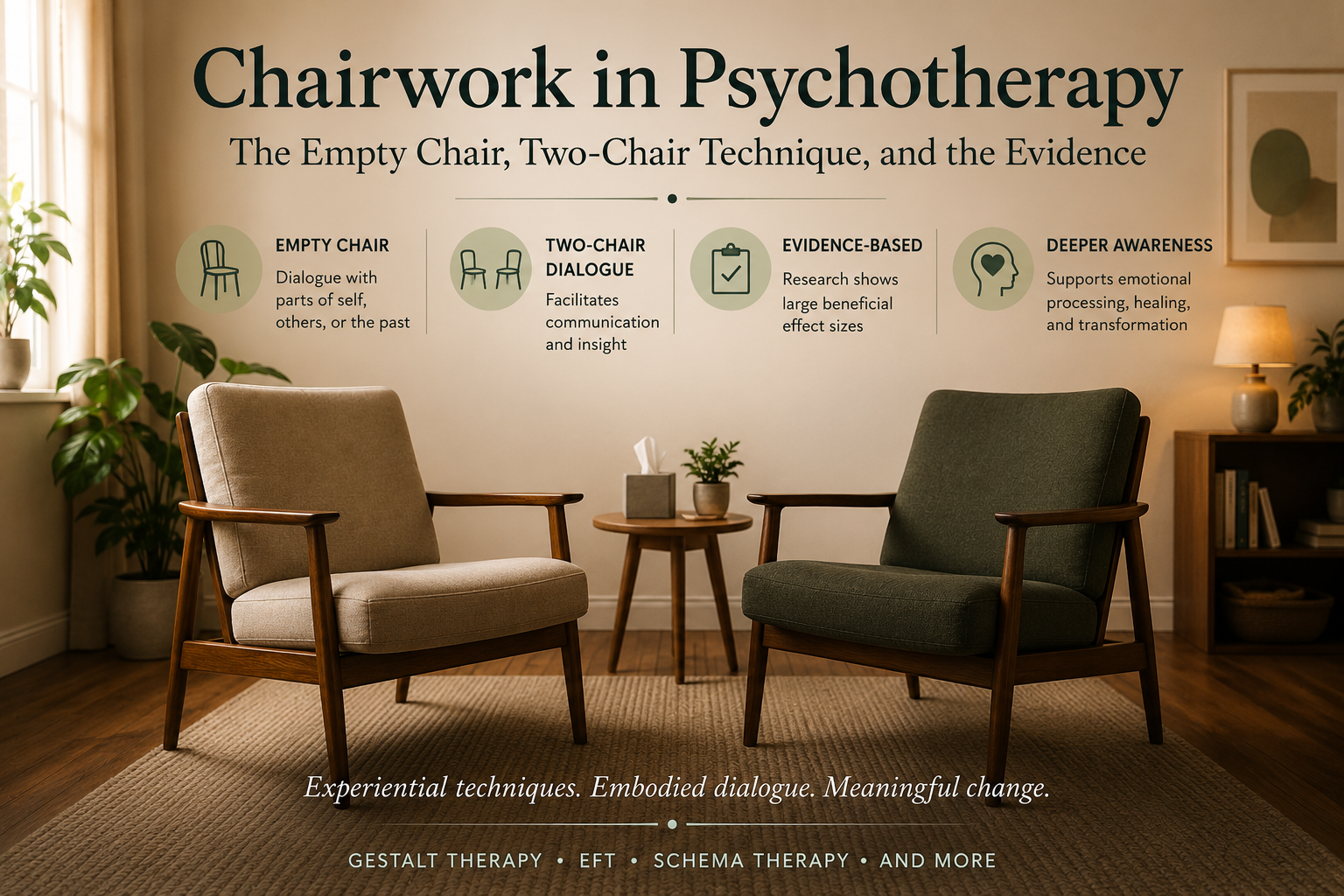
Chairwork is an umbrella term describing a family of experiential therapeutic techniques that use the physical arrangement of one or more chairs to facilitate dialogue, enactment, and emotional processing within a psychotherapy session. Originating within Gestalt therapy, chairwork is now a core component of Emotion-Focused Therapy (EFT), Schema Therapy, Compassion-Focused Therapy (CFT), and several cognitive-behavioural approaches. Contemporary research places it among the most effective experiential psychotherapy interventions currently studied: a 2023 meta-analysis by Pascual-Leone and Baher found a pre-to-post effect size of d = 1.73 within individual sessions of chairwork, and a cumulative treatment effect of d = 0.40 when chairwork was incorporated across multiple sessions compared to treatments that did not use it.
GestaltReview.com · Technique & Evidence · Experiential Psychotherapy
Chairwork in Psychotherapy The Empty Chair, Two-Chair Technique, and the Evidence
What chairwork is, how it works across different therapeutic models, and what contemporary research — including systematic reviews, meta-analyses, and randomized controlled trials — currently supports about its effectiveness.
Introduction: What Is Chairwork?
At its simplest, chairwork refers to therapeutic techniques in which the physical positioning of one or more chairs — and the movement between them — is used to facilitate enactment, dialogue, and emotional processing in psychotherapy. The technique might involve a client speaking to an imagined figure seated in an empty chair beside them; moving between two chairs to voice an internal conflict from two distinct positions; or embodying different aspects of the self in a structured dialogue mediated by physical location in space.
Chairwork is experiential rather than cognitive. Where cognitive approaches primarily work through thought — examining the content of beliefs, evaluating evidence, restructuring cognitions — chairwork works through enacted experience: the client does not simply discuss their relationship with a critical parent but speaks to that parent directly, in the present tense, and discovers in the doing of it what they could not access through narration or analysis. The physical dimension of the work — the use of space, movement, and embodied presence — is not incidental to its effectiveness but is a primary mechanism of it.
What makes chairwork distinctive in the contemporary psychotherapy landscape is its theoretical flexibility. Unlike many specific techniques that belong to a single therapeutic tradition, chairwork has been adopted, adapted, and empirically investigated across Gestalt therapy, Emotion-Focused Therapy, Schema Therapy, Compassion-Focused Therapy, psychodrama, transactional analysis, and cognitive-behavioural therapy. Each model uses chairwork in ways shaped by its own theoretical framework and clinical goals — and understanding these differences is as important as understanding what they share.
Why Chairwork Matters in Contemporary Psychotherapy
Psychotherapy research consistently identifies emotional processing depth as a predictor of therapeutic outcome. Clients who achieve genuine emotional engagement with their experience in session — who access the felt, embodied, affective dimension of their difficulties rather than discussing them from a safe cognitive distance — consistently show better outcomes than those who remain in an exclusively narrative or analytical mode. Chairwork is specifically designed to deepen this engagement: to move from talking about experience to being in it.
This emphasis on experiential depth is increasingly supported by neuroscience. The understanding that trauma, attachment patterns, and chronic emotional difficulties are held in implicit, somatic, non-verbal memory systems — rather than primarily in explicit narrative memory — suggests that techniques that access embodied and enacted experience may reach material that verbal approaches cannot reliably touch. For the broader account of how neuroscience supports experiential approaches, see our article on Gestalt Therapy and Neuroscience.
Chairwork is now used across a substantial range of therapeutic settings and clinical presentations, with a growing evidence base that places it among the most well-studied specific experiential interventions in contemporary psychotherapy. The 2026 systematic review by Ottingerová and colleagues identified 22 randomised controlled trials examining chairwork effectiveness — a body of evidence that did not exist even fifteen years ago, and that continues to grow rapidly.
Historical Origins
Chairwork originates with Fritz Perls and the Gestalt therapy tradition he developed alongside Laura Perls and Paul Goodman from the 1940s onward. Perls drew on several intellectual traditions that converged in the technique: the body-centred work of Wilhelm Reich, who understood psychological material as held in muscular and somatic organisation; the psychodramatic techniques of Jacob Moreno, who developed enacted enactment and role-switching as therapeutic methods; and Gestalt therapy's own theoretical emphasis on present-moment experiential awareness and the therapeutic value of direct, enacted contact with the material being worked with.
In Perls' clinical practice, the empty chair became the primary medium through which unfinished business — the Gestalt concept describing emotional situations that have not reached natural completion — could be addressed. Rather than simply talking about the absent person or the unresolved situation, the client engaged with it directly: speaking to the imagined other in the present tense, switching chairs to voice the other's position, and discovering through the enacted dialogue what the purely verbal account had not reached.
For the specific account of how the empty chair technique functions within Gestalt therapy's theoretical framework, see our dedicated article on The Empty Chair Technique in Gestalt Therapy. The present article focuses on chairwork as a broader family of methods across multiple therapeutic models.
From Gestalt therapy, chairwork was taken up and systematised within Emotion-Focused Therapy by Leslie Greenberg, Laura Rice, and Robert Elliott from the 1980s onward. EFT's adoption of chairwork was not simply a borrowing of technique — it involved a theoretical reframing within a distinct evidence-based clinical model, and the systematic research programme that followed has produced the majority of the current RCT and process research evidence for chairwork's effectiveness. The subsequent adoption of chairwork within Schema Therapy (Young, Klosko, and Weishaar, 2003) and Compassion-Focused Therapy (Paul Gilbert, from the 2000s onward) extended the technique's theoretical reach further, embedding it within frameworks that emphasise schema modes and self-compassion respectively.
The Two Major Chairwork Techniques
The Empty Chair Technique
The empty chair technique involves the client speaking to an imagined figure — a person from their past or present, an unresolved relationship, a part of themselves, or an abstract concept such as grief or anxiety — represented in an empty chair beside or opposite them. The client addresses the chair as if the imagined figure were actually present, using the present tense and direct speech: not "I feel angry at my father" but "I'm angry at you."
The primary targets of empty chair work are what EFT calls "unfinished business" — emotional situations with significant people in the client's life that have never reached resolution, and that continue to exert an organising influence on the client's present experience and relationships. The therapeutic aim is to bring these unresolved emotional situations toward some form of completion: typically through the expression of what was never said, the acknowledgement of a need that was never met, and some shift in how the imagined other is represented and experienced.
Within EFT, the empty chair task has been the subject of the most sustained systematic research, with specific markers for task resolution — involving a shift from other-blaming to the expression of a primary emotion and an underlying need, and a corresponding shift in the representation of the other — that can be reliably coded and used to study the mechanisms of therapeutic change.
The Two-Chair Dialogue
The two-chair dialogue technique addresses internal conflict: situations in which two distinct aspects of the self are in active opposition, and the conflict between them is generating psychological distress. In the classic EFT application, this involves what is termed a "self-interruptive split" — a part of the self that criticises, condemns, or inhibits another part — or an "ambivalence split" — conflicting desires or motivations that cannot be resolved at the level of explicit deliberation.
The client moves between two chairs, speaking from each position in turn. In chair A, they voice the critical or interruptive part; in chair B, they voice the experiencing, feeling, or aspiring part. The dialogue between the chairs allows each position to develop more fully, to respond to the other, and gradually — as the dialogue deepens — to arrive at what EFT calls a "softening": a shift in the critical voice toward greater understanding and compassion, and a corresponding shift in the experiencing self toward fuller self-assertion and self-acceptance.
Geniola and colleagues (2025) note that while all chairwork forms share common mechanisms of action — the externalisation of internal processes, the activation of embodied emotional experience, the facilitation of genuine dialogue — each technique has "distinctive procedural specificities and clinical goals" that reflect the theoretical framework within which it is deployed. Treating them as identical risks missing the nuances that distinguish productive chairwork from mere enactment.
Multiple-Chair Work
Multiple-chair work — involving three or more chairs — is used primarily in Schema Therapy's mode work, where different schema modes (the Punitive Parent, the Vulnerable Child, the Healthy Adult, and various coping modes) are spatially located in different chairs, and the client moves among them in a structured dialogue designed to reduce the power of dysfunctional modes and strengthen the Healthy Adult. This is a more complex application that requires particular training in schema theory and the specific mode model of the client being worked with.
How the Two Techniques Differ
Chairwork Across Therapeutic Models
Gestalt Therapy
The origin of chairwork. In Gestalt therapy, both empty chair and two-chair techniques serve the restoration of awareness and genuine contact. The theoretical grounding is in the contact boundary, unfinished situations, and the experiential discovery of what has been avoided or disowned. The therapist does not prescribe what the client should discover — phenomenological inquiry guides what emerges. See our article on The Empty Chair Technique in Gestalt Therapy.
Emotion-Focused Therapy
EFT has developed the most systematic and research-supported chairwork protocols. Empty chair work addresses "unfinished business" markers; two-chair work addresses "self-critical splits" and ambivalence. Specific resolution markers have been operationalised for research. EFT chairwork is embedded within a broader theory of emotion transformation.
Schema Therapy
Schema Therapy uses chairwork within a "mode model" framework. Multiple chairs may represent different schema modes (e.g., Punitive Parent, Vulnerable Child, Healthy Adult). Chairwork aims to reduce the power of maladaptive modes and strengthen the Healthy Adult's ability to meet the Vulnerable Child's needs. The Punitive Parent mode is a frequent target.
Compassion-Focused Therapy
CFT uses chairwork to apply compassion to various aspects of the self. Clients may move between a self-critical position and a compassionate position, developing the embodied, felt sense of receiving compassion from a "compassionate self." Bell and colleagues (2019) found that embodiment and externalisation in CFT chairwork were key mechanisms of change for depression.
Cognitive-Behavioural Therapy
Pugh (2017, 2019) has developed cognitive-behavioural chairwork (CBC) systematically, showing applications for restructuring distressing cognitions, resolving ambivalence, generating metacognitive awareness, bolstering self-compassion, and improving emotion regulation. CBC adapts the chairs to serve CBT-specific goals while retaining the experiential, embodied character of the method.
Other Approaches
Chairwork also appears in psychodrama (its historical parallel development), transactional analysis (for ego state work), EMDR (preparation phases), and integrative therapy. White (2023) traces chairwork's use specifically within transactional analysis for structural analysis, redecision work, and parenting dynamics.
Clinical Applications by Presenting Problem
Trauma and PTSD
Chairwork has significant applications in trauma work, where the enacted, embodied, present-tense character of the technique provides access to traumatic material at the level where it is held — in implicit, somatic, non-verbal experience — rather than in explicit narrative. The 2026 Ottingerová systematic review included PTSD among the clinical domains with robust RCT support for chairwork's efficacy. For a fuller account of trauma-informed experiential approaches, see our article on Gestalt Therapy and Trauma. Empty chair work allows the expression of anger, grief, and thwarted need toward a perpetrator or absent figure in conditions of relative safety — conditions the original traumatic situation did not provide.
Self-Criticism and Depression
Self-criticism is among the most robustly evidenced applications of chairwork. Two-chair dialogue between the self-critical and experiencing parts of the self — targeting the specific quality, content, and intensity of the critical voice and the emotional response of the experiencing self — has been studied across EFT, Schema Therapy, and CFT contexts with consistently positive results. Kroener and colleagues (2023) published the protocol of an RCT specifically designed to test a brief CBT-based emotion-focused chairwork intervention targeting self-criticism in depression. Bell and colleagues' (2019) IPA study of CFT chairwork for self-criticism found that embodying the compassionate position was a key change mechanism.
Grief and Loss
Empty chair work has a long history of application to grief — both resolved and complicated — allowing the bereaved person to speak directly to the person they have lost, express what was never said, and work toward some form of completion that pure narrative discussion cannot reach. Gamoneda and colleagues (2026) examined the emotional processes underlying successful empty chair work for complicated grief, finding that clients in successful cases were able to access and transform "core emotional pain" (such as chronic loneliness) by fully experiencing it and embracing adaptive emotional states such as connection with the deceased. The single-case study by Seen and colleagues (2021) found improvements in psychological wellbeing across six domains of Ryff's scale following empty chair therapy for grief.
Relationship Conflict and Interpersonal Injury
Empty chair work directed toward significant others with whom the client has unresolved emotional business — parents, partners, siblings, abusers — is among the most common chairwork applications in clinical practice. Paiva and colleagues (2025) piloted a brief online group intervention using empty chair work for interpersonal emotional injury, finding large effect sizes for unfinished business resolution and anxiety reduction, with significant time effects.
Anxiety
Both EFT and Schema Therapy applications of chairwork have been studied in anxiety presentations. Timulak and colleagues (2022) found large pre-post change for EFT versus CBT in generalised anxiety disorder, with comparable outcomes between approaches and significantly lower dropout in EFT (10%) than CBT (27%). Schema Therapy's mode-work chairwork is used in social anxiety and OCD, both included in the Ottingerová (2026) RCT review as domains with demonstrated efficacy.
Borderline Personality Disorder and Complex Presentations
Schema Therapy's mode chairwork is most extensively evidenced for borderline personality disorder (BPD). Josek and colleagues' (2023) qualitative study of 29 BPD patients receiving schema therapy found that all participants reported positive long-term effects of chairwork despite initial skepticism and difficulties engaging, including reduced punitive parent mode, greater self-acceptance, and improvements in interpersonal relationships. Baelemans and colleagues (2025) found that empty chair and imagery rescripting techniques in Schema Therapy effectively reduced the power of the Punitive Parent mode, including in cases presenting as auditory verbal hallucinations.
For a comprehensive account of embodied awareness practices that complement chairwork, see our article on Embodied Awareness and the Body in Gestalt Therapy.
The Pascual-Leone & Baher (2023) Meta-Analysis
Pascual-Leone and Baher's (2023) meta-analysis, published in the journal Psychotherapy, examined the effects of chairwork across 28 studies involving 774 clients. It is the most comprehensive quantitative synthesis of chairwork research to date, and its findings deserve careful, contextualised interpretation rather than either dismissal or uncritical celebration.
What d = 1.73 Means — and What It Does Not
The pre-to-post effect size of d = 1.73 refers to symptom change measured from before to after a single session of chairwork. By conventional standards (Cohen's d), a value above 0.80 is considered "large." A value of 1.73 is exceptionally large. This is a pre-to-post change within a session — not a comparison to a control group, and not a measure of maintained change over time. It reflects the intensity and immediacy of the emotional processing that chairwork can generate, not a claim that a single session of chairwork resolves a clinical problem.
The meta-analysis also found that a single session of chairwork produced changes "comparable to other methods of intervention" (d = 0.02 difference from alternative single-session interventions) — meaning the large pre-to-post effect is real but not necessarily unique to chairwork compared to other intensive single-session interventions. The finding that distinguishes chairwork more clearly is the cumulative effect: d = 0.40 when chairwork was incorporated across multiple sessions compared to treatments that did not use it. This is a moderate-to-large effect and represents the most clinically meaningful finding for practitioners considering whether to incorporate chairwork into sustained treatment.
The meta-analysis also found that chairwork outperformed empathic responding for deepening client experiencing (g = 0.90) — a finding with specific clinical significance for therapists deciding when to use chairwork versus remaining in empathic reflection mode. When the goal is to deepen the client's contact with their own emotional experience, chairwork shows a clear advantage.
"d = 1.73 is a session-level pre-to-post effect — very large, and genuinely significant. But the d = 0.40 cumulative effect across treatment is the finding that most directly informs clinical practice."
The Ottingerová et al. (2026) Systematic Review of RCTs
Ottingerová and colleagues' (2026) systematic review, published in Frontiers in Psychology, represents the first comprehensive synthesis of randomised controlled trial evidence for chairwork specifically. Following PRISMA guidelines and using the Cochrane Risk of Bias 2.0 tool, the review identified 22 RCTs examining chairwork across diverse clinical domains and therapeutic approaches.
Key Findings — Ottingerová et al. (2026)
Clinical domains with RCT support: depression, childhood trauma, unfinished business, obsessive-compulsive disorder (OCD), post-traumatic stress disorder (PTSD), social anxiety, and eating disorders. This is a broader clinical reach than has typically been associated with chairwork in the psychotherapy literature.
Effect size range: Cohen's d = 0.20 to 1.73 across studies — from small to very large, depending on outcome measure, population, and comparison condition. The variability reflects genuine heterogeneity in the populations and protocols studied, not inconsistency in the basic finding of efficacy.
Therapeutic modalities: Chairwork was effective both as a core experiential component within broader frameworks (notably EFT) and as a stand-alone intervention. This finding is practically important: it suggests that chairwork's efficacy does not depend on being delivered within a specific theoretical model, though the model shapes how and for what it is used.
Format: Evidence supported chairwork effectiveness in individual, group, and family therapy formats. No relevant couple therapy RCTs were identified.
Risk of bias: Independent assessment using Cochrane Risk of Bias 2.0 was conducted. The review provides certainty assessments for individual studies rather than a single overall rating — practitioners should consult the full review for these assessments.
Geniola and colleagues' (2025) complementary narrative review reached a consistent conclusion: chairwork "emerges as a family of interventions characterized by applicative versatility and trans-theoretical therapeutic potential," while calling for greater methodological standardisation and controlled studies across different modalities.
RCT Evidence by Modality
Emotion-Focused Therapy
EFT has the most developed RCT evidence base among the approaches using chairwork, and much of the chairwork-specific evidence comes from EFT-based studies. Timulak and colleagues (2022) compared EFT and CBT for generalised anxiety disorder in a feasibility RCT (n = 58), finding large pre-post change in both conditions with comparable outcomes and notably lower EFT dropout (10% vs 27%). Aardal and colleagues (2025) found comparable outcomes between EFT and CBT for major depression in a Norwegian pilot RCT (n = 107; d = 0.56 pre-to-follow-up across both conditions). Wiebe and colleagues' (2025) RCT of Emotionally Focused Individual Therapy (EFIT, n = 88) found significant reductions in symptom distress, depression, and anxiety compared to a 15-week waitlist control across 15 sessions.
Schema Therapy
Schema Therapy's RCT evidence is primarily for borderline personality disorder rather than for chairwork specifically, but chairwork is a core component of the model. Assmann and colleagues' (2024) direct comparison RCT of Schema Therapy vs Dialectical Behaviour Therapy for BPD (n = 164) found large pre-to-follow-up effect sizes for both conditions (Schema Therapy: d = 1.78; DBT: d = 2.45), with no statistically significant difference between them — establishing Schema Therapy as comparably effective to DBT for BPD. Chairwork, as a core ST component, was an active element in these improvements.
Gestalt Therapy
Gestalt therapy's RCT evidence base is smaller than EFT's or Schema Therapy's — a limitation of research investment rather than clinical effectiveness. For the most current account of the Gestalt therapy evidence base, see our article on Gestalt Therapy Research and Evidence Base.
Compassion-Focused Therapy
CFT chairwork research is primarily at the case study and qualitative level, with Bell and colleagues' (2019) IPA study of 12 participants providing the most detailed account of the mechanisms through which CFT chairwork produces change in depression: embodiment and enactment, externalisation of the self in physical form, and emotional intensity. Controlled trials specifically for CFT chairwork are at early stages.
What the Current Evidence Supports
Drawing across the meta-analytic, systematic review, and RCT evidence, the following conclusions are supported by current research with reasonable confidence:
Chairwork deepens emotional processing within sessions. The process research finding that chairwork outperforms empathic responding for deepening client experiencing (g = 0.90, Pascual-Leone & Baher, 2023) is consistent and clinically meaningful for practitioners deciding when to introduce chairwork versus remaining in reflective mode.
Chairwork incorporated across treatment produces meaningful additional benefit. The cumulative d = 0.40 versus non-chairwork treatments is the most directly applicable finding for clinical practice decisions. Across the studies in the Pascual-Leone & Baher (2023) meta-analysis, incorporating chairwork into treatment — regardless of the specific modality — added meaningful benefit to outcomes.
Chairwork is effective across a range of clinical presentations. The Ottingerová (2026) systematic review confirmed RCT evidence for efficacy across depression, trauma, unfinished business, OCD, PTSD, social anxiety, and eating disorders. The clinical reach of chairwork is broader than its origins in Gestalt therapy might suggest.
Different therapeutic models use chairwork differently, with different targets and mechanisms. The finding from Pascual-Leone & Baher (2023) that "therapeutic orientation emerged as a potential moderator" is consistent with this — different approaches may be better suited to different applications and populations.
Limitations of the Evidence
Important Limitations — What the Evidence Cannot Yet Claim
Heterogeneity of studies. The 22 RCTs identified by Ottingerová and colleagues vary substantially in population, clinical presentation, therapeutic model, outcome measures, session number, and comparison conditions. The overall finding of efficacy is robust, but the variability limits precision about for whom and under what conditions chairwork is most effective.
The d = 1.73 figure requires contextualisation. This is a within-session, pre-to-post effect size — not a controlled comparison to a waitlist or active comparator. It reflects the emotional intensity of chairwork sessions, not an unqualified claim about treatment superiority. Clinicians presenting this figure to clients or commissioners should contextualise it clearly.
Model-specific evidence is unevenly distributed. EFT has the strongest and most developed chairwork-specific RCT evidence. Schema Therapy's evidence is robust for BPD but primarily at the modality level rather than chairwork-specific. Gestalt therapy's RCT evidence base is smaller. CFT and CBT chairwork evidence is at earlier stages. Claims about any specific approach should be calibrated to the evidence actually available for that approach.
Publication bias and sample sizes. Many individual studies are small, and positive results are more likely to be published. The systematic reviews acknowledge these limitations; practitioners should weight findings from larger, well-controlled studies more heavily than case series or single-case designs.
Long-term follow-up data are limited. Most research examines outcomes at post-treatment or short-term follow-up. Evidence for the maintenance of chairwork-specific gains at 12 months or beyond is limited across most modalities.
Clinical Considerations and Contraindications
Setting Up Chairwork
Introducing chairwork requires clear rationale-giving, client preparation, and explicit consent — particularly because the technique is unfamiliar to most clients and because its experiential, enactive character may initially seem unusual or even threatening. Pugh and colleagues (2022) demonstrated that even for social anxiety — where therapist-client relationship development is often positioned as a prerequisite for intensive techniques — chairwork can be introduced in a single session and can simultaneously strengthen rather than require a pre-existing strong alliance.
Josek and colleagues' (2023) qualitative study of BPD patients' experiences with schema therapy chairwork identified initial skepticism, shame, and a sense of ridiculousness as common initial responses. Therapist behaviors that facilitated engagement included providing genuine safety, clear guidance through the process, flexible application according to individual needs, and sufficient time for debriefing. These practical considerations are clinically important regardless of theoretical orientation.
Contraindications and Cautions
Chairwork is not appropriate for all clients or all moments in therapy. Specific cautions include: active psychosis or severe dissociation, where the capacity to maintain dual awareness (engaging with the enactment while retaining a grounded observing perspective) may be insufficient; very early stages of therapy where the therapeutic relationship is not yet established enough to support the emotional intensity that chairwork can generate; active suicidal crisis; and presentations where the clinical priority is stabilisation rather than processing. For clients with significant trauma histories, the pacing and titration of chairwork requires careful clinical judgment and trauma-informed training.
Holmström and colleagues (2024) identified "difficulties many clients face with engaging in chair work" as a documented clinical phenomenon, and proposed the "chair work with the empathic other" modification — introducing a need-supportive third position — as a potential solution for clients who find standard empty chair work difficult to engage with.
Tele-Chairwork
The rapid expansion of tele-therapy has raised specific questions about chairwork's delivery online. Pugh and colleagues' (2020) qualitative survey of 41 expert tele-chairwork practitioners found divided opinion and identified both practical challenges (camera angle, limited depth perception, technology failure) and unexpected benefits (convergence of therapy and home environment enabling greater accessibility and contextual richness). The consensus was that tele-chairwork is feasible but requires specific adaptation rather than simple direct transfer of in-person methods.
Frequently Misunderstood Aspects of Chairwork
"Chairwork is just about expressing anger at a parent." This is a caricature that captures one possible application but misses the full range of the method. Chairwork is used to address grief, ambivalence, self-criticism, compassion deficits, anxiety, schema modes, unfinished business of many kinds, and the internal conflicts of daily living. The emotional content that emerges is not prescribed — anger is not the goal; genuine emotional contact with whatever is actually present is.
"The physical chair is just a prop." The chair is not a prop — the physical, spatial dimension of chairwork is a primary mechanism of its effectiveness. Bell and colleagues' (2019) IPA study specifically identified "embodiment and enactment" and "externalizing the self in physical form" as key mechanisms. The chair makes internal processes external, spatially distinct, and physically enactable in ways that transform their psychological availability to awareness and change.
"Chairwork is the same as talking to yourself." Chairwork is fundamentally different from internal dialogue or solitary self-reflection. The physical presence of the therapist, the spatial structure of the chairs, the enacted quality of the technique, and the guidance and co-regulation provided by the therapist's attunement all contribute to an experiential quality that is genuinely different from anything that happens in private reflection.
"Only Gestalt therapists use chairwork." As the research evidence makes clear, chairwork is now used across EFT, Schema Therapy, CFT, CBT, psychodrama, transactional analysis, and integrative approaches. Gestalt therapy originated it and continues to hold one of the richest theoretical accounts of why and how it works, but chairwork has become genuinely trans-theoretical.
Future Directions
The most important research needs in the chairwork literature are clear. First, larger and more rigorous RCTs are needed across all therapeutic models — particularly Gestalt therapy, CFT, and cognitive-behavioural chairwork, where the evidence remains preliminary. Second, longer-term follow-up data are needed across all domains to establish whether chairwork-specific gains are maintained at 12 months and beyond. Third, the active ingredients of chairwork need to be more precisely identified — specifically, what it is about the physical, spatial, enacted dimension of chairwork (as opposed to its verbal content) that produces its distinctive effects.
The development of standardised chairwork fidelity measures — tools for assessing whether chairwork has been delivered in a specific way consistent with a given protocol — would enable the kind of comparative and dismantling research needed to answer these questions. The chairwork-specific outcome measures now being developed within EFT (unfinished business resolution scales, experiencing depth measures) provide models for this kind of systematic methodology.
Online delivery of chairwork will continue to be investigated as tele-therapy becomes more established, with the specific questions around embodiment, spatial experience, and therapeutic presence in video-mediated contexts requiring dedicated research rather than assumption that in-person findings transfer directly.
Conclusion
Chairwork is one of the most versatile and empirically investigated experiential intervention families in contemporary psychotherapy. It originated in Gestalt therapy's understanding of the therapeutic value of enacted, present-moment, embodied contact with experience, and has been taken up, adapted, and systematically studied across a range of therapeutic models that share a commitment to emotional processing depth as a primary mechanism of change.
The current evidence — including a meta-analysis of 28 studies and a systematic review of 22 RCTs — supports chairwork as an effective therapeutic method across a range of clinical presentations including depression, trauma, unfinished business, OCD, PTSD, social anxiety, and eating disorders. The key finding for clinical practice is the cumulative effect of d = 0.40 when chairwork is incorporated across treatment versus treatments that do not use it — a meaningful and clinically significant advantage that supports the deliberate inclusion of chairwork in treatment planning rather than its occasional use as a supplementary technique.
The d = 1.73 single-session effect size indicates the emotional intensity of well-conducted chairwork — its capacity to generate rapid and substantial within-session emotional processing. This intensity is both chairwork's greatest clinical asset and a clinical responsibility: it requires careful preparation, genuine relational safety, and skilled therapist facilitation to produce therapeutic rather than merely distressing effects.
Chairwork is not owned by any single therapeutic tradition, and clinicians across orientations can draw on it legitimately — provided they understand the theoretical framework within which they are using it and the specific procedural requirements of the technique being employed. The differences between Gestalt therapy's empty chair, EFT's unfinished business task, Schema Therapy's mode work, and CFT's compassion chairs are real and theoretically significant, and conflating them risks losing the precision that makes each approach maximally effective for specific clinical targets.