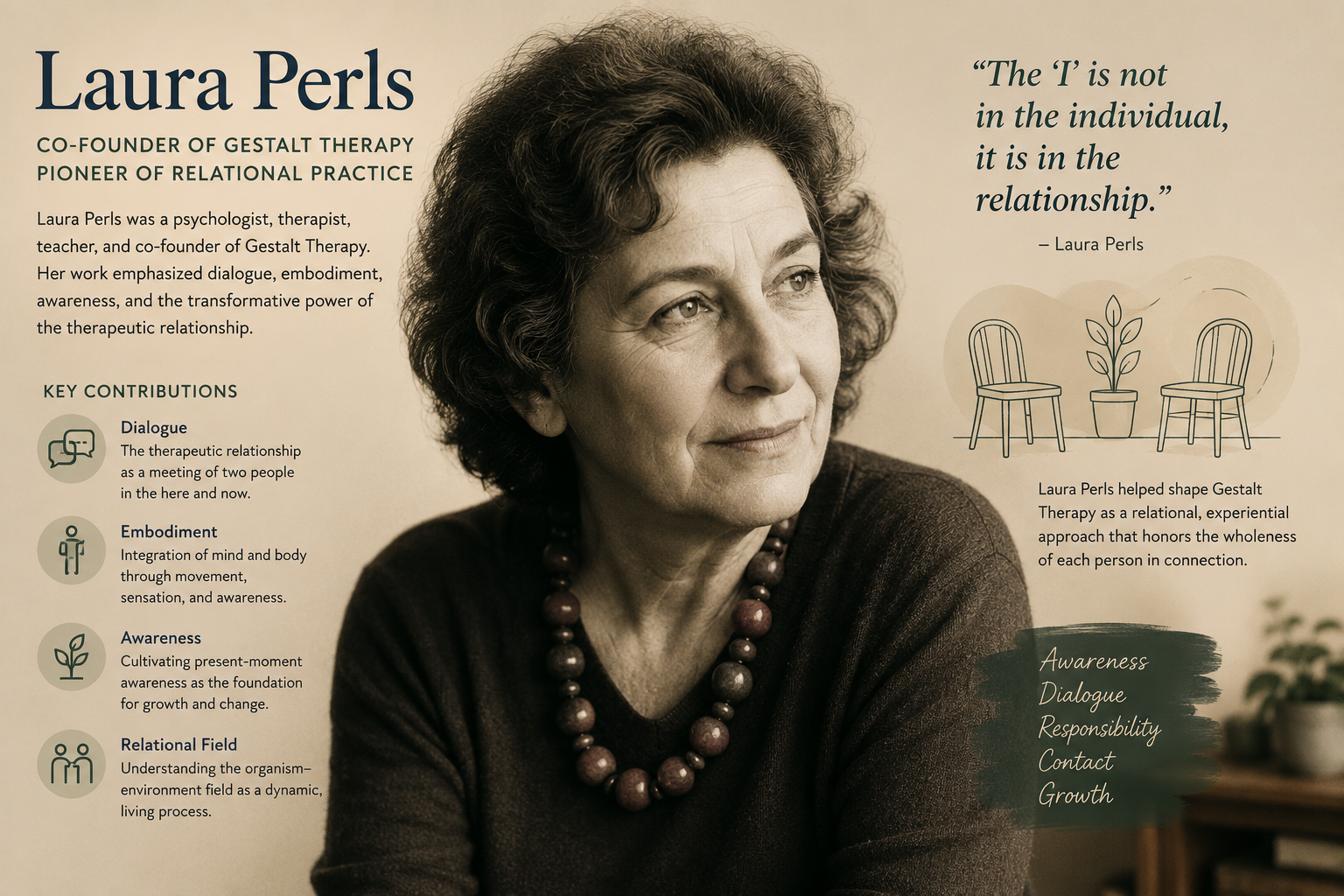
Laura Perls (1905–1990) was a co-founder of Gestalt therapy whose contributions to the approach were as foundational as Fritz Perls' clinical innovations or Paul Goodman's theoretical architecture — and whose influence on contemporary Gestalt therapy, particularly its relational, dialogical, and embodied dimensions, has been consistently underacknowledged. A philosopher, dancer, concert pianist, and psychotherapist trained directly in phenomenology and existential thought, she brought to Gestalt therapy the philosophical depth and the understanding of relationship that distinguishes it from its contemporaries and that continues to shape how Gestalt therapy is practised today.
GestaltReview.com · Biography & History · Founders
Laura Perls Co-Founder of Gestalt Therapy and the Architect of Relational Practice
The philosopher, dancer, psychotherapist, and thinker who gave Gestalt therapy its dialogical foundations, its understanding of embodied contact, and its insistence that the therapeutic relationship — not the technique — is the primary medium of genuine change.
Born
15 August 1905, Pforzheim, Germany
Died
13 July 1990, Frankfurt, Germany
Known for
Co-founding Gestalt therapy; emphasis on dialogue, embodiment, and relational practice; New York Institute for Gestalt Therapy; training generations of Gestalt therapists
Fields
Psychotherapy, phenomenological philosophy, dance and movement, music, existential thought
Introduction
For much of its history, the public face of Gestalt therapy has been Fritz Perls: the charismatic, confrontational clinician whose demonstrations at Esalen made Gestalt therapy internationally visible and whose dramatic public persona defined how the approach was understood, both inside and outside the field. This visibility came at a cost — not least to the historical understanding of who actually created Gestalt therapy and what it originally stood for. Laura Perls, Fritz's wife and intellectual partner, and Paul Goodman, the philosopher who wrote the theoretical foundations of the 1951 text, were both largely eclipsed by the force of Fritz Perls' personality and the popular culture of the encounter movement he embodied.
In Laura Perls' case, the erasure is particularly significant and particularly well documented by scholars. She was not simply Fritz Perls' wife who happened to be involved in the early development of Gestalt therapy. She was a fully formed intellectual — trained in phenomenological philosophy and existential thought at the highest level, a concert pianist and movement-trained dancer with a sophisticated understanding of embodied experience, and a psychotherapist whose clinical style was in many respects directly opposed to Fritz's. When Serlin (1992) wrote that Laura's story needed to be told because "women's narratives are often not heard, and because Laura wrote very little," she identified both the problem and one of its sources: Laura Perls consistently prioritised practice over publication, preferring to convey her ideas through direct clinical work and teaching rather than through the texts that would have secured her historical reputation.
This article aims to correct that imbalance. It does so not by diminishing Fritz Perls or Paul Goodman — whose contributions to Gestalt therapy are addressed in their own dedicated articles — but by recovering what was always there: the intellectual depth, the philosophical grounding, the specific theoretical contributions, and the distinctive clinical orientation of one of the most significant figures in twentieth-century psychotherapy.
Early Life and Education
Lore Posner — who would later be known as Laura Perls — was born on 15 August 1905 in Pforzheim, a town in the Black Forest region of Baden, Germany. She was the daughter of a prosperous middle-class Jewish family; her father was a merchant, and the family's cultural life was rich. She showed extraordinary musical aptitude from early childhood and was a concert-level pianist before reaching adulthood — a training that would later shape her understanding of rhythm, timing, contact, and the embodied relationship between performer and audience in ways that proved directly relevant to her clinical work.
She studied psychology at the Johann Wolfgang Goethe University in Frankfurt, where she encountered the vibrant intellectual milieu of the Weimar Republic's most dynamic university city. Frankfurt in the late 1920s was home to, among others, Max Wertheimer — one of the founding figures of Gestalt psychology — and it was through Wertheimer's lectures and seminars that Lore Posner first encountered the Gestalt perceptual principles that would later inform the therapeutic tradition she co-created. She attended Wertheimer's seminars directly and was deeply influenced by his account of organised experience, holistic perception, and the dynamic relationships between figure and ground.
It was also in Frankfurt that she studied philosophy under Paul Tillich — the existential theologian whose thought connected religious experience with existential philosophy in ways that informed Laura Perls' later clinical emphasis on meaning, ground, and the existential dimensions of therapeutic encounter. And she studied with Martin Buber — the philosopher of dialogue and the I-Thou relation — whose influence on Laura Perls' understanding of the therapeutic relationship was, if anything, deeper and more direct than his influence on Fritz.
Philosophical Formation: Phenomenology, Existentialism, and Buber
Laura Perls' philosophical training is one of the most significant and most underemphasised facts about Gestalt therapy's intellectual genealogy. Where Fritz Perls came to phenomenology and existential philosophy relatively indirectly — through his reading, his clinical observations, and his encounter with Goldstein's holistic neurology — Laura came to these traditions through direct academic formation at their German source. Boris (2017) confirms that Laura Perls and Goodman channelled Gestalt psychology, Goldstein, and phenomenological thought (including Brentano, Husserl, and Merleau-Ponty) into Gestalt therapy's foundations, and that this influence was carried primarily through Laura's direct philosophical training rather than through secondary sources.
Buber's I-Thou philosophy was particularly central to Laura Perls' understanding of both the therapeutic relationship and human existence more broadly. Buber's distinction between I-It relating — in which the other is encountered as an object to be used, observed, or analysed — and I-Thou relating — in which the other is encountered as a full subject in genuine present-moment meeting — became for Laura the fundamental model of what a therapeutic relationship could and should be. The therapist who genuinely meets the client, who is genuinely present and genuinely affected by the encounter, who does not manage or manipulate the client from behind a professional neutrality, but who risks genuine encounter — this is Buber's I-Thou model directly translated into therapeutic practice. Serlin (1992) noted that Laura studied with Buber directly, an intellectual connection that distinguished her clinical philosophy from the more technique-centred approach that Fritz Perls would later develop.
Laura was also deeply influenced by existential philosophy's account of human existence as essentially situated, temporal, embodied, and relational. Her later insistence — reflected in her reported remark that she had wanted to call the emerging therapy "existential therapy" rather than "Gestalt therapy" — reflected her sense that the most fundamental thing the new approach had to offer was not a set of techniques or even a distinctive theory of perception, but a genuinely existential orientation to the human being: one that took seriously the person's situation, temporality, embodied presence, and capacity for genuine dialogical meeting.
"Laura Perls wanted to name the new therapy 'existential therapy.' She lost the argument — but her existential orientation gave Gestalt therapy much of its philosophical depth."
For a comprehensive account of how phenomenology and existentialism inform Gestalt therapy's clinical practice, see our article on Phenomenology and Gestalt Therapy.
The Body, Dance, and Somatic Awareness
Laura Perls' engagement with the body was not simply theoretical. She was trained in movement and dance — an artistic discipline that gave her a direct, pre-reflective understanding of how the body carries experience, communicates without language, and participates in relationship in ways that purely verbal accounts of experience cannot reach. This background in movement was not incidental to her contribution to Gestalt therapy; it was a primary source of the embodied clinical sensibility that distinguishes the approach from more cognitively oriented psychotherapies.
Gregory (2001), in a study of what she calls "Lost Gestalt Ancestors," documents the significant influence of the German body awareness teacher Elsa Gindler on both Fritz and Laura Perls. Gindler, who taught a systematic approach to developing awareness of bodily experience, breath, and movement, was a significant figure in the German somatic tradition of the 1920s and 1930s. Gregory establishes that Laura Perls was directly influenced by Gindler's work, and that this influence was a primary source of Gestalt therapy's emphasis on bodily awareness, breath, and somatic contact as clinical instruments. Laura was also trained in dance more formally — Serlin (1992) identifies her as a dancer as well as a concert pianist — and this dual artistic formation gave her an embodied intelligence that she brought directly into her clinical work and her teaching.
In her clinical practice, Laura Perls attended to the body continuously: to the quality of a person's breath, to the postural organisation that expressed their contact style, to the somatic aspects of their way of being present in the room. This was not technique — it was the natural expression of someone who had spent years in disciplines that required the cultivation of bodily awareness and the capacity to read physical experience with precision. For the full account of how embodied awareness functions in contemporary Gestalt practice, see our article on Embodied Awareness and the Body in Gestalt Therapy.
Meeting Fritz Perls
Lore Posner met Friedrich (Fritz) Perls in Frankfurt in 1926, when she was twenty-one and he was thirty-three. Fritz was at that time a psychoanalytic trainee with connections to the psychoanalytic circles in Frankfurt and Berlin, and was beginning the intellectual journey away from orthodox Freudianism that would eventually produce Gestalt therapy. Their relationship was immediately both romantic and intellectual: Lore possessed philosophical training and musical and somatic sensibility that Fritz lacked, and Fritz possessed clinical experience, intellectual boldness, and a restless innovative energy that complemented her deeper, more systematic philosophical orientation.
They married in 1929. Their collaboration on what would become Gestalt therapy began in the early years of their marriage, long before the formal founding of the approach — Resnick (2015) places the beginning of their joint development of Gestalt therapy in the mid 1920s, though the formal publication did not appear until 1951. Their first joint clinical work was in South Africa, where the family relocated from Germany and the Netherlands in 1934 as the Nazi regime made remaining in Germany increasingly dangerous for Jewish intellectuals. Fritz founded a psychoanalytic training institute in Johannesburg, and Laura practised alongside him while continuing her own clinical and philosophical development. De et al. (2018) document that the concept of aggression — central to the early development of Gestalt therapy's account of the organism's relationship with its environment — was developed by Fritz and Laura together through their observation of children, not by Fritz alone.
The Development of Gestalt Therapy
The development of Gestalt therapy from the mid 1930s to the publication of the 1951 foundational text was a collaborative project in which Laura Perls' contributions were genuine and substantial, though they were largely unacknowledged in the public account that solidified around the history of the approach. The joint intellectual work during the South African years produced material that fed directly into Ego, Hunger and Aggression (1942/1947), Fritz Perls' first book, to which Laura contributed sections — a contribution that was acknowledged in the first South African edition but removed from the later American edition in a pattern that would characterise the broader erasure of her contribution.
When the family moved to New York in 1946, Laura and Fritz began the period of collaboration that produced the 1951 text and established the New York Institute for Gestalt Therapy. The New York intellectual environment — politically engaged, culturally diverse, sceptical of institutional authority — provided conditions in which the emerging approach could develop. Fritz's encounter with Paul Goodman was facilitated partly by the overlapping political and intellectual networks of New York's post-war left, and the three-way collaboration that produced the 1951 text drew on Fritz's clinical innovation, Goodman's philosophical and theoretical architecture, and Laura's phenomenological grounding and clinical experience.
The 1951 Founding Book
Gestalt Therapy: Excitement and Growth in the Human Personality (1951) appeared under the names of Frederick Perls, Ralph Hefferline, and Paul Goodman. Laura Perls' name is absent from the title page, a fact that has attracted scholarly attention and that reflects in miniature the broader pattern of her contribution being formally unacknowledged even when substantively present. Various accounts suggest that Laura was closely involved in the discussions and clinical demonstrations from which the book emerged, and that her philosophical orientation — particularly the Buberian dialogical dimension — is visible throughout the theoretical sections that Goodman wrote.
The practical sections of the book — the awareness exercises through which the reader is invited to discover the approach's key insights experientially — reflect clinical sensibilities that are consistent with what we know of Laura's clinical work: the attention to breath, embodied experience, sensory awareness, and the relationship between the person and their immediate environment. Whether these specific contributions were directly authored by Laura or whether they reflect a shared clinical orientation developed collaboratively over two decades of joint work is not definitively established in the historical record, and intellectual honesty requires acknowledging this ambiguity. What is clear is that the phenomenological and existential dimensions of the 1951 text reflect a philosophical tradition to which Laura Perls had a more direct, formal, and substantive relationship than Fritz Perls did.
For a comprehensive account of the 1951 text and its theoretical architecture, see our articles on Fritz Perls and Paul Goodman.
Laura Perls' Independent Theoretical Contributions
Dialogue and the I-Thou Therapeutic Relationship
Laura Perls' most distinctive and most clinically influential contribution was her understanding of the therapeutic relationship as a genuine I-Thou encounter — a meeting between two fully present persons in which the therapist's genuine presence, genuine responsiveness, and genuine willingness to be affected is not a supplement to the clinical work but its primary vehicle. This was not simply Buber applied to psychotherapy; it was a worked-out clinical position with specific implications for how the therapist should be present, what "technique" means and doesn't mean, and what makes therapy genuinely therapeutic rather than merely professionally competent.
Bloom (2005), in his centennial celebration of Laura Perls, identifies her "early dialogic practice" as one of her most significant theoretical contributions, and describes her clinical philosophy as fundamentally organised around genuine encounter rather than technical intervention. This dialogical orientation is the direct opposite of the hot-seat technique associated with Fritz Perls' Esalen demonstrations, in which the therapist's provocative, confrontational interventions were directed at a client who was not invited to genuinely encounter the therapist as a person but to engage with their own material under the therapist's challenging direction. Laura's version of Gestalt therapy insists that genuine therapeutic contact requires genuine contact — in both directions.
Support and Contact as Foundational Concepts
Bloom (2005) identifies "contact and support as two central pillars of Gestalt therapy" that are particularly associated with Laura Perls' theoretical contributions. While contact appears in the 1951 text as a foundational concept, the specific elaboration of support — what the organism requires in order for genuine contact to be possible, and what the therapist's role is in providing or facilitating that support — reflects Laura's orientation toward the relational and developmental conditions of therapeutic change more than the 1951 text's organism-environment field framework alone.
Laura Perls understood support not as a supplementary comfort offered to distressed clients but as a foundational element of the contact process itself: the organism can only make genuine contact with what is genuinely other — including its own avoided experience — from a position of adequate support. The therapeutic relationship's provision of support is therefore not a preparatory phase before the real work begins but the ongoing condition within which genuine therapeutic contact becomes possible. This understanding is closely related to contemporary relational Gestalt theory's emphasis on the therapeutic relationship as primary medium, and it reflects an orientation that Laura Perls articulated decades before it became the mainstream position of contemporary relational Gestalt practice.
Embodiment, Movement, and Aesthetic Sensitivity
Laura Perls brought to Gestalt therapy a somatic intelligence — rooted in her training as a concert pianist, her movement education, and her engagement with Elsa Gindler's body awareness work — that gave the approach its distinctive attention to breath, posture, gesture, and the physical dimensions of the therapeutic encounter. Amendt-Lyon (2001) specifically credits Laura Perls with developing "the aesthetic and creative dimensions of Gestalt therapy" — an account that connects her musical and artistic training with her clinical approach in ways that are not incidental but constitutive of what she brought to the approach.
The concept of "aesthetic criterion" — the therapist's use of an aesthetically informed sensibility to assess the quality and completeness of therapeutic contact — is associated particularly with Laura Perls in Bloom (2005)'s account. This is not a technical criterion (did the intervention follow the protocol correctly?) or an outcome criterion (did the symptoms reduce?) but a quality criterion: does the therapeutic encounter have the quality of genuine, full, appropriately formed contact? Is there something in it that has the character of good art — of form that genuinely expresses and communicates what it is trying to express and communicate?
Awareness and the Present Moment
Laura Perls' understanding of awareness was grounded in her phenomenological training rather than in the more behaviourally or catharsis-oriented account that sometimes characterised Fritz Perls' later clinical demonstrations. For Laura, awareness was not primarily a tool for producing dramatic emotional release or behavioural change — it was the quality of genuine present-moment contact with one's own experience and with the other person, cultivated through the kind of patient, phenomenologically disciplined attention that her philosophical training had taught her to sustain.
Her attention to the present moment was also shaped by her musical training: a concert pianist who is not genuinely present to the current moment of the music — who is already anticipating the next bar while still in the current one, or still managing the aftermath of a previous passage — is not making genuine music. The quality of musical presence that requires full, embodied, attentional engagement with what is happening right now has a direct clinical parallel in what Laura Perls understood as therapeutic awareness.
The New York Institute for Gestalt Therapy
The New York Institute for Gestalt Therapy (NYIGT) was founded in 1952, one year after the publication of the foundational text, by Fritz and Laura Perls together with a small group of colleagues including Paul Goodman, Isadore From, and Paul Weisz. It was the first formal Gestalt therapy training institution and remained the primary East Coast centre for Gestalt training for decades.
After Fritz Perls relocated to California in the 1960s and subsequently moved to Esalen in 1964, Laura remained in New York, taking primary responsibility for the ongoing development of the Institute and its training programme. This geographical and institutional division had significant consequences for how Gestalt therapy developed in the following decades: Fritz's work at Esalen, heavily documented through films, workshop recordings, and his own writings, became the dominant public image of Gestalt therapy; Laura's work at the NYIGT — quieter, more relational, more philosophically grounded, and largely confined to direct teaching and clinical demonstration rather than publication — remained comparatively invisible outside the community of therapists she trained.
The therapists trained by Laura Perls at the NYIGT, however, carried her clinical orientation directly into their own practice and training, and the relational, dialogical orientation that characterises contemporary Gestalt therapy — as distinct from the hot-seat, catharsis-centred approach associated with Fritz's Esalen period — is substantially a product of Laura Perls' sustained influence through the New York community. Michael Vincent Miller, a past president of the NYIGT who worked extensively with Laura Perls, articulates the aesthetic and dialogic orientation she transmitted as central to what distinguishes a serious engagement with Gestalt therapy from the technique-centred caricature (Cole, 2024).
Laura Perls Compared with Fritz Perls
The contrast between Laura and Fritz Perls is not simply a difference in personality but a difference in clinical philosophy with genuine theoretical implications. Laura's insistence on genuine dialogical presence as the primary therapeutic instrument, her emphasis on support as a precondition of genuine contact, and her grounding in phenomenological method produced a version of Gestalt therapy that was consistent in ways Fritz's Esalen period was not with the theoretical commitments of the 1951 founding text. Wymore (2009) notes that none of the first circle of therapists trained by Fritz and Laura practised the aggressive, confrontational style of Fritz's Esalen demonstrations — a fact that suggests Laura's clinical orientation was closer to what the founders actually intended than the public image that Fritz's later career projected.
Laura Perls Compared with Paul Goodman
Where Paul Goodman's contribution to Gestalt therapy was primarily philosophical and theoretical — the organism-environment field ontology, the theory of self as process, the concept of creative adjustment, the anarchist social philosophy that positioned individual health within the conditions of social organisation — Laura Perls' contribution was primarily clinical, phenomenological, and dialogical. The two contributions are complementary rather than redundant.
Goodman provided Gestalt therapy with a comprehensive philosophical framework — a way of understanding what kind of thing a human being is, what the conditions of genuine health are, and how social organisation can support or obstruct them. Laura provided Gestalt therapy with a way of being with another person in the therapeutic encounter — an orientation to the quality and character of the relationship that could not be derived from Goodman's theoretical framework alone, however sophisticated that framework was.
Both Goodman and Laura drew on Buber — but they drew on different aspects of Buber's thought. Goodman engaged with the philosophical and social-political dimensions; Laura engaged with the relational and dialogical ones. Together, their contributions give Gestalt therapy a depth of philosophical grounding that neither alone could have provided. For the full account of Goodman's theoretical contributions, see our article on Paul Goodman.
Teaching and International Influence
Laura Perls taught extensively throughout her career, and her influence on the development of Gestalt therapy was conveyed primarily through direct personal contact with students and trainees rather than through publication. This was a deliberate choice as much as a practical one: she believed, consistent with Gestalt therapy's foundational commitments, that the approach was not primarily transmissible through text but through the quality of lived encounter between teacher and student. A clinician who had worked with Laura Perls — who had experienced directly her quality of presence, her attentiveness, her patient phenomenological inquiry, her somatic sensitivity — carried something from that encounter that no amount of reading could fully replicate.
In her later years, Laura Perls taught internationally — particularly in Germany and across Europe, where she participated in Gestalt therapy conferences and training events until close to the end of her life. She died in Frankfurt in July 1990, having returned to Germany for a conference. Her death in the country from which she had been forced to flee as a Jewish woman in 1933 carried a historical resonance that those who knew her found deeply moving.
The Milan interview of 1987, conducted by Milan Sreckovic and introduced by Bernd Bocian (Perls, 2014), provides valuable autobiographical and historical material in Laura Perls' own voice, making connections between Gestalt therapy, Buber's dialogical work, and the foundations of Gestalt psychology that she herself drew. It is one of the primary historical sources for understanding her own account of her contributions.
Major Publications
Laura Perls published sparingly by the standards of the academic world, a fact that contributed to her historical underrepresentation while reflecting her conviction that the approach was better transmitted through practice and direct encounter than through text. Her published writings include her article "Concepts and Misconceptions of Gestalt Therapy" (1992, Journal of Humanistic Psychology) — a concise account of what she understood Gestalt therapy to be and the ways in which it was commonly misunderstood — and the collection Living at the Boundary (1992, translated as Vivendo en los límites, 1994), which gathered her major papers and interviews and remains the primary source for her own articulation of her theoretical positions.
"Gestalt therapy is a phenomenological, existential, and experiential therapy — it is therapy about being and becoming, about experience, and about relationship. It is not a set of techniques."
— Laura Perls, "Concepts and Misconceptions of Gestalt Therapy" (1992)The relative slenderness of her published output should not be taken as evidence of a lesser intellectual contribution. Her ideas were transmitted primarily through direct teaching, clinical supervision, and the living demonstration of a particular quality of therapeutic presence that those who worked with her consistently describe as transformative. The fact that she chose this mode of transmission over publication was itself an expression of her clinical philosophy — the belief that genuine understanding requires genuine encounter, not merely the reading of text.
How Contemporary Gestalt Therapy Reflects Laura's Influence
The relational turn in contemporary Gestalt therapy — the shift from understanding therapeutic change as primarily produced by the therapist's skilled use of technique, to understanding it as emerging from the quality of genuine dialogical encounter between therapist and client — is, more than any other single development, a recovery of Laura Perls' original orientation rather than a departure from Gestalt therapy's foundations. The therapists associated with the relational turn — Gary Yontef, Lynne Jacobs, Gordon Wheeler, Margherita Spagnuolo Lobb, and others — have explicitly acknowledged that the relational Gestalt they articulate was already present in Laura Perls' clinical practice, even if it was articulated theoretically only later.
The contemporary emphasis on the therapist's genuine presence as an active clinical instrument — the understanding that what the therapist brings to the encounter, including their own somatic experience, genuine emotional response, and willingness to be affected — reflects Laura's Buberian orientation more directly than it does Fritz's hot-seat approach or Goodman's field-theoretic philosophy. The phenomenological stance — genuine curiosity, suspension of premature interpretation, horizontal attention to all dimensions of present experience — is the clinical attitude that Laura Perls embodied and transmitted through her teaching. For the full account of how field theory and dialogue function in contemporary Gestalt practice, see our article on Field Theory and Dialogue in Gestalt Therapy.
Modern Scholarly Reassessment
Scholarly Recognition of Laura Perls' Contributions
Serlin's (1992) tribute essay, published in the Journal of Humanistic Psychology immediately following Laura Perls' death, was among the first systematic scholarly accounts of her specific contributions and explicitly framed the need to tell her story in terms of the broader pattern of women's contributions to intellectual history being underacknowledged. Serlin identified the philosophical directness of Laura's engagement with Buber and Tillich, her artistic formation as a dancer and pianist, and her preference for what Serlin characterised as a more "feminine" — meaning relational and supportive — therapeutic orientation as the distinctive features of her contribution.
Bloom's (2005) centennial address at the Munich conference marking the hundredth anniversary of Laura Perls' birth provided a more systematic account of her theoretical contributions, identifying contact and support as the two central pillars of her clinical philosophy and articulating the concept of "aesthetic criterion for contacting" as a synthesis of her ideas. Amendt-Lyon (2001) specifically documented Laura's role in developing the aesthetic and creative dimensions of Gestalt therapy, connecting her artistic training with her clinical contributions in ways that had not previously been systematically examined. Gregory (2001) established the previously underexamined connection between Laura Perls and Elsa Gindler's body awareness tradition, providing the historical grounding for Laura's somatic contributions.
Boris (2017) confirmed, on the basis of a broader review of the influence of phenomenology and existentialism on Gestalt therapy, that Laura Perls was one of the primary channels through which phenomenological thought entered Gestalt therapy — her direct academic training in this tradition giving her a different and more formal relationship to these ideas than Fritz Perls possessed.
Taken together, this body of scholarship has significantly revised the historical account of Gestalt therapy's founding from one in which Fritz Perls is the primary creative figure and Laura Perls a supportive collaborator, to one in which Laura Perls is recognised as a co-founder with a distinct, significant, and philosophically grounded contribution that shaped the approach in ways different from and complementary to Fritz Perls' clinical innovations and Paul Goodman's theoretical architecture.
Criticisms and Misunderstandings
Historical and Interpretive Cautions
Limited primary sources. Laura Perls published relatively little, and the reconstruction of her specific contributions relies substantially on accounts by others — students, colleagues, scholars — rather than on her own extensive written record. This creates genuine epistemic limitations on how precisely we can characterise her specific theoretical positions, as distinct from the broader orientation that those who worked with her consistently describe.
Attribution ambiguity. The degree to which ideas in the 1951 text reflect Laura Perls' specific contributions rather than the collective orientation of the founding collaboration cannot be definitively established from the available historical record. Scholarly caution is required about claims of specific authorship that go beyond what the evidence supports.
Idealisation risks. The scholarly reassessment of Laura Perls' contributions — welcome and overdue as it is — carries a risk of overcorrection: of constructing a figure who is unambiguously superior to Fritz Perls in clinical orientation and whose work is without limitation. Laura Perls was a human being with her own blind spots and limitations, and hagiography serves the historical record no better than undervaluation does.
The "feminine vs masculine" framing. Serlin's (1992) characterisation of Laura's approach as more "feminine" than Fritz's raises legitimate concerns about gender essentialism: there is no reason to conclude that relational, supportive clinical orientations are inherently feminine, or that confrontational ones are inherently masculine. The framing, while historically understandable, is conceptually problematic, and later scholarship has largely moved away from it in favour of characterising the difference in terms of clinical philosophy rather than gender.
Legacy
Laura Perls' legacy is visible in contemporary Gestalt therapy in ways that are not always attributed to her by name but that reflect her orientation at every level. The dialogical emphasis of relational Gestalt therapy — the understanding of the therapeutic relationship as the primary vehicle of change rather than a container for technique — is her legacy, however directly or indirectly transmitted. The embodied, aesthetically sensitive clinical presence that the best Gestalt practitioners embody — the attention to breath, posture, timing, and the quality of contact between therapist and client — reflects her formation as a musician and movement artist translated into clinical intelligence. The phenomenological discipline of genuine curiosity and suspension of premature interpretation reflects her direct academic formation in a tradition that Fritz Perls approached more informally.
Beyond Gestalt therapy specifically, Laura Perls' insistence that the quality of genuine encounter between two persons is the primary vehicle of psychological healing — and that technique, however sophisticated, cannot substitute for this quality of meeting — is a contribution to the broader psychotherapy field that has been independently confirmed by psychotherapy process research's consistent finding that therapeutic alliance and relational quality are among the strongest predictors of therapeutic outcome across modalities.
The 2005 centenary conference in Munich — a three-day event bringing together Gestalt therapists from across Europe and beyond to mark the hundredth anniversary of her birth — represented an institutional recognition of Laura Perls' centrality to the Gestalt tradition that her historical underrepresentation had not previously allowed. The scholarly work stimulated by that recognition, and the broader reassessment of Gestalt therapy's founding that it represented, is ongoing and productively revising the historical record in directions that serve the field's understanding of its own origins and its own deepest commitments.
Conclusion
Laura Perls was a co-founder of Gestalt therapy who brought to the emerging approach a set of intellectual, artistic, and clinical resources that were genuinely irreplaceable and that have shaped every significant development in Gestalt therapy's history — most visibly in the relational and dialogical orientation that contemporary Gestalt therapy regards as central to its theoretical identity. She was trained directly in the phenomenological and existential traditions that Gestalt therapy claims as its philosophical foundations, in ways that Fritz Perls was not; she brought to the approach an embodied somatic intelligence rooted in concert-level musical training and movement practice that gave Gestalt therapy its characteristic attention to body, breath, and physical presence; and she modelled in her clinical practice a version of the I-Thou dialogical relationship that remains the most sophisticated and the most demanding understanding of what the therapeutic encounter can and should be.
The historical underacknowledgement of her contribution — while partly explained by her own preference for practice over publication, and partly by the dynamics of gender in the intellectual world of mid-twentieth-century psychotherapy — does not reflect the actual weight of her influence on what Gestalt therapy is and what it has become. The scholarly reassessment of recent decades has begun to correct this imbalance, and continuing that correction — understanding the three founders not as Fritz Perls plus two collaborators, but as three genuinely distinct and equally foundational thinkers — is both historically accurate and therapeutically productive for a field whose most distinctive contribution to contemporary psychotherapy is precisely the insight that genuine encounter, genuine relationship, and genuine presence are the ground from which all healing grows.
For the comprehensive introduction to Gestalt therapy that contextualises Laura Perls' contributions within the approach as a whole, see our article on Gestalt Therapy: An Overview.