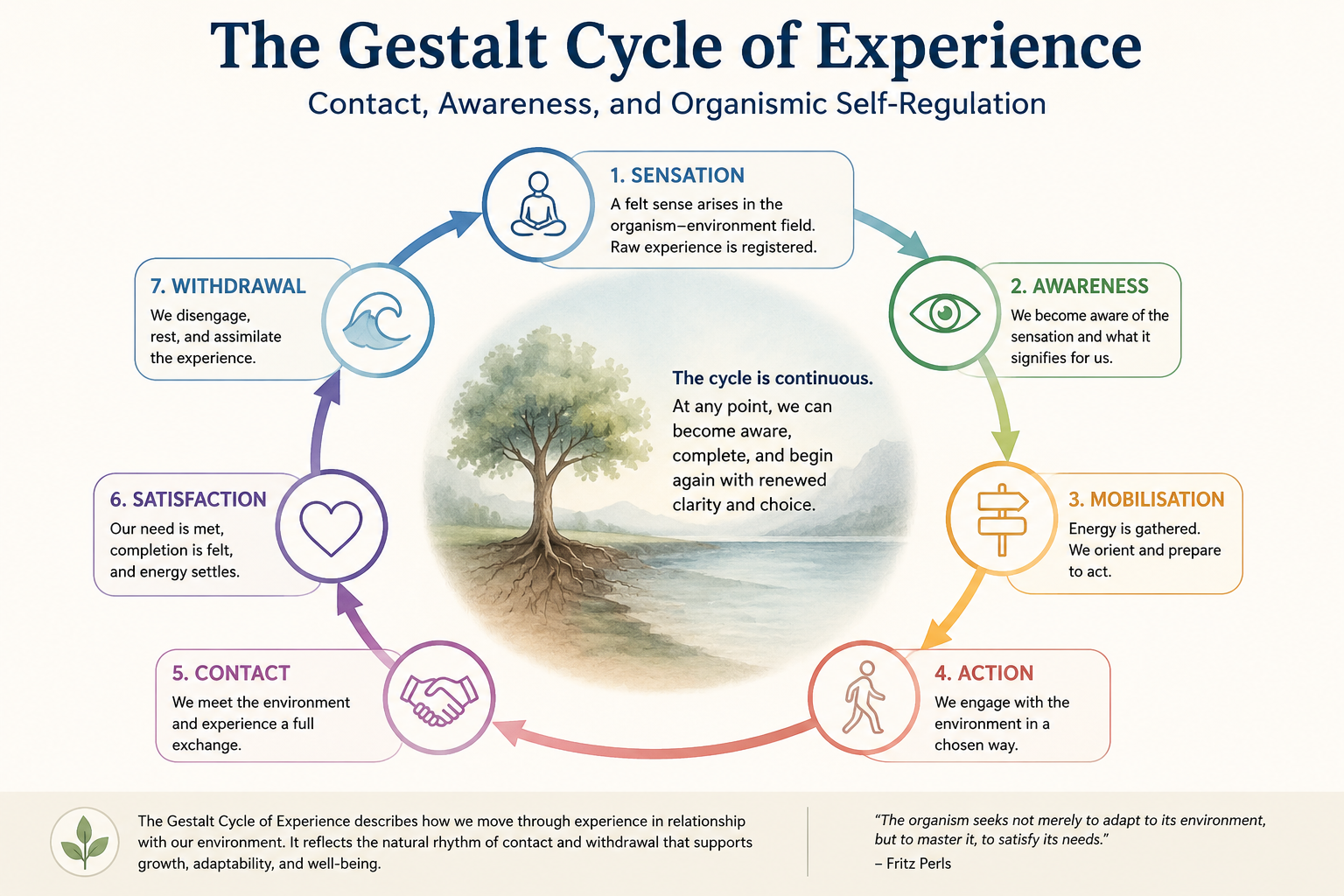
The Gestalt Cycle of Experience is a foundational model describing how the organism moves through a natural sequence of awareness, mobilisation, contact, and withdrawal in response to its needs. It explains how healthy self-regulation works, where psychological difficulties arise when the cycle is interrupted, and why increasing awareness at any stage of the cycle is, in itself, therapeutically transformative. Central to Gestalt therapy's training programmes worldwide, the cycle is both a clinical map and a framework for understanding how change actually occurs in therapy.
GestaltReview.com · Theory & Clinical Practice · Process Models
The Gestalt Cycle of Experience Contact, Awareness, and Organismic Self-Regulation
What the Cycle of Experience is, how its six stages describe healthy self-regulation, what happens when the cycle is interrupted, and how Gestalt therapists work with cycle awareness clinically — across presentations from anxiety and depression to trauma and relationship difficulties.
Introduction
Human beings are not static entities who occasionally encounter problems to be solved. They are dynamic, continuously cycling organisms that are always in some stage of an unfolding process: noticing a need, gathering themselves toward it, engaging with what the environment has to offer, finding — or failing to find — satisfaction, and returning to a state of rest from which the next need will emerge. This continuous cycling is as natural as breathing, as rhythmic as sleep and waking, and as fundamental to psychological health as any specific clinical skill or therapeutic technique.
The Gestalt Cycle of Experience is a theoretical model of this process. It describes, in a form that is both clinically precise and humanistically generous, the natural sequence through which the organism moves from need to satisfaction — and it identifies, with specificity and without pathologising judgement, the points at which this natural cycle most commonly becomes interrupted or frozen. It is not a rigid mechanistic schema but a flexible orienting framework: a way of understanding where a person currently is in their relationship to their own experience, and what kind of support might help them move forward.
For Gestalt therapists, understanding the cycle is not merely theoretical knowledge but a living clinical capacity — the ability to sense, in the texture of the session, where in the cycle the client is and what the cycle is asking for at this moment. That capacity, developed through training, personal therapy, and supervised clinical experience, is one of the foundations of skilled Gestalt practice.
What Is the Cycle of Experience?
The Gestalt Cycle of Experience — also called the Contact Cycle, the Cycle of Contact, or the Interactive Contact Cycle — is a process model describing how the organism organises its experience as it moves from the background of undifferentiated ground through the emergence of a need (figure formation), the mobilisation of energy toward meeting that need, contact with the environment, satisfaction, and the return to ground through withdrawal. The cycle describes a complete unit of experience: what happens from the moment a need begins to emerge into awareness to the moment it has been met and the organism has returned to rest.
As Chidiac (2018) articulates, the cycle functions as "an orienting principle" within a field-theoretical frame — a way of understanding that experience, despite its immense complexity and the many influences that shape it, "follows a certain sequence or cycle driven by the urge to self-regulate." The cycle is not a rigid mechanical sequence but a natural rhythm, as variable as the needs that generate it, but always moving — in healthy functioning — through the same fundamental arc from need to satisfaction to rest.
Different Gestalt theorists have articulated the cycle's stages somewhat differently, and different training programmes use slightly different versions of the model. The version most widely used in contemporary Gestalt training, elaborated by Clarkson (1989) and others building on the foundational 1951 text, identifies six primary stages: sensation, awareness, mobilisation, action, contact, satisfaction, and withdrawal. Some versions compress these into four or five; others expand them to seven or eight. What matters clinically is not which version of the model is used, but that the therapist understands its underlying principle and can apply it with phenomenological sensitivity to what is actually occurring in the session.
Historical Development
The cycle of experience is implicit in the foundational 1951 text Gestalt Therapy: Excitement and Growth in the Human Personality by Fritz Perls, Ralph Hefferline, and Paul Goodman, where it appears in the account of organismic self-regulation and the contact cycle — the sequence through which the organism's engagement with its environment reaches completion or fails to. Laura Perls' emphasis on support as a prerequisite for contact gave the model its relational dimension: the organism does not traverse the cycle in isolation but always in relation to its environment, and the support available in that environment (including the therapeutic relationship) shapes what is possible at each stage.
The concept has deeper scientific roots than the 1951 text alone. Bluma Zeigarnik's 1927 experimental finding — that waitresses remembered interrupted orders significantly better than completed ones, because incomplete tasks maintained a persistent tension that completed tasks did not — provided the empirical precursor to the cycle's central insight: the incomplete gestalt persists, pressing for completion. Kurt Lewin's field theory, from which Gestalt therapy drew substantially, formulated this as a quasi-need — a motivational state generated by the gap between the current and the goal situation that drives the organism toward closure. The cycle model is, in part, a clinical translation of these experimental findings: what Zeigarnik found in memory, and Lewin in motivated behaviour, Gestalt therapy finds in the full arc of organismic experience from need to satisfaction.
The cycle was subsequently elaborated and systematised by a range of Gestalt theorists, most notably Joseph Zinker, whose 1977 Creative Process in Gestalt Therapy made a contribution that is often underappreciated: he not only named and elaborated the stages but drew the cycle as a circle. This seemingly simple visual act was a significant pedagogical innovation — giving the cycle a spatial, iconic form that made it teachable, memorable, and applicable in training settings in ways that the 1951 text's dense prose account could not be. Clarkson (1989) then provided the most comprehensive clinical account, mapping each stage to specific therapeutic objectives and specific contact disturbances. Subsequent elaborations have added relational and field-theoretic dimensions, moving the model from a primarily intrapsychic account to a field-level description of how organism and environment co-create the conditions for contact and its completion.
Organismic Self-Regulation
The theoretical foundation of the cycle is the concept of organismic self-regulation — the organism's inherent, natural capacity to identify what it needs from its environment, to mobilise toward meeting those needs, and to return to equilibrium once they have been satisfied. This capacity is not something the organism has to learn or that requires cognitive deliberation; it is a biological and psychological given, expressed in something as simple as the thirst that arises when the body needs water, the hunger that emerges when it needs food, and the fatigue that signals the need for rest.
The genius of the foundational Gestalt insight is to generalise this principle: the organism's self-regulatory intelligence applies not only to physiological needs but to psychological, relational, and existential ones. The person who needs to express grief, establish a boundary, receive genuine recognition, experience genuine solitude, or complete unfinished emotional business is as genuinely in need as the person who is hungry or tired — and the cycle that would naturally carry them from that need to its satisfaction operates according to the same fundamental principles.
One of the most philosophically distinctive claims the cycle model makes is about the nature of the self itself. The 1951 text defines the self not as a fixed inner structure or container but as "the system of contacts at the contact boundary" — a function rather than a substance. On this account, the self does not have the cycle of experience; the self is the cycling. It exists only in the dynamic process of contact and withdrawal, emerging freshly at each moment of genuine engagement and receding as each cycle completes. This is not a merely metaphysical observation: it means that helping a person becomes equivalent to helping their contact process become more free, more vivid, more genuinely responsive. The self is not something to be recovered but something that is continuously being constituted in genuine meeting.
Disruption of organismic self-regulation — the interruption of the cycle before it can complete — is the primary account that Gestalt therapy offers of how psychological difficulty arises. Not as deficit or disease, but as what Gestalt theory calls creative adjustment: an intelligent adaptation to the specific field conditions the organism encountered. The child who shuts down awareness of need because expressing need reliably produced rejection was doing something genuinely intelligent — in the original field. The cycle has been interrupted, often repeatedly, in specific places, generating characteristic patterns of arrested experience that once served a protective function and have become fixed beyond their original context. Understanding cycle interruptions as former creative adjustments — as solutions that outlived their context rather than as deficits or failures — is one of the most clinically generous and practically useful perspectives the cycle model offers. For the foundational theoretical context, see our article on Gestalt Therapy: An Overview.
The Six Stages of the Cycle
Sensation
The organism becomes aware of a physical or somatic signal — a stirring of the body, a vague discomfort, an undefined restlessness, an incipient feeling. This is the cycle's beginning: something is happening in the organism that is not yet named or understood, but that is beginning to make itself felt as a bodily phenomenon. Sensation precedes awareness; it is the raw somatic material from which awareness will form. At this stage the organism has not yet identified what the sensation means or what it needs — it has only registered that something is present and insistent.
Awareness
The vague sensation crystallises into something more specific: a need, a feeling, a desire, a concern that rises into figural awareness against the background of everything else. "I am hungry." "I am lonely." "I am angry about what was said." Awareness in this sense is not merely cognitive recognition — it is an integrated body-mind knowing in which the organism begins to understand what the sensation is pointing toward. At this stage, a figure forms from the ground: what was undifferentiated background becomes specific, pressing, and definite. The quality and clarity of this figure — whether it is vivid and accurate or vague and distorted — is one of the primary determinants of what becomes possible in the stages that follow. For the foundational account, see our article on Awareness in Gestalt Therapy.
Mobilisation
Once the need has been clearly identified, the organism mobilises its energy toward meeting it. This is the stage of excitement, of gathering oneself, of preparing for action. In healthy mobilisation, the organism's energy rises — there is a felt quality of aliveness, anticipation, and readiness. The 1951 text, drawing on Wilhelm Reich's account of character and energy, makes a clinically important distinction here: healthy mobilised energy moves forward toward the environment as excitement; the same mobilised energy that cannot move forward, that finds its path to action blocked, becomes anxiety. Anxiety, on this account, is not a separate emotion but excitement without an outlet — the same physiological arousal, the same mobilised energy, but frozen at the threshold between awareness and action rather than flowing forward into genuine engagement. This accounts for why anxiety and excitement feel physiologically similar (both involve heightened arousal, elevated heart rate, altered breathing) while being phenomenologically opposite in quality: one is the forward movement of energy toward genuine contact; the other is that same energy caught and cycling in on itself. In disrupted mobilisation, energy may be blocked, deflected, or turned back on the organism before it has engaged with the environment.
Action
The organism begins to move toward what it needs in the environment: speaking, reaching, asking, approaching, withdrawing. Action translates the mobilised energy into actual engagement with the environment. At this stage the organism commits — however tentatively — to making genuine contact with whatever the need requires. The quality of action matters enormously: action that is congruent with the actual need (asking directly for what is needed rather than hinting) tends to lead toward genuine contact; action that is already modified by defensive self-interruption (asking in a way that pre-empts refusal, or approaching in a way that maintains protective distance) tends to forestall it.
Contact
The organism meets what it was moving toward — genuinely, fully, in the present moment. Contact, in Gestalt therapy, is not simply the occurrence of an encounter but the quality of genuine meeting: the organism and its environment actually engaging, being genuinely affected by each other. The hungry person eating, the lonely person genuinely met by another person, the angry person expressing what they actually feel to the person it is about. Full contact involves both the organism's full presence and the environment's genuine response; partial contact — skimming the surface of an encounter without genuine engagement — does not complete the cycle. For the full theoretical account, see our article on Contact and Withdrawal in Gestalt Therapy.
Satisfaction and Withdrawal
When contact has been genuine and the need genuinely met, the organism experiences satisfaction — a quality of completion, fullness, and ease. The figure that had been pressing and figural dissolves back into ground: the need is met and no longer demands attention. The organism then withdraws — not an absence of contact but a natural recession from the fullness of contact into a period of assimilation, rest, and the gathering of ground from which the next figure will emerge. Healthy withdrawal is as important as healthy contact: the organism that cannot withdraw — that cannot disengage, assimilate, and rest — will be as unable to return to genuine contact as the organism that cannot approach it in the first place.
Figure Formation and the Cycle
The cycle of experience and the figure-ground principle are inseparable: each stage of the cycle corresponds to a particular quality of figure formation and dissolution. At the sensation stage, a vague figural stirring emerges from an undifferentiated ground. At awareness, the figure sharpens into something specific and identifiable. Through mobilisation and action, the figure intensifies — it becomes more vivid, more pressing, more demanding of engagement. At contact, the figure reaches its peak intensity and its fullest expression. At satisfaction and withdrawal, the figure dissolves back into ground, making space for the next emergent need.
This means that disruptions to the cycle are, simultaneously, disruptions to figure formation: wherever the cycle is interrupted, the figure that would have sharpened into full vividness either fails to form clearly, remains fixedly figural without completing into contact and dissolution, or collapses prematurely before genuine contact is reached. The person who consistently interrupts the cycle at the mobilisation stage, for example, will tend to have vague, unformed awarenesses of need that never crystallise into the sharp, compelling figures that would motivate genuine action. For the full account of figure-ground dynamics, see our article on Figure and Ground in Gestalt Psychology and Gestalt Therapy.
The Organism–Environment Field
The cycle of experience does not occur inside the organism in isolation but at the contact boundary between organism and environment — in Goodman's field-theoretic terms, as a field event rather than a purely intrapsychic one. This field-theoretic understanding of the cycle has significant clinical implications. It means that whether and how the cycle completes is not solely a function of the individual's internal state but is co-determined by the conditions of the field: the quality of the relational environment, the supports available in it, the history that the organism brings to the encounter with its environment, and the way those historical patterns shape what the environment appears to offer.
A child who grew up in an environment that consistently responded to expressed need with withdrawal, punishment, or contempt will develop patterns of cycle interruption that reflect those field conditions — not as individual pathology but as intelligent adaptation to a field that did not support the natural completion of the contact cycle. The therapeutic field — with its specific quality of safety, attunement, and genuine dialogical presence — provides different field conditions, within which patterns of cycle interruption that were adaptive in the original field can begin to relax. For the full account, see our article on Field Theory and Dialogue in Gestalt Therapy.
"The cycle does not occur inside the organism alone — it occurs in the field between organism and environment. Whether it completes depends on what both parties bring to the encounter."
Embodiment Throughout the Cycle
Every stage of the cycle has an embodied dimension — a specific somatic quality that the skilled Gestalt clinician learns to track as primary clinical data. The vague somatic stirring of sensation; the somatic shift that accompanies the formation of a clear awareness; the quality of excitation, aliveness, and anticipation of mobilisation; the muscular commitment of action; the full-body openness and responsiveness of genuine contact; the settling and softening of satisfaction; the quiet recession of withdrawal — each of these is a distinct somatic experience, and the body's engagement with each stage is both clinically informative and therapeutically relevant.
When the cycle is interrupted, the body reveals it: the breath that shallows as mobilisation is inhibited; the shoulders that hunch as action is arrested; the jaw that tightens as contact is approached but not allowed; the somatic flatness of a satisfaction that has not truly occurred. Grossman (2020) found in her somatic-focused Gestalt study that increasing present awareness in Gestalt treatment led clients to bring previously non-conscious contact patterns into conscious experiencing — the body's cycle interruptions becoming available to awareness and, through awareness, to change.
Kaisler and colleagues (2023) found in their multi-case study of seven Gestalt therapy clients that therapists appropriately prioritised "body awareness-oriented interventions" with low-integrated clients — those for whom the emotional and somatic dimensions of experience were most fragmented — while providing relational emphasis for those with more integrated personality structures. This finding supports the clinical account: different stages of the cycle may require different levels of somatic attentiveness, and the therapist's ability to track the cycle in the body is particularly critical when somatic holding of cycle interruption is pronounced. For the full account, see our article on Embodied Awareness and the Body in Gestalt Therapy.
The Cycle in Everyday Life
Multiple cycles are running simultaneously at every moment of daily life, across different timescales and different levels of significance. A person in a single morning may be completing dozens of micro-cycles (reaching for a coffee cup, noticing and meeting the need for warmth, the cycle completes) while mid-cycle in several larger ones (the unresolved conversation with a partner, the work project whose completion is several weeks away) and barely at the sensation stage in others yet (the need for a career change that is only beginning to make itself felt as a vague somatic restlessness).
Healthy psychological functioning does not require that all cycles complete immediately or quickly — some cycles take years to complete, and the rhythm of a full life includes many simultaneously open cycles at different stages. What healthy functioning requires is flexibility: the ability to enter cycles when needs arise, move through them at the pace genuine contact requires, complete them when contact is achieved, and return to rest. It is the rigidity, the fixed interruption at characteristic points, the cycle that never completes because the same interruption always occurs in the same place — this is what generates psychological suffering.
It is worth being specific about why cycles fail to complete — since different failure modes generate different clinical presentations. Some cycles fail at inception: sensation is dulled or unavailable (desensitisation), and no figure forms. The organism moves through the day without genuine awareness of what it needs, producing a characteristic flatness, disconnection, or chronic low-grade dissatisfaction. Other cycles form clearly but cannot mobilise (awareness is present but energy is blocked), generating the specific frustration of knowing what one needs and being unable to move toward it. Still other cycles mobilise fully but interrupt at the contact threshold — the classic pattern of the person who can articulate their needs precisely but consistently diverts from genuine meeting at the last moment, leaving a trail of almost-contacts and near-encounters that nourish without satisfying. And some cycles reach contact but cannot complete the withdrawal — leaving the organism unable to disengage, assimilate, and rest, sustained in a kind of chronic contact that eventually exhausts rather than nourishes. Each failure mode has a different somatic signature, a different phenomenological texture, and a different clinical implication — and the Gestalt therapist who can distinguish them has a substantially more precise clinical instrument than one who treats "cycle interruption" as a single undifferentiated phenomenon.
Clinical Examples
Midway through a session, a client's voice shifts quality slightly — a tightness that wasn't there before. The therapist notices. "What's happening right now?" (Supporting the sensation-to-awareness transition.) The client pauses. "There's something... I don't know. Something tight in my chest." The therapist stays with this. "Can you stay with that tightness? What does it want to say?" Slowly: "I think — I'm angry. I didn't realise how angry." (Awareness formed.) The quality of the session shifts. Energy rises. The client's posture changes, becomes more upright. (Mobilisation.) "Who are you angry with?" The client speaks — directly, with feeling, to the person who wronged them (not to the therapist, but to the figural presence of that person in the room). (Action, then contact — the emotional situation meeting itself genuinely in the present encounter.) A quietening follows. The shoulders soften. The breath deepens. "I hadn't let myself know I felt that." (Satisfaction, beginning withdrawal.) The cycle has completed — not resolved the external situation, but completed within the organism's own process of experiencing.
A client describes a situation at work where he felt profoundly disrespected. As he narrates, his voice flattens and his body settles into the chair as if becoming smaller. The energy that was briefly present as he described the original incident has disappeared. The therapist tracks this: "As you're describing what happened, something just shifted. You were more animated a moment ago. What happened in your body just then?" The client pauses, notices. "I sort of... deflated. Like I thought 'well, what's the point.'" Here the therapist recognises the interruption — the cycle was moving into mobilisation (energy beginning to rise in response to the awareness of having been wronged) and then collapsed. The deflation is retroflection — the energy turned back on the organism, the outward assertion converted into inward collapse. The work: gently supporting the mobilisation, creating conditions under which the energy can rise and not be immediately suppressed. "What would the energy want to do, if it didn't deflate?" And slowly: "I'd want to say something. To say it wasn't acceptable."
Interruptions of the Cycle
The contact disturbances that Gestalt therapy identifies — introjection, projection, retroflection, deflection, and confluence — are each characteristic patterns of cycle interruption that tend to occur at specific stages. Understanding them in cycle terms illuminates both where the interruption occurs and what function it serves.
Desensitisation
Characteristic at the sensation stage — the most primary interruption, occurring before the cycle can properly begin. The organism dulls its somatic receptivity, reducing the vividness or availability of bodily sensation so that needs do not register clearly enough to form figures. Common in chronic stress, traumatic numbing, and cultures that systematically devalue somatic experience.
Introjection
Characteristic between sensation and awareness: external voices (parental, cultural, institutional) are swallowed whole, overwriting the organism's own figural awareness before it can fully form. "I shouldn't want that." "That feeling is not appropriate." The figure forms but is immediately suppressed by an inherited prohibition.
Projection
Characteristic at the awareness stage: what is beginning to form as a figural awareness in the organism is relocated into the environment. The anger that is forming becomes perceived as the anger of the other person. The need for closeness becomes the other person's neediness.
Retroflection
Characteristic at the mobilisation-to-action transition: energy mobilised toward the environment is turned back against the self instead of moving into action and contact. Depression often involves significant retroflection — energy that would be assertiveness, anger, or outward-directed need turned inward as self-criticism, collapse, or withdrawal.
Deflection
Characteristic at the action-to-contact transition: the organism approaches contact but diverts the quality of the engagement at the last moment, maintaining a degree of distance that prevents genuine meeting. Humour, intellectualisation, topic-changing, and compulsive over-explanation are common deflective patterns.
Egotism
Characteristic at the contact stage itself: the organism approaches full contact but maintains a split self-consciousness — spectating its own experience rather than being fully in it — that prevents the complete meeting of genuine contact. "Watching myself feel" rather than feeling. Common in high-intellectualisation presentations and in therapists early in training.
Confluence
Characteristic at both ends of the cycle: at the sensation and awareness stages, when self and environment are not sufficiently differentiated for the organism's specific needs to form as distinct figures; and at the satisfaction-withdrawal stage, when the organism cannot disengage from contact and return to the distinctness that genuine withdrawal requires.
It is essential to emphasise — as the brief explicitly requires — that interruptions of the cycle are not inherently pathological. Every person interrupts the cycle at various points and in various ways across the day; the capacity to modulate contact (to choose when and how fully to engage with what is emerging) is itself an expression of healthy organismic intelligence. The interruptions become clinically significant when they are rigid, automatic, operated without awareness, and deployed in situations that no longer require the protection they once provided. For the full relational account, see our article on Contact Interruptions in Gestalt Therapy.
The Cycle Across Clinical Presentations
Anxiety
Anxiety characteristically involves an interruption at the mobilisation stage: the organism has become aware of a need or anticipated a threat and energy has mobilised, but the mobilised energy cannot proceed into action — either because the action is experienced as too dangerous or because the anticipated outcome is experienced as too uncertain. The energy of mobilisation remains suspended between awareness and action, generating the somatic and cognitive experience of anxious excitation that characterises anxiety. In the cycle's terms: the organism is poised, energy accumulated, but the movement into action is blocked, leaving the mobilised energy cycling internally without discharge.
Depression
Depression often involves significant retroflection — the turning back of mobilised energy against the organism before it can move into outward action and contact. The energy that might be experienced as anger (outwardly directed), grief (which requires genuine contact for its expression), or assertive need-meeting is directed inward, producing the flatness, self-criticism, and withdrawn passivity characteristic of depressive states. The cycle, in this account, is not absent but inverted: energy mobilises and then turns back rather than forward. Leung (2010), in her Gestalt account of addiction, notes the addiction cycle as an "inhibited sensation-action loop" — a related structure in which the cycle is abbreviated, moving rapidly from sensation directly to action (substance use) bypassing the awareness, mobilisation, and contact stages entirely.
Trauma
Trauma produces specific cycle disturbances that reflect the overwhelming quality of the original traumatic experience. At the sensation stage, the body may remain in a chronic state of hyperarousal (the somatic alarm signal never settles back to ground) or hypoarousal (the sensation stage is numbed, making the entry into awareness difficult or impossible). At the awareness stage, traumatic material may break through involuntarily as flashbacks (a fixed gestalt that erupts into present awareness) or may be kept out of awareness through significant defensive effort. The therapeutic work with trauma in cycle terms involves creating the safety and somatic regulation conditions that allow the cycle to proceed gently and gradually, at the pace the organism's regulatory capacity can sustain, toward the genuine contact and completion that the original traumatic situation could not provide. For the full account, see our article on Gestalt Therapy and Trauma.
Relational Difficulties
Relational difficulties often involve characteristic cycle interruptions at the contact and withdrawal stages. The person who cannot allow full contact — who consistently deflects or retroflects at the moment when genuine meeting becomes possible — never achieves the satisfaction that full contact provides, leaving an accumulation of incompletely experienced cycles that press toward completion and generate relational frustration and dissatisfaction. The person who cannot withdraw — who remains in a state of constant contact or confluence — cannot restore the organismic distinctness that makes genuine renewed contact possible, leaving both partners in a kind of exhausted enmeshment rather than the genuine meeting that nourishes both.
How Therapists Work with the Cycle
The cycle of experience functions for the Gestalt therapist as a dynamic map of where the client currently is and what kind of support the cycle is asking for at this stage. The therapist's attention moves fluidly between different levels of the cycle, tracking not only the content of what the client is saying but the somatic and relational quality of how they are saying it, and the stage of the cycle that quality indicates.
At the sensation stage, the therapist's primary function is to slow the client down enough to allow the vague somatic stirring to register — to create the conditions of sufficient quiet and attentiveness that what is barely beginning to make itself felt can become noticeable. "What's happening in your body right now?" is a sensation-stage intervention: it invites the client toward the somatic ground of their experience before awareness has fully formed. Where desensitisation is operating, this may require extended, patient attention over many sessions before sensation becomes reliably accessible; pushing toward awareness before sensation is available creates frustration rather than contact.
At the awareness stage, the therapist supports the sharpening of the figure — helping the vague sensing to crystallise into something specific and owned. "It sounds like there's something happening there — what is it? What's the feeling?" This is phenomenological inquiry in its most direct clinical form: helping the figure form fully rather than remaining vague and unowned, or being immediately suppressed by introjected prohibitions ("I shouldn't feel this").
At the mobilisation stage, the therapist tracks and supports the rise of energy — noticing when it arises, affirming it rather than deflecting it, and remaining genuinely interested in the organism's excitement about its own need. The primary clinical task here is distinguishing healthy mobilisation from the anxious frozen version of the same energy: when the client's arousal is rising and can move forward, the therapist supports and accompanies it; when the arousal is rising but turning toward anxiety (forward movement blocked), the question is what the action is afraid of, and what conditions might make it safe enough to risk.
At the action-to-contact transition, the therapist's primary function is to support the genuine completion of the contact rather than allowing the characteristic defensive interruption to occur — not by pushing through the defense but by attending with genuine curiosity to what the interruption is protecting against, creating conditions of sufficient relational safety that the organism can risk what it has been unable to risk.
At the contact stage, the therapist's role shifts: rather than supporting the approach, the task is to be genuinely present within the contact itself — to be an available, responsive, genuinely moved other within the encounter that the client is, perhaps for the first time, completing. The contact stage is not a stage the therapist can make happen; it can only be available for. The therapist who remains genuinely present, non-managed, and actually affected by what is occurring is providing the conditions in which genuine contact becomes possible.
At the satisfaction and withdrawal stage — the most clinically neglected in most training — the therapist's task is to support the natural recession from fullness of contact into rest: to allow the session's energy to settle, to resist the impulse to introduce new material or new interventions as energy lowers, and to honour the withdrawal as a legitimate and necessary phase rather than a sign that something has gone wrong. Where a client cannot withdraw — where they remain in a state of maintained contact or confluence even after the cycle has reached its natural endpoint — the therapist gently supports differentiation: "I notice something seems to want to complete. How does it feel to simply let that settle?"
The Cycle Compared with Emotion Regulation Models
The Gestalt cycle of experience and contemporary emotion regulation research address overlapping territory through different theoretical frameworks — and their comparison is illuminating for both.
Contemporary neuroscience and clinical psychology have established that interoception — the organism's awareness of its own internal bodily states — is fundamental to healthy emotion regulation. Price and colleagues (2018), in their influential framework for interoceptive awareness skills in emotion regulation, identify the capacities to "detect, access, and appraise" internal bodily signals as the critical components of interoception for emotion regulation. This maps directly onto the Gestalt cycle's first two stages: the sensation stage (detecting) and the awareness stage (accessing and beginning to appraise). The finding from Price and colleagues that disrupted interoceptive awareness is associated with difficulties in emotion regulation provides empirical grounding for the Gestalt account: interruption at the sensation-to-awareness transition — a failure to attend adequately to the organism's somatic signals — has measurable consequences for the organism's ability to regulate its emotional experience.
Füstös and colleagues' (2013) study, finding that higher interoceptive awareness (IA) facilitates the downregulation of affect and is associated with more pronounced neural modulation during emotion regulation tasks, provides further convergent support: the organism that is more sensitively attuned to its own somatic signals — that has a more developed sensation-to-awareness capacity — is better able to regulate its emotional experience. This is precisely what the Gestalt cycle predicts: a more fluid, uninterrupted sensation-to-awareness transition supports more flexible and effective self-regulation throughout the cycle.
Pinna and colleagues' (2020) systematic review, finding that greater interoceptive awareness is associated with better emotion regulation and specifically with the use of adaptive strategies such as reappraisal and acceptance of emotions, extends this convergence: what contemporary research operationalises as interoceptive awareness and emotional regulation capacity, Gestalt therapy approaches clinically through the cultivation of present-moment, embodied, phenomenologically disciplined attention to what is arising in the organism's experience — a somatic and relational approach to developing the same capacities.
The differences are also real. Emotion regulation research and the Gestalt cycle address different aspects of the same underlying process, using different theoretical vocabularies, and the Gestalt cycle's emphasis on the relational and field-level dimensions of self-regulation — the understanding that the cycle completes in contact with the environment, not in the isolated individual — is not fully captured by individual emotion regulation frameworks. The cycle model is also specifically a clinical orienting framework rather than a research-validated process model; the convergent evidence supports its relevance but does not constitute direct empirical validation of the specific stage model.
Current Research
Research Relevant to the Cycle of Experience
Direct empirical research specifically testing the Gestalt cycle of experience as a stage model is limited. The cycle is a clinical and theoretical framework rather than a directly operationalised empirical construct. The research that most directly illuminates its underlying principles comes from the interoception, emotion regulation, and experiential psychotherapy literatures.
Sønderland and colleagues' (2023) meta-analysis of emotional change processes in psychotherapy found that "experiencing in psychotherapy" — the depth of clients' present-moment emotional processing — was the strongest process predictor of outcomes in depression (r = .44). This construct directly operationalises what the cycle's awareness and contact stages describe: the degree to which the client is in genuine, present-moment, embodied contact with their own emotional experience rather than managing it from cognitive distance. The strength of this predictor across 121 studies provides robust support for the clinical centrality of what the cycle framework targets.
Kaisler and colleagues (2023) multi-case study of seven clients across 30 Gestalt therapy sessions found that "support of self-regulation was reported to be essential for successful outcomes in the moderately integrated group" and that body awareness-oriented interventions and promotion of emotional verbalisation were specifically important for the low-integrated group. These findings are consistent with the cycle framework: different levels of personality integration involve different characteristic cycle interruptions, requiring different therapeutic emphases at different stages.
Grossman (2020), in an empirical study of somatic-focused Gestalt psychotherapy, found that increasing present awareness led clients to bring previously non-conscious contact patterns into conscious experience — consistent with the theoretical claim that awareness at any stage of the cycle supports movement through interrupted patterns. Maher and colleagues' (2011) phenomenological study of awareness in Gestalt training groups found three sequential stages of awareness development — isolation, contact, engaging — that map recognisably onto elements of the contact cycle.
Iwakabe and colleagues (2023) systematic review of therapist methods to facilitate emotion regulation found that affect-focused therapist interventions showed positive intermediate outcomes, with a large mean effect size (ES = 0.82) across 26 studies for distal ER improvements. This convergent finding from a non-Gestalt tradition supports the clinical value of the affective, embodied, present-moment approach to emotional processing that the Gestalt cycle framework structures.
Strengths, Limitations, and Misunderstandings
Strengths
The cycle of experience provides Gestalt therapy with a clinically generative, theoretically coherent, and educationally powerful model of psychological process — one that applies across the full range of clinical presentations without requiring separate models for different diagnostic categories. Its emphasis on the natural wisdom of organismic self-regulation positions the therapist as someone who supports the client's own process rather than directing it toward externally defined outcomes. And its integration of somatic, cognitive, relational, and field-level dimensions of experience makes it one of the most genuinely holistic process models in psychotherapy.
Limitations and Common Misunderstandings
The cycle is not a linear checklist. One of the most common misapplications of the cycle model is treating it as a rigid sequence of steps that should be completed in order. In clinical practice, the cycle does not move in a straight line: it may spiral, stall, double back, accelerate, and appear in fragments across multiple sessions. The cycle is an orienting framework, not a procedural protocol.
Direct empirical validation of the stage model is limited. The convergent research support from interoception, emotion regulation, and experiential psychotherapy literatures is substantial and relevant, but it does not constitute direct empirical validation of the specific six-stage model. Presenting the cycle as if it were an established empirical finding rather than a theoretically grounded clinical framework misrepresents its evidential status.
Interruptions are not always pathological. The framework can be misapplied if every cycle interruption is treated as a problem to be corrected. The capacity to modulate contact — to choose when and how fully to engage with what is arising — is itself a sign of psychological health. It is the rigid, unconscious, automatic interruption that is clinically significant; the chosen, aware, appropriate modulation of contact that is adaptive.
Cultural considerations. The cycle's emphasis on individual need-expression and outward-directed contact reflects cultural assumptions that are not universal. In contexts where more collective, less individually expressive modes of self-regulation are normative, the model requires sensitive adaptation rather than uncritical application.
Conclusion
The Gestalt Cycle of Experience is one of the most practically useful and theoretically generative models in the Gestalt therapy tradition — a framework that describes, with genuine precision and genuine humanity, the natural rhythm through which all organisms move in their engagement with their world, and the characteristic ways in which that rhythm becomes disrupted, frozen, or distorted in the course of a human life that has required certain kinds of self-protective adaptation.
Its clinical value lies not in the model itself but in what using it requires of the therapist: genuine, present-moment, embodied, phenomenologically disciplined attention to where the client currently is in their own process; a sensitivity to the somatic and relational signals that indicate where the cycle is moving freely and where it is arrested; and the clinical wisdom to know what kind of support — at which stage — the cycle is actually asking for, in this client, in this session, at this moment.
The convergent research evidence from interoception, emotion regulation, and experiential psychotherapy — particularly the finding that the depth of present-moment emotional processing is among the strongest available predictors of therapeutic outcomes — supports the clinical centrality of what the cycle framework addresses, even where direct empirical validation of the specific stage model is absent. And the ongoing development of Gestalt therapy's relational and field-theoretic dimensions continues to deepen the cycle model beyond its original individualistic articulation, toward a genuinely ecological understanding of self-regulation as something that happens between organisms rather than simply within them.
For the foundational context within which the cycle operates, see our cornerstone article on Gestalt Therapy: An Overview. For the evidence base that supports the approach, see our article on the Gestalt Therapy Research and Evidence Base.