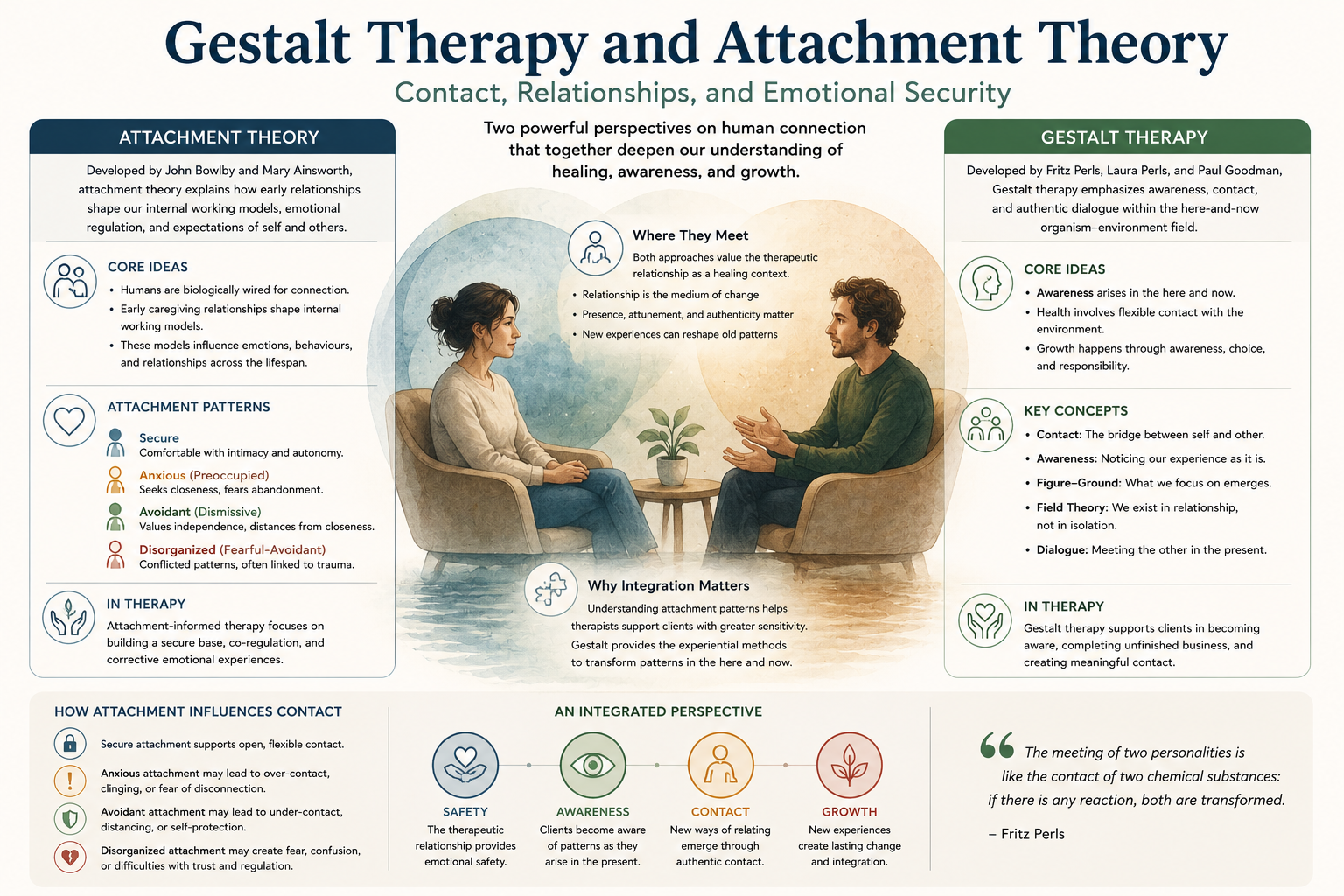
Gestalt therapy and attachment theory are independent intellectual traditions that arrived, by different routes, at a shared recognition: that the quality of human relationship is not merely the context in which psychological change occurs but the primary medium through which it occurs. Attachment theory, developed by John Bowlby and Mary Ainsworth from the 1960s onward, provides a developmental account of how early relational experiences shape the patterns of emotional regulation, self-organisation, and relating that continue throughout adult life. Gestalt therapy, developed simultaneously, offers a phenomenological, field-theoretic, and dialogical account of how contact between organism and environment generates both health and suffering — and how the therapeutic relationship can provide conditions for new patterns of contact. The two traditions were not designed to be integrated, but their convergences are real, productive, and increasingly reflected in contemporary relational Gestalt practice.
GestaltReview.com · Theory & Contemporary Contexts · Relational Practice
Gestalt Therapy and Attachment Theory Contact, Relationships, and Emotional Security
How attachment theory's developmental account of relational security and Gestalt therapy's phenomenological theory of contact and field relate to each other — and what their integration offers clinical practice.
Introduction
Attachment theory and Gestalt therapy developed in the same mid-twentieth-century intellectual moment, each responding — from different disciplines, different theoretical traditions, and different clinical concerns — to the same fundamental observation: that human beings are profoundly shaped by the quality of their most intimate relationships, and that psychological suffering frequently reflects the distorting consequences of relationships that did not adequately support the organism's natural needs.
Bowlby was a psychiatrist and psychoanalyst who drew on ethology, control systems theory, and developmental psychology to build an empirically grounded account of how early attachment relationships shape development. The Gestalt founders drew on phenomenological philosophy, Gestalt perceptual psychology, field theory, and existential thought to build a clinical approach grounded in present-moment awareness and genuine dialogical encounter. The two traditions did not know each other and were not designed to converge. But they arrived at related insights through genuinely different routes — and the integration that contemporary relational Gestalt therapists have increasingly pursued reflects a genuine theoretical compatibility rather than a forced synthesis.
This article examines that compatibility honestly: what attachment theory says, what Gestalt therapy says, where they genuinely converge, where they differ, and what the integration of attachment perspectives within Gestalt clinical practice offers that neither tradition alone provides. It maintains throughout the distinction that intellectual honesty requires: Gestalt therapy is not an attachment therapy, and the two frameworks are not identical. But they are productively complementary — and understanding why requires understanding both.
What Is Attachment Theory?
Attachment theory, in its original Bowlbian formulation, proposes that human beings are biologically predisposed to seek closeness to a small number of specific relationship figures — "attachment figures" — particularly under conditions of threat, distress, or uncertainty. This attachment behavioural system is not a sign of dependency or weakness but an evolutionary adaptation: the developing organism that maintains proximity to a protective caregiver has a significantly higher probability of surviving and reaching reproductive maturity than one that does not.
The attachment system is activated by perceived threat and deactivated by proximity to, or attunement from, the attachment figure. When the system is successfully deactivated — when the child achieves felt security through genuine responsiveness from the caregiver — the child is free to explore the environment, to learn, to engage with novelty and challenge, and to develop the psychological capacities that constitute health: emotional regulation, curiosity, creativity, and the capacity for genuine intimate relationship. The attachment figure functions simultaneously as a "safe haven" (a source of comfort when the system is activated by threat) and a "secure base" (a stable platform from which to explore when the system is not activated).
Bowlby's framework was revolutionary in its time because it placed the centrality of real relationship — not drive satisfaction, not symbolic fantasy, but the actual quality of the lived relational experience — at the heart of developmental psychology and psychopathology. A child who cannot reliably achieve felt security through a responsive attachment figure does not simply develop a "problem with dependency"; they adapt — intelligently, given their circumstances — developing a particular pattern of attachment behaviour designed to maximise proximity under the conditions actually available.
Bowlby, Ainsworth, and the Four Attachment Patterns
Mary Ainsworth's "Strange Situation" experiments, developed in the 1970s, provided the empirical methodology that gave attachment theory its most influential evidence base. By observing the responses of infants and young children to brief separations from and reunions with their primary caregiver, Ainsworth and her colleagues identified three primary patterns of attachment organisation — and a fourth, identified by later researchers, that captured a qualitatively different kind of difficulty.
Secure Attachment
The caregiver is consistently accessible and responsive. The child can use the caregiver as a secure base for exploration, protests genuine distress at separation, and is comforted by reunion. In adults: comfortable with intimacy and interdependence; able to seek support when distressed; resilient under stress. Associated with better psychotherapy outcomes and stronger therapeutic alliances.
Anxious-Ambivalent Attachment
The caregiver is inconsistently responsive — sometimes available, sometimes not. The child maximises attachment behaviour, maintaining heightened vigilance toward the caregiver's availability. In adults: preoccupied with relationships, hyperactivating attachment behaviour, difficulty with autonomy, prone to separation anxiety and jealousy. Emotion regulation characterised by hyperactivation.
Avoidant Attachment
The caregiver consistently dismisses or minimises the child's emotional needs. The child deactivates the attachment system, minimising the display of attachment behaviour. In adults: discomfort with intimacy and dependence, emotional self-sufficiency as defensive strategy, difficulty acknowledging emotional needs. Physiological stress is present but masked behaviourally.
Disorganised Attachment
The caregiver is simultaneously the source of threat and the intended refuge — most commonly in contexts of abuse, severe neglect, or unresolved parental trauma. The child has no coherent strategy for managing attachment needs. Associated with greatest difficulties in regulation, and with highest risk of dissociation, relational difficulties, and complex trauma presentations in adulthood.
One detail about the Strange Situation that has profound clinical implications is often overlooked: what Ainsworth found diagnostic was not the quality of the child's distress at separation but the quality of their response at reunion. Securely attached children were distressed by separation — but when the caregiver returned, they could be comforted. Insecurely attached children either showed little apparent distress at separation but rejected contact at reunion (avoidant), or showed intense distress that the returning caregiver could not resolve (anxious-ambivalent). The reunion behaviour was the signal. Translated to therapy: what matters clinically is not how much distress a client shows when the therapeutic relationship is under threat, but whether they can use the therapist's presence to return to regulation when it is repaired.
These patterns are not immutable diagnoses but organising strategies — ways the organism has learned to manage attachment needs given the specific relational conditions available. The research evidence consistently shows that, while stable across the lifespan without specific developmental or therapeutic experience, they are genuinely malleable. Taylor and colleagues' (2015) systematic review found that attachment security increases and anxiety decreases following therapy across different approaches and patient groups.
Central to the clinical hope that attachment theory offers is the concept of earned secure attachment — first identified by Mary Main and her colleagues in Adult Attachment Interview research. "Earned secure" describes adults who, despite histories of insecure or even traumatic early attachment experiences, have developed a coherent, reflective, and secure way of narrating and relating to those experiences. They are indistinguishable from continuously secure individuals in their therapeutic functioning — suggesting that the security achieved through later corrective relational experience is not a lesser version of the real thing. The primary vehicle of earned security is precisely what therapy offers: sustained, attuned, genuinely responsive relational experience over time. Jacobsen and colleagues' (2024) study of 330 adult clients found that the development of what they termed "individuated-secure therapeutic attachment" — distinct from and controlling for the client's general attachment pattern — was significantly associated with reduction in interpersonal problems. The implication is that the therapeutic relationship itself can function as a source of earned security, and that this earned security transfers to the client's broader relational life.
Adult Attachment and Internal Working Models
The extension of attachment theory from infant-caregiver research to adult psychology required a further theoretical step, made most influentially by Hazan and Shaver (1987), who proposed that adult romantic love is an attachment process and that the three infant patterns (secure, anxious-ambivalent, avoidant) have direct analogues in adult romantic relating. A separate research tradition, associated with Mary Main's Adult Attachment Interview (AAI), developed interview-based assessment of adults' attachment representations — their way of narrating their own attachment histories — and found that the coherence and reflectiveness of the narrative, rather than the content of the history itself, predicted attachment organisation. An adult who had a difficult childhood but could narrate it coherently and reflectively was classified as "earned secure"; an adult who idealised their history without specific memories (dismissing) or who became confused and overwhelmed in narrating it (preoccupied) showed insecure organisation regardless of the apparent content. This methodological distinction — between interview-based representations and self-report attachment style — remains important: the two measures are only modestly correlated and capture somewhat different aspects of attachment organisation.
Bowlby proposed that attachment experiences are encoded over time as "internal working models" — mental representations of self, of others, and of the relationships between them, derived from the history of actual relational experiences. These models are not static cognitive schemas but dynamic, hierarchically organised mental structures that shape perception, expectation, and response in new relational situations: the person whose early experience taught them that caregivers are reliably responsive will approach new relationships with an implicit expectation of responsiveness; the person whose experience taught them that caregivers are unreliable or dangerous will approach new relationships with a corresponding vigilance or withdrawal.
Dugan and colleagues' (2022) longitudinal study of 4,904 adults found that different working models — global models and relationship-specific models — not only change together over the long run but exhibit co-occurring short-term fluctuations, suggesting that internal working models are dynamic and continuously updated by ongoing relational experience rather than simply fixed in early childhood. This finding has significant implications for psychotherapy: if working models continue to be updated by relational experience throughout adulthood, then the quality of the therapeutic relationship — as a sustained, recurrent, relational experience — has ongoing potential to contribute to the revision of internal working models in ways that support greater attachment security.
Schore and Schore (2008), in their account of modern attachment theory as "regulation theory," emphasise that internal working models are not primarily cognitive structures but are encoded in right-brain, nonconscious, procedural systems — in implicit relational knowing rather than in explicit narrative memory. This neurobiological account has direct clinical implications: approaches that work with explicit verbal narrative alone may not adequately reach the implicit, bodily-based, procedurally encoded dimensions of internal working models. The body-aware, present-moment, experientially oriented quality of Gestalt therapeutic practice may be specifically well-positioned to reach material that exclusively verbal approaches do not.
Attachment, Emotion Regulation, and the Brain
One of the most significant developments in attachment theory since Bowlby's original formulation has been the progressive integration of attachment research with affective neuroscience and interpersonal neurobiology. Mikulincer and colleagues' (2018) comprehensive review — with 565 citations — establishes that individual differences in attachment orientation are reflected in cognitive, behavioural, and neural patterns of emotion regulation: secure attachment is associated with flexible, balanced emotion regulation; anxious attachment with hyperactivating strategies (maximising the expression and experience of distress to maximise the likelihood of eliciting caregiver response); and avoidant attachment with deactivating strategies (suppressing the expression and, over time, the conscious experience of attachment-related emotion).
Eilert and colleagues' (2023) systematic review of 37 studies (2,006 subjects) using objective measures — autonomic nervous system, brain activity, biochemistry, and nonverbal behaviour — found that secure attachment consistently correlates with balanced emotion regulation, while unresolved (disorganised) attachment displays counterintuitive physiological responses and a failure to use attachment as a regulatory resource. Importantly, insecure-dismissing individuals use a deactivating strategy at the behavioural level, but physiological measures reveal that emotional stress is still present — the deactivation is in the display, not in the underlying experience. This finding has important implications for clinical work with avoidant presentations: the apparent emotional absence in an avoidantly organised client does not indicate absence of emotional experience but absence of access to it.
Suliani (2026), integrating attachment theory with polyvagal theory, positions co-regulation — the nervous system's mutual, bidirectional regulation between two persons — as "the central point of convergence" between the two theories and as a foundational condition for emotional regulation and psychotherapeutic change. Feeling safe with another is not merely a pleasant background condition for therapy but a neurophysiological prerequisite for the kind of emotional processing and relational reorganisation that therapy aims to support. For a deeper account of how Gestalt therapy relates to these neuroscientific developments, see our article on Gestalt Therapy and Neuroscience.
Gestalt Therapy and Human Relationships
Gestalt therapy was not originally formulated as a relational or attachment-informed approach — its earliest emphasis was on individual awareness, on the organism's internal process, on present-moment experience, and on the contact boundary between organism and environment. Fritz Perls' public clinical style, particularly during the Esalen years, was more confrontational than relational, more focused on individual catharsis and authentic self-expression than on the co-created quality of the therapeutic encounter.
But the relational dimension was always latent in the foundational theoretical architecture. Laura Perls' direct formation in Martin Buber's I-Thou philosophy, and her insistence on the dialogical, genuinely mutual quality of genuine therapeutic encounter, gave Gestalt therapy from its beginning a relational philosophy that its early clinical demonstrations did not always embody. Paul Goodman's organism-environment field theory positioned the therapeutic relationship not as a tool for producing change in the client but as a field event in which both therapist and client are genuinely affected and in which change occurs through the quality of genuine contact between them.
The relational turn in contemporary Gestalt therapy — the explicit development of a dialogical, field-theoretic, genuinely two-person clinical model — has made the theoretical proximity between Gestalt therapy and attachment theory more explicit and more theoretically developed than the first generation of Gestalt therapists articulated. Contemporary relational Gestalt therapy speaks a language — of genuine presence, of the therapist's attunement as a clinical instrument, of the therapeutic relationship as the primary vehicle of change — that is immediately recognisable to attachment-informed clinicians, even though the theoretical traditions remain distinct.
Contact Theory, Field Theory, and Dialogue
Gestalt therapy's core theoretical concepts — contact, field theory, and dialogue — each carry relational dimensions that resonate with attachment theory's account of the relational conditions for security and healthy development.
Contact — genuine, present-moment, embodied meeting between organism and environment — is not identical with Bowlby's concept of proximity-seeking, but both describe something essential: the organism's active engagement with a specific other in a way that is genuinely responsive to what that other actually offers, rather than organised primarily around past expectation or defensive strategy. The person with a secure attachment history can make genuine contact — can be genuinely present to another person without the defensive activation that an insecure history generates. The person with an insecure attachment history makes contact that is characteristically distorted — not absent, but shaped by the pattern of contact interruptions that their early relational experience made adaptive.
Field theory's understanding that experience is constituted in the dynamic relationship between organism and environment — that what the organism perceives, feels, and responds to is always co-determined by what it brings and what the environment offers — maps onto attachment theory's understanding that the internal working model is both an interpretation of and an influence on the relational experience it encounters. The person who brings an internal working model of others as unavailable will organise the field of new relationships partly in accordance with that model, eliciting responses that confirm it — and the therapeutic field's specific quality of consistent, attuned responsiveness creates conditions in which that organising principle can gradually be revised. For the full account, see our article on Field Theory and Dialogue in Gestalt Therapy.
Buber's I-Thou dialogue — the genuine, present-moment, mutually affecting meeting between two persons — is perhaps the Gestalt concept that most directly parallels what attachment theory means by a secure attachment relationship. The precise parallel is this: Ainsworth found that the key to secure attachment is not the caregiver's consistent availability per se, but their sensitive responsiveness — the caregiver's genuine attunement to the specific emotional state of the specific child in the specific moment, rather than a generalised warmth that treats the child as a category rather than a person. Buber's I-Thou describes the same quality of encounter from the philosophical side: in I-Thou relating, the other is met as a full, irreducible subject — not managed, not instrumentalised, not responded to as a type. The caregiver who provides I-Thou relating provides secure attachment. The therapist who provides I-Thou relating provides the relational conditions from which earned security can develop. The parallel is not metaphorical but structural: both describe the same quality of genuine meeting, approached from developmental psychology and phenomenological philosophy respectively.
Convergences Between the Two Traditions
The convergences between attachment theory and Gestalt therapy are genuine and theoretically substantive, even though the traditions are historically independent.
Both understand psychological difficulty as an intelligent adaptation to specific relational conditions rather than as a deficiency or disease. Attachment theory frames insecure attachment patterns as adaptive strategies that maximised the child's proximity to an imperfect caregiver; Gestalt therapy frames contact interruptions as creative adjustments that allowed the organism to manage a field that did not support its genuine needs. Both recognise the adaptive intelligence of the pattern without endorsing its continuation in conditions that no longer require it.
Both understand therapeutic change as relational in its mechanism rather than primarily cognitive or technical. Attachment theory's emphasis on the therapeutic relationship as providing a "secure base" and "safe haven" parallels Gestalt therapy's understanding of the therapeutic relationship as the primary field within which genuine contact becomes possible — not a container for technique but the medium of change itself.
Both attend to the bodily, non-verbal, procedurally encoded dimensions of experience. Attachment theory's modern neuroscientific development has increasingly emphasised right-brain, implicit, somatic encoding of attachment patterns; Gestalt therapy has always emphasised present-moment somatic attention as a primary clinical instrument. Both point toward the same clinical conclusion: purely verbal, cognitively oriented approaches may not adequately reach the level at which attachment patterns and contact interruptions are actually held. For a fuller account, see our article on Embodied Awareness and the Body in Gestalt Therapy.
"Both traditions understood, independently, that relationship is not the context of healing — it is the medium. Not where change happens, but how it happens."
How Gestalt Therapists Work with Attachment Patterns
A Gestalt therapist who brings attachment awareness to their clinical work does not thereby become an attachment therapist — they become a Gestalt therapist with a more articulated understanding of the relational developmental context from which their client's characteristic contact patterns emerged. The clinical work remains phenomenological, present-moment, dialogical, and experiential; but the therapist's understanding of what they are encountering is enriched by attachment theory's developmental account.
With an anxiously attached client — whose characteristic pattern involves hyperactivating attention toward the therapist's availability, difficulty tolerating separation, and a need for reassurance that easily becomes chronic — the Gestalt therapist attends to the way these patterns manifest in the present-moment contact of the session: the quality of the client's attention to the therapist, the heightened responsiveness to any perceived withdrawal of interest or warmth, the difficulty moving into genuine present-moment contact because attention is partly organised around monitoring the relationship's safety. The Gestalt work is not to reassure the client directly but to bring the pattern into present awareness — to notice it, name it gently as a field phenomenon, and create conditions under which the client can begin to experience something different in the therapeutic encounter itself.
With an avoidantly attached client — whose characteristic pattern involves deactivating emotional expression, maintaining self-sufficiency as a defensive strategy, and finding the therapist's warmth or attunement either uncomfortable or confusing — the Gestalt therapist tracks the somatic signals of an emotional experience that is present but not consciously accessible: the tightening, the flattening of affect, the intellectual distancing that characterises the avoidant presentation. The phenomenological inquiry — "What is happening in your body right now?" "What's the quality of this moment for you?" — gently draws attention to what is somatically present but not yet owned.
A client in his early forties presents with a generally competent, self-contained quality. He describes his relationships with observable precision but without noticeable emotional engagement — an analytical account of why each relationship has become difficult, delivered with the clarity of someone who has thought about this very carefully and reached accurate conclusions. The therapist listens, but also tracks: there is something flat in the room, a slight disconnectedness, as if the client is describing someone else's life with great accuracy.
After a while, the therapist says gently: "I'm noticing something. As you describe all of this — your clarity about what's happened — I find myself wondering what it's like for you to be describing it. Right now. In your body." A pause. The client looks slightly uncertain — as if the question doesn't quite compute. "I'm not sure what you mean." The therapist stays with it, curious rather than pushing: "I mean... what's happening inside you, physically, as you're talking about these relationships?" The uncertainty deepens slightly. Then, slowly: "I don't know. I don't really... notice." And there it is: the not-noticing itself, the gap between the precision of the analytical account and the absence of somatic presence. The Gestalt work begins here — not with interpretation, but with gentle, patient attention to what is and isn't accessible.
Attachment Injuries and Unfinished Business
Attachment theory's concept of "attachment injury" — a specific relational wound, typically involving abandonment or betrayal by an attachment figure at a moment of need — maps naturally onto Gestalt therapy's concept of unfinished business: emotional situations with significant others that have not reached natural completion and that continue to exert an organising influence on present experience.
Both frameworks understand that these unresolved relational situations do not remain merely in the past but are carried into the present — in the internal working model (attachment theory) or as a fixed gestalt (Gestalt therapy) — shaping how new relationships are perceived and engaged with. And both understand that resolution requires something more than cognitive insight or narrative understanding: it requires an emotional encounter with the unresolved situation that allows it to reach a form of completion that the original situation could not provide.
Gestalt therapy's empty chair work — in which the client addresses the attachment figure directly, in the present tense, expressing what could not be expressed in the original relational context — provides a specific experiential method for working with attachment injuries that attachment theory, as a developmental and research framework, does not itself supply. The clinical research on empty chair work for unfinished business (Paivio & Greenberg, 1995; Greenberg et al., 2002) provides some of the strongest empirical support for experiential approaches to exactly the material that attachment theory identifies as clinically central. For the foundational account of the cycle within which attachment patterns show up, see our article on The Gestalt Cycle of Experience.
Co-Regulation in the Therapeutic Relationship
The concept of co-regulation — the bidirectional, physiologically enacted, relational process through which two nervous systems mutually influence each other's states — has become increasingly central to both attachment-informed psychotherapy and the neuroscience of therapeutic change. Sbarra and colleagues' (2008) influential account proposes that the felt security of attachment bonds reflects a pattern of "interwoven physiology" between partners — not merely a psychological representation of safety but an actual neurobiological state that emerges between two regulated organisms in sustained relationship.
The mechanism matters clinically. The regulated therapist — whose parasympathetic nervous system is active, whose breath is slow and full, whose posture is open, whose vocal prosody is warm and unhurried — sends a continuous, multilevel biological signal to the client's nervous system that safety is present. This signal travels faster than language: through micro-expressions, through the quality of eye contact, through postural resonance, through the tone and rhythm of voice. For a client whose nervous system has been chronically organised around threat detection in relational contexts — whose autonomic baseline has been set by repeated experiences of caregiving that was unreliable, dismissive, or threatening — this sustained biological signal of relational safety is not a preparation for the therapeutic work. It is the therapeutic work, at the level where attachment patterns are actually encoded.
Romano and colleagues' (2021) neurobiology review proposes that the therapeutic relationship can "model and re-map neural networks involved in emotional self-regulation" — and that this remodelling occurs through precisely the mechanism of sustained co-regulation rather than through cognitive intervention alone. The implication for Gestalt practice is direct: the therapist's own somatic attunement — maintained not as a technique but as a genuine quality of present-moment awareness and care — is doing something neurobiologically significant that the most skillfully deployed technique cannot replicate.
A client with anxious-ambivalent attachment arrives to a session visibly distressed — voice high, breathing shallow, words rapid. She begins describing an incident at work with a quality of urgency that seems to outpace the events she is describing. The therapist notices their own impulse to respond at speed — to match the energy, to ask clarifying questions, to begin working with the material. Instead, they slow. Deliberately, not artificially: a slightly fuller breath, a visible settling in the chair, a pause before speaking. "Something about what you're describing..." — and a longer pause. The quality of the room changes slightly. The client's speech slows, almost involuntarily. "Yes — I was really scared," she says, and her voice drops half a tone. The therapist has not said anything about the anxiety or offered any intervention about it. But the client's nervous system has received, through the therapist's own regulated state, a signal that the speed and urgency are not required here — that there is enough safety to slow down. This is co-regulation. It preceded any content-level therapeutic work, and it made that work possible.
Corrective Emotional Experience
The concept of corrective emotional experience — the idea that genuine therapeutic change involves experiencing in the therapeutic relationship something qualitatively different from the relational patterns that generated the original difficulty — is central to both attachment-informed psychotherapy and, in its own vocabulary, to Gestalt therapy's account of how the therapeutic field supports new forms of contact.
Mallinckrodt (2010), in his relational account of the psychotherapy relationship as attachment, argues that therapists create corrective emotional experience by offering clients "not one static attachment relationship, but rather a progressively changing series of relationships that promote more adaptive functioning" — regulating therapeutic distance in ways that are specifically calibrated to the client's attachment pattern. This progressive calibration — offering an anxiously attached client more consistency and reliability; offering an avoidantly attached client more warmth and emotional availability than they have been able to tolerate — is directly related to the Gestalt clinical principle of meeting the client where they are while remaining genuinely present as a distinct other.
Brubacher (2017), in her account of emotionally focused individual therapy as an attachment-based experiential approach, frames therapy as "a process of love (developing secure connections)" and corrective emotional experience as the creation of new relational experiences that transform patterns of emotion regulation into secure bonds — interpersonally and intrapsychically. This language, while different from Gestalt therapy's theoretical vocabulary, describes a process that is deeply consonant with what relational Gestalt therapy understands as the therapeutic function of genuine I-Thou encounter.
Attachment and Trauma
The intersection of attachment and trauma is one of the most clinically significant areas in contemporary psychotherapy, and it is where the convergence between attachment theory and Gestalt therapy is most pressing in its clinical consequences. Disorganised attachment — the pattern that emerges when the attachment figure is simultaneously the source of threat and the intended refuge — is specifically associated with complex trauma, with the highest rates of dissociation, and with the greatest challenges in the therapeutic relationship.
The person with a disorganised attachment history does not bring to therapy a coherent strategy for managing the relational demands of the encounter. They may simultaneously seek and fear the proximity of the therapist, experiencing the therapeutic relationship's warmth as both desperately needed and deeply threatening. The field conditions required for safe therapeutic work with this population are specific and demanding: sustained consistency without rigidity, genuine warmth without enmeshment, clear boundaries without coldness, and the therapist's own capacity to remain grounded and non-anxiously present even when the client's distress or relational demands are intense.
Attachment awareness is particularly valuable for Gestalt therapists working with trauma: it provides a developmental framework for understanding why the relational field of therapy is experienced as it is, and for calibrating the pace and intensity of contact in ways that support the gradual development of felt safety rather than inadvertently reproducing the relational dynamics that the client has been navigating all their life. For the full account of how Gestalt therapy approaches trauma, see our article on Gestalt Therapy and Trauma.
Gestalt Compared with Attachment-Informed Approaches
Several contemporary psychotherapy approaches have explicitly integrated attachment theory into their theoretical and clinical models. Understanding how Gestalt therapy relates to each clarifies not only its distinctive character but the specific clinical territory each approach reaches most effectively.
Emotion-Focused Therapy (EFT), developed by Leslie Greenberg and colleagues directly from Gestalt therapy, uses attachment theory as its explicit developmental framework and chairwork as its primary clinical method. EFT works with what it calls "primary attachment emotions" — the core adaptive feelings (grief, anger, fear) that were not allowed completion in attachment relationships — and its resolution model for unfinished business specifies the shift from secondary reactive emotion to primary adaptive emotion as the change mechanism. Gestalt therapy shares the method (chairwork) and some of the theoretical territory (unfinished business, emotional processing) but does not organise these within an explicit attachment framework. The practical difference is consequential: an EFT therapist working with an avoidant client will formulate their deflection as a suppression of primary attachment-related affect and will direct interventions specifically toward accessing and completing that affect. A Gestalt therapist will bring phenomenological curiosity to what is happening in the present-moment contact — which may arrive at the same material, but through a less directed route that leaves more open to what emerges.
Mentalization-Based Treatment (MBT), developed by Peter Fonagy, Bateman, and colleagues for borderline and complex personality presentations, focuses specifically on developing the client's capacity to understand their own and others' mental states — a capacity that disorganised attachment specifically impairs. MBT's epistemological stance — "not knowing," curiosity about mental states, genuine openness to the client's perspective — resonates directly with Gestalt's phenomenological method. But MBT is more explicitly structured (with regular mentalizing loops, marking, and structured exercises), and its theoretical architecture is explicitly psychoanalytic and cognitive. The difference that matters clinically is that MBT works primarily at the reflective-cognitive level — developing the capacity to think about feeling — while Gestalt therapy works at the experiential level — developing the capacity to be in the feeling with genuine present-moment awareness. For disorganised clients, both capacities need development; the question is sequencing and dosage.
Rupture and repair deserves specific mention here because it represents the specific mechanism through which therapy can revise attachment organisation — and it is available in Gestalt therapy's dialogical framework in ways that more structured approaches may actually constrain. A therapeutic rupture (a moment of misattunement, misunderstanding, or genuine conflict in the therapeutic relationship) followed by genuine repair (the therapist acknowledging what happened, remaining non-defensive, returning to genuine contact) provides the insecurely attached client with a relational experience they may never have had: conflict that does not destroy the relationship, misunderstanding that can be corrected, the therapist remaining a stable other through difficulty. This rupture-and-repair sequence is the specific relational event through which internal working models are most directly revised. Gestalt therapy's emphasis on the therapist's genuine presence — their willingness to be affected, to acknowledge their own part in ruptures, to bring authentic response rather than managed technique — makes it specifically well-positioned to provide this experience.
What Gestalt therapy offers that attachment-organised approaches do not: phenomenological access to the present-moment, enacted, somatic form in which attachment patterns appear — the quality of breath, posture, voice, and relational timing that carries the procedural memory of relational history in ways that narrative and reflective approaches cannot fully reach. The distinction between attachment theory's cognitive-representational account (internal working models) and Gestalt therapy's enacted, procedural account (contact interruptions) is not merely terminological: it points to different levels of psychological organisation, and therefore to different clinical access points. The most complete work with attachment-related difficulty may require both.
Current Research Evidence
Key Research Evidence
Levy and colleagues' (2018) meta-analysis of 36 studies (3,158 patients) is the most comprehensive available synthesis of attachment and psychotherapy outcome research. Key findings: secure attachment pretreatment predicts better outcome; improvements in attachment security during therapy are associated with better outcome; and preliminary moderator analysis suggests that insecurely attached clients particularly benefit from therapy that incorporates a focus on interpersonal interactions and close relationships. This last finding is specifically relevant to Gestalt therapy's relational emphasis: the explicit attention to how the client relates — and to how they relate in the therapeutic encounter itself — may be particularly valuable for the insecurely attached clients who are most at risk of poor outcome.
Mikulincer and colleagues' (2013) review confirms three key propositions for the therapeutic application of attachment theory: the client's sense of security during therapy is crucial for facilitating therapeutic work; the therapist's own sense of security contributes to positive outcomes; and attachment insecurities can be effectively reduced in therapy, with movement toward greater attachment security being central to favourable outcomes. Horne and colleagues' (2024) systematic review of 42 studies confirmed that more securely attached therapists tend to have stronger working alliances — a finding that underscores the importance of therapists' own personal therapy and attachment-related development, a commitment that Gestalt training programmes have always maintained.
Bahloul and colleagues' (2026) study of 206 participants found that therapeutic alliance fully mediated the relationship between secure attachment and psychotherapy satisfaction, and that a strong alliance can buffer the effects of insecure attachment — directly supporting the clinical emphasis on alliance quality as the primary instrument through which attachment-related change occurs. The finding that a strong alliance offsets insecurity is significant: it suggests that the quality of the therapeutic relationship itself is the relevant variable, not solely the client's preexisting attachment pattern.
On the specific Gestalt-attachment interface: Direct empirical research examining attachment awareness within specifically Gestalt therapeutic work is absent from the published literature. The research above comes from the broader psychotherapy literature, and the applicability of these findings to Gestalt therapy specifically — while theoretically plausible and clinically indicated — rests on inference from the general research rather than direct empirical investigation.
Strengths, Limitations, and Misunderstandings
The integration of attachment awareness within Gestalt clinical practice offers genuine strengths: a developmental framework for understanding where characteristic contact patterns came from; a vocabulary for describing the quality and safety of the therapeutic relational field that supplements Gestalt's own theoretical vocabulary; a body of empirical evidence — particularly on attachment patterns, their association with therapeutic alliance, and their malleability through therapy — that grounds clinically important practices in research; and specific clinical guidance for working with different attachment patterns in ways that are calibrated to what each pattern specifically needs.
Limitations and Misunderstandings
Gestalt therapy is not an attachment therapy. The two traditions are independently grounded in different theoretical architectures, and treating Gestalt therapy as simply an attachment-based experiential approach misrepresents both. Gestalt therapy's phenomenological method, field-theoretic ontology, and paradoxical theory of change are not derivable from attachment theory and are not reducible to it.
Attachment patterns are not diagnostic categories. Framing anxious, avoidant, or disorganised clients primarily through their attachment classification risks the same reductiveness that Gestalt therapy consistently resists in all diagnostic framing: the substitution of a category for a person. Attachment awareness should inform clinical sensitivity, not replace phenomenological inquiry.
The developmental account is one account, not the only one. Attachment theory provides a developmental account of how relational patterns are established. Gestalt therapy's account of contact interruptions as creative adjustments to specific field conditions is consistent with but not identical to this account, and preserves a present-moment, non-historicising orientation that the attachment framework, with its developmental emphasis, does not.
Research on Gestalt-specific attachment integration is absent. The empirical evidence on attachment and psychotherapy comes from the broader field, not from specifically Gestalt therapy research. Claims about what Gestalt therapy specifically offers for attachment-related presentations should be distinguished from what the general research supports.
Mapping Contact Interruptions to Attachment Patterns
The most clinically useful contribution that reading attachment theory alongside Gestalt therapy generates is a precise correspondence between Gestalt's contact interruptions and attachment theory's characteristic regulatory strategies. This mapping is not available in either tradition's own literature — it emerges from holding both frameworks simultaneously. It is offered here as a clinical working hypothesis, theoretically grounded and clinically useful, rather than as an empirically established finding.
| Gestalt Contact Interruption | Attachment Strategy Parallel | How It Appears in Session | Gestalt Clinical Approach |
|---|---|---|---|
| Retroflection | Avoidant deactivating strategy — relational energy turned back against the self rather than expressed outward | Self-criticism, collapse of energy, emotional flatness; physiological arousal present but not expressed | Support outward mobilisation; enquire about what the energy "wants to do" before the self-interruption |
| Deflection | Anxious hyperactivating strategy — approaches contact but diverts at the moment of genuine meeting, perpetuating relational anxiety rather than resolving it | Humour, tangents, over-explanation; warmth offered and then sidestepped; eye contact broken at moments of closeness | Slow the deflection with gentle attention; "I notice you moved away just then — what happened?" |
| Confluence | Anxious-ambivalent dissolution — self-other boundary so permeable that the organism cannot sustain an autonomous position; constant monitoring of other's state | Hypervigilance to therapist's responses, difficulty knowing own experience without checking what the therapist thinks, chronic relational anxiety | Support differentiation; invite the client's own experience before offering the therapist's; cultivate capacity to tolerate difference |
| Introjection | Internalised dismissive or critical caregiver voice — the critical introjected voice frequently carries the tone, content, and relational style of an insecure attachment figure | Harsh self-criticism in the dismissing caregiver's characteristic terms; "should" and "shouldn't" language; self-worth conditional on performance | Explore the origin and ownership of the voice; two-chair work to externalise and engage with the introjected figure |
| Disorganised contact | Disorganised/unresolved attachment — no coherent relational strategy; simultaneous activation of approach and withdrawal systems; the therapist is simultaneously sought and feared | Rapid oscillation between closeness and withdrawal; relational confusion; the client's behaviour toward the therapist is unpredictable from session to session | Prioritise consistent safe presence over technique; pace titrated to window of tolerance; name the paradox gently: "I notice you want to be close and also want to disappear" |
This correspondence is not one-to-one in a rigid sense — real clients present with combinations and variations, and the same contact interruption can serve different relational functions in different individuals. But the mapping offers the Gestalt therapist a developmental hypothesis: when retroflection is the dominant contact style, the developmental question is what happened to make outward relational expression unsafe. When deflection is pervasive, the question is what genuine meeting has historically meant. When confluence dominates, the question is what it has cost to remain a distinct, autonomous self in the relationships that mattered most. These are not questions to be asked directly but orientations to hold — ways of being curious about the developmental soil from which the contact pattern grew, while attending to the pattern in its present-moment, lived, enacted form.
Conclusion
Attachment theory and Gestalt therapy arrived, by different intellectual routes, at a shared recognition: that human beings need genuine relational security in order to develop the psychological capacities that constitute health — curiosity, emotional regulation, creativity, and the capacity for genuine intimate relationship — and that the disruption of this security generates characteristic patterns of self-protection that once served a genuine adaptive function and can become obstacles to growth in conditions that are more benign than the original relational field required.
The therapeutic implications they draw from this recognition are related but distinct. Attachment theory provides a developmental account of how insecure patterns are established, a classification system for their characteristic forms, and a substantial body of empirical research on their relationship to therapeutic processes and outcomes. Gestalt therapy provides a phenomenological method for attending to these patterns as they appear in present-moment awareness and therapeutic contact, an experiential method for working with the unfinished emotional situations in which they are rooted, and a dialogical philosophy of therapeutic relationship that offers the conditions for genuine relational encounter rather than the management of the client toward predetermined outcomes.
Contemporary relational Gestalt therapists who bring attachment awareness to their clinical work do not abandon Gestalt therapy for attachment theory; they bring a richer understanding of the developmental soil from which the contact patterns they encounter have grown — and they bring that understanding to clinical work that remains, in its method, genuinely Gestalt: present-moment, phenomenological, experiential, embodied, and dialogical.
For the comprehensive introduction to Gestalt therapy's foundational principles, see our article on Gestalt Therapy: An Overview.