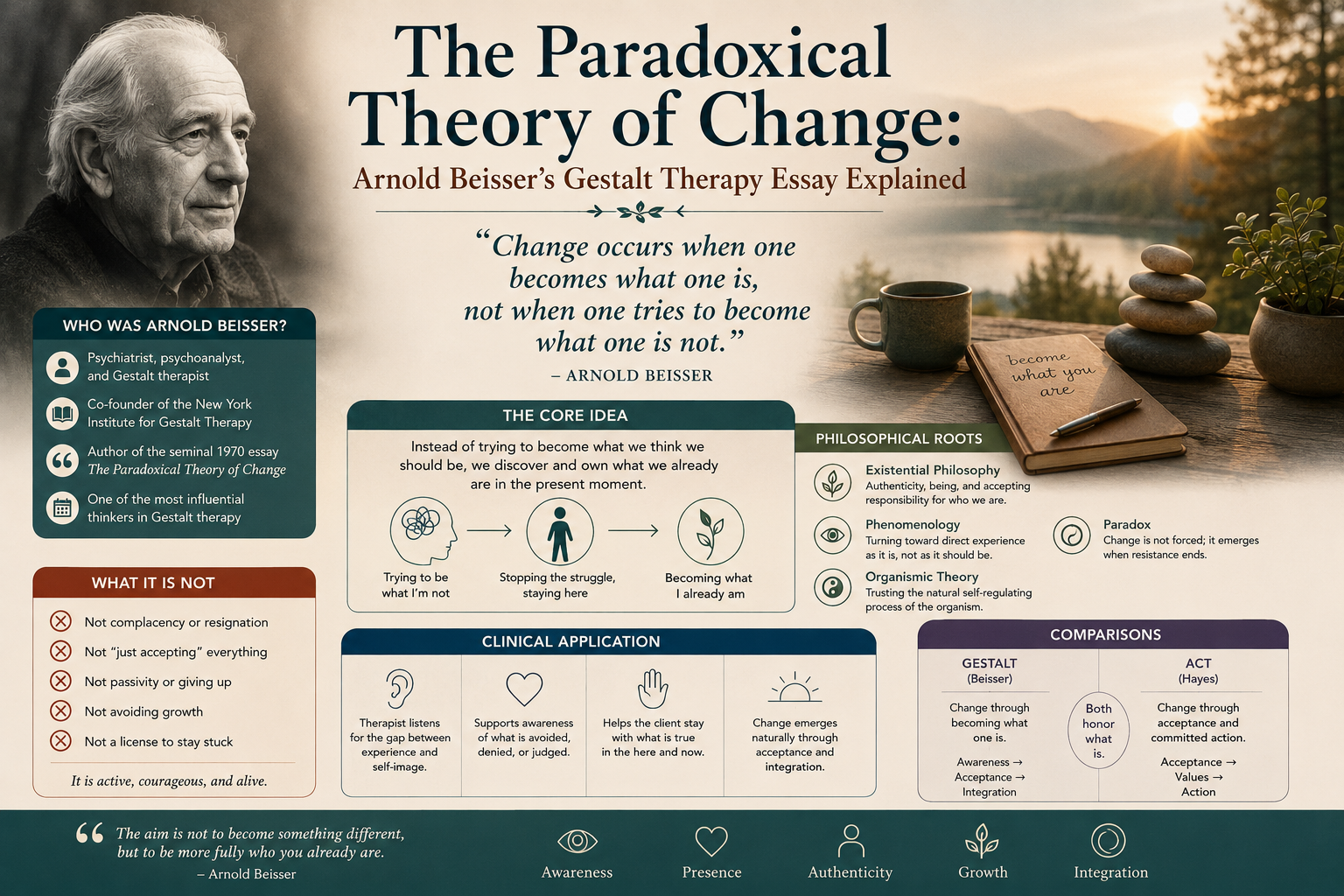
The paradoxical theory of change is Gestalt therapy's foundational account of how genuine psychological change occurs — not through effort to become different, but through fuller awareness and acceptance of what one already is. Articulated by the psychiatrist Arnold Beisser in a short 1970 essay, it holds that change happens when a person becomes more fully themselves, not when they try to become what they are not. This article explains Beisser's theory, its philosophical foundations, its clinical application, and what contemporary psychotherapy research suggests about the processes it describes.
GestaltReview.com · Theory & Foundations · Change Processes
The Paradoxical Theory of Change in Gestalt Therapy Arnold Beisser's Enduring Contribution
How a four-page essay, written by a psychiatrist living with severe paralysis, became one of the most influential and most widely cited texts in the history of Gestalt therapy — and what it actually says about how people change.
Author
Arnold R. Beisser, M.D. (1925–1991)
Published
1970, in Gestalt Therapy Now (eds. Fagan & Shepherd)
Length
Approximately four pages
Known for
"The Paradoxical Theory of Change" — Gestalt therapy's foundational essay on the mechanism of psychological change
Introduction
Few essays in the history of psychotherapy have achieved the influence of Arnold Beisser's four-page contribution to the 1970 anthology Gestalt Therapy Now. "The Paradoxical Theory of Change" is short enough to read in ten minutes and dense enough to spend a career digesting. It articulates, more clearly and more memorably than any other single text in the Gestalt literature, the central mechanism by which Gestalt therapy understands psychological change to occur — and in doing so, it captured something that therapists across multiple traditions have continued to find genuinely illuminating more than five decades later.
The theory's central claim is deceptively simple: people change not by trying to become what they are not, but by becoming more fully what they already are. This single sentence has shaped generations of Gestalt clinical practice, has been cited and reinterpreted across organisational consulting, coaching, and other therapeutic traditions, and continues to generate scholarly engagement, including significant theoretical reconsideration within contemporary Gestalt therapy itself.
This article explains Beisser's theory in full: who he was, what the original essay actually says, the philosophical foundations it draws on, how it is applied clinically, how it compares with other contemporary approaches to change, and what current psychotherapy research suggests about the processes it describes — while being honest about where direct empirical validation of Beisser's specific theory does not yet exist.
Who Was Arnold Beisser?
Arnold R. Beisser was an American psychiatrist whose own life gave his theory of change a depth of lived authority that few psychotherapy texts can claim. Before his career as a psychiatrist and Gestalt therapist, Beisser had been a nationally ranked tennis player — a young man whose identity was substantially built around athletic achievement and physical competence. In 1950, he contracted poliomyelitis, which left him almost completely paralysed, eventually requiring lifelong use of a wheelchair and a respirator for breathing support.
This was not a peripheral biographical detail that happened to precede his theoretical work — it was, by Beisser's own account and by the testimony of those who knew him, central to how he arrived at the insight the essay describes. Estrup's (2026) recent paper on Beisser specifically traces the connection between his personal experience — including, notably, his relationship to smoking, which he continued despite his respiratory vulnerability — and the paradoxical theory of change, illustrating how Beisser's own struggle with acceptance and self-judgment informed the theory he eventually articulated.
Beisser went on to have a substantial career in psychiatry and community mental health, eventually serving as Director of the Southern California Psychiatric Society and holding senior positions in public mental health administration. His personal history of profound physical limitation, and his discovery — clinically and personally — that genuine adaptation and even flourishing occurred not through denial of his condition or through forced struggle against it, but through full acknowledgment and acceptance of his actual situation, gave the paradoxical theory of change a biographical foundation that distinguishes it from a purely abstract theoretical proposition.
Historical Background
Beisser's essay appeared in Gestalt Therapy Now (1970), edited by Joen Fagan and Irma Lee Shepherd — an anthology that gathered contributions from a range of Gestalt therapists in the years following the founding generation, at a moment when Gestalt therapy was moving from its original New York intellectual circle into a broader, more geographically dispersed, and increasingly influential professional movement, particularly through the growing prominence of Esalen Institute and the California humanistic psychology scene.
The theoretical seeds of Beisser's formulation were already present in the founding 1951 text, Gestalt Therapy: Excitement and Growth in the Human Personality by Fritz Perls, Ralph Hefferline, and Paul Goodman — particularly in the concept of organismic self-regulation and the understanding of neurosis as a disruption of the organism's natural capacity for self-regulating contact with its environment. What Beisser did was not invent a new theory from nothing but crystallise, name, and articulate with unusual clarity a principle that had been implicit in Gestalt theory from its founding. Stevenson (2010) traces this lineage explicitly, noting that the paradoxical theory of change "flows from the primary premise" implied by Perls and "captured by Beisser" — a formulation that positions Beisser's essay as a distillation rather than an entirely novel contribution.
The essay's brevity and clarity are part of why it achieved the influence it did. Unlike the dense, philosophically demanding theoretical sections of the 1951 text, Beisser's essay is accessible, memorable, and immediately graspable — qualities that made it an effective teaching tool and a frequently cited touchstone across the subsequent decades of Gestalt training and practice.
The Original 1970 Essay
Beisser's essay opens by observing a paradox that anyone with clinical experience will recognise: psychotherapists who explicitly disavow any role as "changers" — who hold that their function is not to push clients toward predetermined outcomes — nonetheless witness their clients changing, often substantially, through the therapeutic process. How does this happen, if the therapist is not actively engineering change?
Beisser's answer constitutes the theory's core claim: change does not come about through a coercive attempt by the individual or another person to change them, but it occurs if one takes the time and effort to be what one is — to be fully invested in one's current positions. By rejecting the role of "changer," the therapist makes it possible for the client to reject that role for themselves, and thereby to allow what Beisser describes as a more orderly and less disrupted growth to occur.
The essay is notable for its conceptual modesty: Beisser does not claim to have discovered a universal law of psychological functioning, nor does he present elaborate clinical case material to demonstrate the theory's application. He offers, instead, a clear conceptual account and trusts the reader's own clinical or personal experience to recognise its truth. This understated, almost spare quality of the original text stands in some contrast to the extensive theoretical elaboration the concept has subsequently received.
The Famous Statement Explained
"Change occurs when one becomes what one is, not when one tries to become what one is not."
— Arnold Beisser, "The Paradoxical Theory of Change" (1970)This sentence has become, for many therapists, the single most frequently quoted line in the entire Gestalt literature. Its power lies in its compression: it states, in a single clause, a position that runs directly counter to the dominant common-sense assumption about how change happens — the assumption, deeply embedded in self-improvement culture, in much of cognitive-behavioural framing, and in ordinary folk psychology, that change is produced by identifying a gap between where one currently is and where one should be, and then working to close that gap through effort, willpower, and the rejection of the current, unsatisfactory state.
Beisser's statement inverts this logic. It claims that the effortful pursuit of a different, better, more idealised self is not merely an inefficient route to change — it is actively counterproductive, because it requires the person to stand in continuous opposition to their actual present experience, reinforcing exactly the fragmentation and self-rejection that produced the original difficulty. Genuine change, by contrast, requires the person to inhabit fully — to "be" — what they currently are: their actual feelings, their actual patterns, their actual experience, including the parts they find unwanted or unacceptable.
It is important to be precise about what "becoming what one is" means here. It does not mean behavioural resignation — continuing to act exactly as before. It means something closer to full phenomenological ownership: genuinely inhabiting, acknowledging, and being present to one's actual current experience, rather than the idealised or rejected alternative. For the theoretical grounding of this kind of phenomenological attention, see our article on Phenomenology and Gestalt Therapy.
What Does This Actually Mean?
The paradoxical theory of change is frequently misunderstood as a counsel of passivity — as though Gestalt therapy were advising people to simply accept their current state and abandon any aspiration toward growth or improvement. This misunderstanding is significant enough, and common enough, to require direct and careful correction.
What Beisser actually describes is a theory about the mechanism of change, not an argument against the desirability of change. The claim is not "do not try to grow" but "growth occurs through a different mechanism than effortful self-rejection." The person who is anxious does not become less anxious by trying very hard not to be anxious — an effort that typically generates more anxiety, since it requires the anxious person to be in continuous, vigilant opposition to their own actual experience. They become less anxious, paradoxically, by more fully experiencing and acknowledging their anxiety: by inhabiting it completely enough that its function, its triggers, and its relationship to disowned needs and feelings becomes available to awareness — at which point the anxiety's grip on the organism's functioning naturally begins to loosen.
Yontef (2007) captures this precisely in his account of the theory: "Fundamental change results from self-acceptance and not attempts to change based on self-rejection." This is the crucial distinction. The paradoxical theory of change is not opposed to change; it is opposed to a particular, self-rejecting mechanism for pursuing change — one that, the theory holds, is not merely inefficient but actively interferes with the change it is trying to produce.
"The theory is not an argument against growth. It is an argument about which mechanism actually produces growth — and which mechanism, however well-intentioned, gets in its way."
Philosophical Foundations
Phenomenology
The paradoxical theory of change rests on the phenomenological commitment that runs through all of Gestalt therapy: that genuine, direct, non-defended awareness of one's actual present experience is itself transformative, in ways that conceptual analysis, willed effort, or behavioural management of that experience are not. The theory assumes that the organism's current state — however symptomatic, however apparently undesirable — contains within it the information and the organising intelligence the organism needs to move toward greater health, and that this information becomes available specifically through full phenomenological contact with the current state rather than through attempts to bypass or override it.
Existential Philosophy and Authenticity
The theory's emphasis on "being what one is" carries clear resonances with existentialist philosophy's concern with authenticity — Heidegger's and Sartre's accounts of the human tendency toward inauthentic flight from one's actual situation into socially prescribed roles, idealised self-images, or denial of one's actual freedom and responsibility. The paradoxical theory of change can be understood as a clinical application of the existentialist insistence that genuine human flourishing requires owning one's actual situation rather than fleeing into a more comfortable but inauthentic alternative.
Organismic Self-Regulation and the Organism-Environment Field
Goodman's organism-environment field theory provides the theoretical grounding for the claim that the organism, when its contact with its own experience is unobstructed, possesses a natural capacity for self-regulation that moves it toward what it actually needs. The paradoxical theory of change applies this principle directly to the process of psychotherapeutic change: the therapist's task is not to engineer change through external direction but to restore the conditions — full awareness, genuine contact, freedom from self-rejection — under which the organism's own self-regulatory intelligence can operate.
Friedlaender's Creative Indifference
Several scholars trace a less commonly discussed philosophical source for the paradoxical theory of change: Salomo Friedlaender's concept of creative indifference, developed in the early twentieth century and an influence on Fritz Perls' early intellectual formation. Stevenson (2004) summarises Friedlaender's account: phenomena become perceptible and meaningful only through their relationship to their opposite — figures of the world are constituted through polarity and difference. "Creative indifference" describes the point of indifferentiation from which both poles of any polarity emerge — and from which genuine, undefended awareness of a polarity (rather than collapse into one pole at the expense of the other) becomes possible. This concept underlies the Gestalt understanding that genuine change involves holding both poles of a polarity — the current state and the desired state, the symptom and the health — in awareness simultaneously, rather than fleeing from one toward the other.
The Paradox Explained
The "paradox" in the paradoxical theory of change refers to the counter-intuitive structure of the claim: that the most direct route to becoming different is to more fully accept and inhabit what one currently is, rather than to strive directly toward the different state one wants to become. This is genuinely paradoxical in the logical sense — it is not simply surprising or unexpected, but appears, on first encounter, to be self-contradictory: how can accepting what is produce movement away from what is?
The resolution of the apparent contradiction lies in distinguishing between two different processes that ordinary language tends to conflate under the single word "change." The first process — effortful, willed pursuit of an idealised alternative state — requires the person to maintain a position of opposition to their actual present experience, a position that Gestalt theory holds to be inherently fragmenting and self-perpetuating, because it never allows the actual present experience to be fully metabolised, understood, or resolved. The second process — full, aware, non-defended inhabitation of the actual present state — allows the organism's own self-regulatory capacity, restored to function through the removal of the self-rejecting opposition, to generate movement that the willed effort could not produce.
The paradox, then, is not a logical contradiction but a counter-intuitive empirical claim about psychological mechanism: that acceptance, rather than rejection, is the more effective vehicle for transformation. Philippson (2018) examines this claim carefully, distinguishing what he calls "strategic, naïve, and Gestalt" versions of paradoxical change theory — noting that the Gestalt version is distinctive in grounding the paradox not in strategic therapeutic technique (as in some uses of paradoxical intention in other traditions) but in a genuine philosophical claim about the nature of organismic functioning and self-regulation.
Clinical Applications
In clinical practice, the paradoxical theory of change shapes virtually every dimension of how a Gestalt therapist works — not as a specific technique to be applied at particular moments, but as the underlying orientation that informs the therapist's entire stance toward the client and toward the change process.
A client presents wanting to "stop being so anxious" — describing a pattern of chronic self-criticism for their anxiety, treating it as a defect to be eliminated through sufficient willpower and positive thinking. Applying the paradoxical theory of change, the therapist does not collude with this framing by offering anxiety-reduction techniques aimed directly at eliminating the symptom. Instead, the therapist invites the client toward fuller awareness of the anxiety itself: "What is it actually like, right now, to feel anxious? What happens in your body? What are you anxious about, specifically, in this moment?"
As the client more fully inhabits and describes their actual anxious experience — rather than fighting it or trying to think their way out of it — they begin to discover what the anxiety has been protecting them from, or what need it has been expressing in a distorted form. The anxiety, paradoxically, becomes less overwhelming and less totalising precisely as the client stops trying to eliminate it and starts genuinely attending to it.
Gestalt two-chair work, in which a client moves between two physical positions to voice an internal conflict — a self-critical part and an experiencing part, for example — directly enacts the paradoxical theory of change. Rather than the therapist or the client trying to "fix" or eliminate the critical voice, both positions are given full, embodied voice and expression. As each position becomes more fully itself — more fully and completely expressed — the rigid opposition between them often begins to soften, not because either position has been argued out of existence, but because each has finally been fully heard.
For the broader account of how chairwork and related experiential methods operationalise this principle, see our article on Chairwork in Psychotherapy.
In trauma-informed Gestalt work, the paradoxical theory of change shapes the careful, titrated approach to traumatic material: rather than pushing the client to "move past" or "overcome" traumatic experience through forced exposure or willed reframing, the therapist supports the client's graduated capacity to be genuinely present to and aware of what actually happened and what they actually feel about it — trusting that this full, supported acknowledgment, rather than avoidance or forced reframing, is what allows genuine integration to occur. For the full account, see our article on Gestalt Therapy and Trauma.
The Therapist's Stance
The paradoxical theory of change has profound implications for how the Gestalt therapist understands their own role. If change occurs through the client's fuller awareness and acceptance of their actual present experience, then the therapist's primary task is not to direct, instruct, or persuade the client toward a predetermined better state, but to create the relational and phenomenological conditions in which the client's own full awareness becomes possible.
Yontef (2007) describes this as requiring "dialogic contact" — characterised by inclusion (the therapist's genuine attempt to understand the client's experience from the inside), confirmation (the therapist's genuine acknowledgment of the client's experience as valid and real), authentic presence (the therapist's genuine, non-managed engagement rather than professional distance), and a commitment to what emerges between therapist and client rather than to a predetermined therapeutic agenda. This dialogical stance is itself an expression of the paradoxical theory of change applied to the therapeutic relationship: the therapist does not try to make the client different; the therapist is genuinely present to the client as they actually are, and this genuine presence is itself the condition under which change becomes possible.
Yontef and colleagues (2016) further argue that this dialogical commitment is fully compatible with — rather than in tension with — the active experiential interventions (Gestalt "experiments") that characterise Gestalt clinical method. Experiments, properly understood within the paradoxical theory of change, do not aim for preset behavioural goals but are themselves expressions of the dialogical attitude: invitations to fuller awareness, not techniques designed to engineer a predetermined outcome.
Common Misunderstandings
"The theory says people should not try to change." This is the single most common and most significant misunderstanding. The theory does not argue against change or growth; it argues for a different mechanism of change — one grounded in awareness and acceptance rather than effortful self-rejection. Beisser himself, whose own life involved substantial adaptation to profound physical limitation, was not counselling passivity but describing the actual mechanism through which his own adaptation — and the adaptation he witnessed in his clients — occurred.
"This is just positive thinking or self-acceptance culture." The contemporary self-help and wellness culture's invocation of "self-acceptance" frequently means something quite different from what Beisser describes: a comforting affirmation that one is fine as one is, often deployed precisely to avoid the difficult, demanding work of genuine phenomenological contact with one's actual, sometimes painful or unwanted experience. Beisser's theory requires the opposite of comfortable self-affirmation — it requires full, undefended contact with whatever is actually present, including material that is difficult, shameful, or painful to acknowledge.
"It means therapists should be passive and non-directive." The paradoxical theory of change does not require therapeutic passivity. Gestalt therapists actively use experiments, dialogue, phenomenological inquiry, and embodied techniques — but these are deployed in service of expanding the client's awareness of their actual present experience, not in service of directing the client toward a predetermined outcome the therapist has decided is correct.
"It contradicts the idea of therapeutic goals." Clients can and do have goals in Gestalt therapy, and Gestalt therapists do not refuse to engage with what the client wants to achieve. The paradoxical theory of change concerns the mechanism through which movement toward those goals actually occurs — through fuller awareness rather than forced effort — not whether goals are legitimate or worth pursuing.
Compared with CBT, ACT, and Mindfulness
Ayala Romera and colleagues (2020) provide the most systematic direct comparison between Gestalt therapy and Acceptance and Commitment Therapy in the academic literature, identifying experiential avoidance — the tendency to avoid or escape unwanted internal experiences, even when doing so is costly — as a shared explanatory construct for psychological difficulty across both approaches, despite their different theoretical histories (ACT grounded in Relational Frame Theory and behaviour analysis; Gestalt therapy grounded in phenomenology, field theory, and existentialism). They identify a range of shared clinical practices that reflect this convergence, while noting that the two traditions arrived at similar clinical positions through genuinely different theoretical routes.
Field Theory Reconsiderations
Contemporary Gestalt scholarship has not treated Beisser's formulation as a fixed, unchangeable doctrine but has continued to develop and reconsider it theoretically. Roubal and Francesetti's (2022) significant paper, "Field Theory in Contemporary Gestalt Therapy, Part Two: Paradoxical Theory of Change Reconsidered," undertakes exactly this kind of theoretical development, examining the paradoxical theory of change from three perspectives: mono-personal (the original, individually focused formulation), bi-personal (accounting for the dyadic therapist-client relationship), and field-theoretic (accounting for the full relational and situational field within which change occurs).
Their reconsideration argues that a purely mono-personal reading of Beisser's theory — focused exclusively on the individual client's relationship to their own experience — is theoretically incomplete. A field-theoretic reading recognises that the "becoming what one is" that Beisser describes is never a purely individual, intrapsychic event; it occurs within and is shaped by the relational field of the therapeutic encounter, and by the broader situational field within which the client's life is embedded. This reconsideration does not reject Beisser's original formulation but extends and deepens it, consistent with the broader theoretical development of field theory within contemporary Gestalt therapy. For the fuller account of this framework, see our article on Field Theory and Dialogue in Gestalt Therapy.
Marmgren (1998) offers a different kind of theoretical extension, drawing on complexity theory and dynamical systems theory to provide additional conceptual grounding for why awareness-based change processes might produce genuine transformation — proposing that Gestalt therapy's clinical method works but "has no viable model for explaining what is actually happening" in the dynamical-systems sense, and suggesting complexity theory as a resource for developing this further explanatory account.
Current Research
Direct empirical research testing Beisser's specific theoretical claims is essentially absent from the psychotherapy research literature. This should be stated plainly and without evasion: there is no controlled study that directly operationalises "the paradoxical theory of change" as a testable hypothesis and reports outcome data confirming or disconfirming it. This is consistent with the broader pattern in Gestalt therapy research, where foundational theoretical concepts have rarely been the direct subject of controlled empirical investigation.
What does exist is a substantial and rapidly growing body of research on adjacent constructs — psychological flexibility, experiential avoidance, acceptance, and self-compassion — that illuminates, without directly validating, the processes Beisser's theory describes. This research comes primarily from the Acceptance and Commitment Therapy tradition, which, as noted above, arrived at theoretically similar clinical positions through an entirely different intellectual route (behaviour analysis and Relational Frame Theory rather than phenomenology and existentialism).
Adjacent Research Evidence — Acceptance, Flexibility, and Change
Macri and colleagues' (2024) comprehensive systematic and meta-analytic review of psychological flexibility as a treatment mechanism in ACT — covering 77 records and 67 unique studies with 9,123 participants — found that ACT interventions reliably reduced psychological inflexibility (including experiential avoidance and lack of present-moment awareness) and increased psychological flexibility (including acceptance and present-moment contact), and that these changes were significantly linked to corresponding reductions in psychological distress, supporting their role as genuine treatment mechanisms rather than incidental correlates.
Yadavaia and colleagues' (2014) randomized controlled trial of an ACT-based workshop targeting self-compassion found that the intervention was significantly superior to a wait-list control in increasing self-compassion and reducing general psychological distress and anxiety, with process analyses revealing psychological flexibility to be a significant mediator of these changes — directly relevant to Beisser's claim that acceptance-based processes (rather than effortful self-improvement) mediate genuine change.
Marshall and colleagues (2016) found that self-compassion was significantly correlated with psychological flexibility processes — including mindful acceptance and cognitive defusion — and predicted significant unique variance in emotional wellbeing above and beyond psychological flexibility alone, suggesting that the capacity for non-judgmental acceptance of one's own experience (closely related to what Beisser describes as "becoming what one is") is a genuine and measurable contributor to psychological health.
Rutschmann and colleagues' (2024) study of 90 patients in a transdiagnostic ACT-based day hospital programme found that increases in psychological flexibility from admission to discharge were strongly correlated with decreases in symptomatology (r = .60–.83) and increases in quality of life — providing further process-outcome evidence for acceptance-based, awareness-focused change mechanisms, though within an ACT rather than a Gestalt-specific framework.
This adjacent evidence base is suggestive rather than confirmatory. The constructs measured in ACT research (psychological flexibility, experiential avoidance, cognitive defusion) are conceptually related to but not identical with Beisser's specific formulation, and the theoretical frameworks within which they are embedded differ substantially from Gestalt theory's phenomenological and field-theoretic foundations. Intellectual honesty requires presenting this research as illuminating rather than validating Beisser's theory directly.
Strengths, Limitations, and Criticisms
Strengths
The paradoxical theory of change offers a clinically generative, philosophically grounded, and genuinely distinctive account of psychological change that avoids the moralising and pathologising tendencies of approaches that treat symptoms as deficits to be corrected. Its emphasis on awareness and acceptance as the vehicle of change rather than effortful self-improvement provides a coherent rationale for Gestalt therapy's broader clinical method, and the convergent (though independently developed) findings from the ACT and psychological flexibility literature provide indirect support for the plausibility of acceptance-based change mechanisms more generally.
Honest Limitations and Criticisms
No direct empirical test exists. As discussed above, Beisser's specific theoretical claims have not been directly operationalised and tested in controlled research. This is a genuine gap that the field has not yet addressed.
Risk of misapplication toward passivity. Despite the careful clarifications available in the literature, the theory's compressed, aphoristic form makes it genuinely vulnerable to misapplication — by both therapists and clients — as a justification for avoiding necessary behavioural change or for romanticising symptomatic states rather than working with them. This risk is real and requires active clinical vigilance.
Underspecified mechanism. As Marmgren (1998) notes, Gestalt therapy's clinical method around the paradoxical theory of change works in practice, in the testimony of generations of clinicians, but the theory does not provide a detailed account of precisely how full awareness of present experience translates into changed functioning — a gap that complexity theory and other explanatory frameworks have been proposed to address but have not definitively closed.
Cultural and contextual limits. The theory's emphasis on individual awareness and self-acceptance reflects assumptions about selfhood and autonomy that are not universal across cultures, and its application in contexts of severe social constraint, oppression, or trauma requires careful adaptation rather than uncritical application — a person whose external circumstances are genuinely and urgently in need of change should not be counselled toward acceptance of those circumstances in place of appropriate action.
Why the Essay Remains Influential
Beisser's essay has retained its influence for more than fifty years for several converging reasons. Its brevity and clarity make it exceptionally teachable — a four-page text that can be read, discussed, and genuinely understood in a single training session, in contrast to the much denser theoretical material in the 1951 foundational text. Its biographical grounding in Beisser's own profound physical adaptation gives it an authority and emotional resonance that purely abstract theoretical writing rarely achieves. And its central claim continues to be independently rediscovered and validated, in different theoretical vocabulary, by subsequent developments in psychotherapy — most notably the acceptance-based "third wave" behavioural therapies, whose core processes (psychological flexibility, acceptance, defusion) bear a clear family resemblance to what Beisser articulated decades earlier from a phenomenological and existential starting point.
The essay's continued application beyond clinical psychotherapy — in organisational consulting (Stevenson 2004, 2010; Maurer 2003), in coaching (Chidiac 2008), and even in philanthropic and community contexts (Harris & colleagues, 2014) — testifies to the generality of the principle it articulates: that systems, whether individual persons or organisations, change more reliably through full, honest engagement with their actual current state than through forced pursuit of an idealised alternative. This breadth of application, well beyond the clinical context in which it was originally formulated, is itself a marker of the theory's genuine explanatory power.
Conclusion
Arnold Beisser's "The Paradoxical Theory of Change" remains, more than five decades after its publication, one of the most clinically generative and conceptually compressed texts in the history of psychotherapy. Its central claim — that genuine change occurs through fuller awareness and acceptance of what one actually is, not through effortful pursuit of what one believes one should become — offers a coherent and distinctive account of psychological transformation that continues to shape Gestalt clinical practice and that finds significant, if indirect, support in the contemporary research on psychological flexibility, acceptance, and experiential avoidance.
The theory requires careful understanding to avoid its common misapplication as a counsel of passivity. It is not an argument against growth, change, or aspiration; it is a specific claim about mechanism — that the path toward becoming different runs through, not around, full and honest contact with what one currently is. For Beisser himself, whose own profound physical adaptation gave the theory its lived authority, this was not an abstract philosophical position but a discovered truth about how genuine human flourishing actually occurs, even — especially — under conditions of severe and permanent constraint.
For the comprehensive theoretical context within which the paradoxical theory of change operates, see our cornerstone article on Gestalt Therapy: An Overview.